
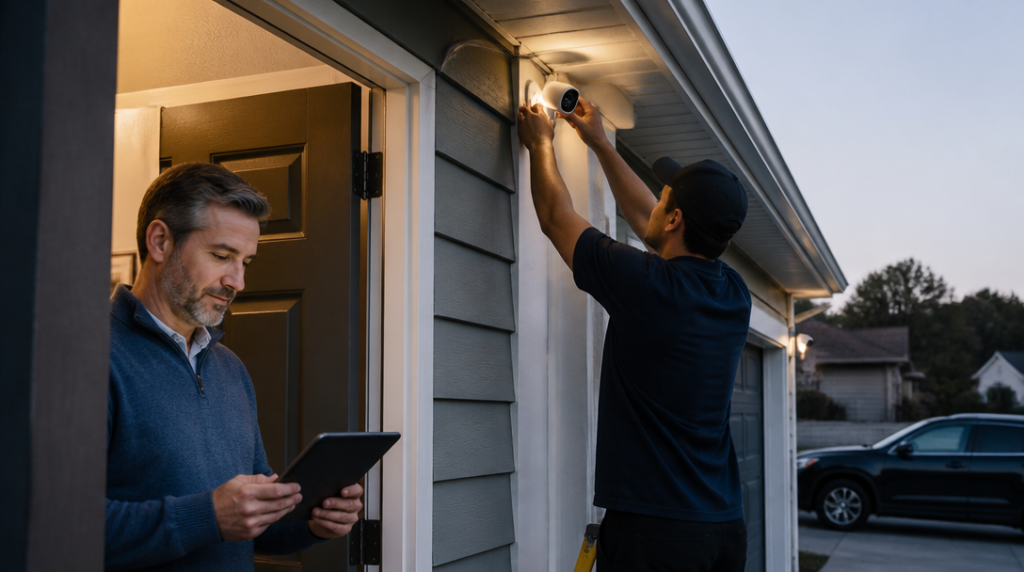
The quote arrives at $1,850 for four cameras. The homeowner expected a few hundred dollars, especially because the cameras themselves were advertised as affordable Wi-Fi models. The installer, however, has included mounting, configuration, testing, outdoor weatherproofing, and the awkward work of reaching two points under the eaves.
That gap between the price of a camera and the price of a working security system is where most confusion begins.
In the United States, a professionally installed home camera system costs an average of about $1,290 in 2026. Typical projects fall between roughly $590 and $2,040, a range broad enough to cover a basic indoor setup and a more demanding installation with several outdoor cameras, longer cable runs, and extra equipment. The average is useful as a reference, but it is not a prediction. A small house with accessible walls can land near the low end. A larger property with brick, high mounting points, or a preference for wired connections can move quickly toward the top.
The first question for any homeowner should be simple: what exactly does the quote include?
A professionally installed Wi-Fi camera generally costs about $95 to $227 per camera, including equipment and labor. That sounds manageable until the system needs four, five, or six cameras. A typical four- to six-camera home system may cost approximately $1,200 to $2,900, depending heavily on the wiring and the equipment selected. The figures do not contradict each other as much as they first appear to. A per-camera estimate may describe relatively straightforward work, while a full-system quote can include a recorder, storage, network changes, ladders, cable concealment, and setup across the entire property.
Labor alone commonly runs from $80 to $200 per camera. That is not necessarily a sign of overcharging. The technician may need to drill through exterior walls, route cable through an attic or crawl space, seal openings against water, connect the cameras to a network, adjust viewing angles, and make sure the footage can actually be retrieved later. Still, a labor figure at the upper end deserves questions. Is the price higher because the camera is difficult to reach, because the installer charges a minimum service fee, or because several unrelated tasks have been folded into the same line item?
A camera mounted outdoors creates another jump in the bill. An outdoor camera with installation typically costs about $125 to $550 per unit. The spread is striking, and it reflects more than the camera’s casing. Outdoor work brings exposure to weather, greater mounting challenges, possible drilling into masonry, and the need to protect cable connections. A camera ten feet above a porch is not the same job as one attached to a detached garage or positioned high enough to watch a driveway.
This is also where a glossy product description can mislead. “Wireless” does not mean “installation-free.” Most Wi-Fi cameras still need a power source unless they run on batteries or use a dedicated solar setup. They may also depend on a strong wireless signal at the exact place where they are mounted. A camera that works perfectly beside the router may struggle at the far end of the house, behind dense walls, or outside. If the installer has to improve network coverage or relocate equipment, the original camera price tells only a small part of the story.
Wired systems raise a different set of questions. They can require more labor at the start, especially if cables must be hidden inside walls or routed through finished ceilings. Yet the installation may provide a more stable connection and avoid some battery maintenance. The important distinction is not simply wired versus wireless; it is how difficult the chosen route is and what the homeowner expects the system to do during a power or network interruption.
A low quote may also leave out the hardware that makes the cameras practical. Some systems store video locally on a recorder or memory device. Others use cloud storage that may involve an ongoing subscription. A quote can look inexpensive if it covers mounting and setup but excludes storage, upgraded network equipment, replacement batteries, or future service. Those omissions are not automatically unfair, but they should be visible before the work begins rather than appearing as surprises on the final invoice.
The same problem applies to camera count. Four cameras may sound like adequate coverage until the property is viewed from the street rather than from a floor plan. One camera may watch the front door, another the driveway, and a third the backyard, but blind spots can remain along side passages, gates, or approaches hidden by landscaping. Adding cameras later is often more expensive than planning cable paths and network capacity from the beginning. On the other hand, filling every corner with a lens can produce a great deal of footage without improving security proportionally. The useful question is not “How many cameras can fit in the budget?” but “Which routes onto the property need to be visible, and from what angle?”
That is where an installer’s recommendations deserve scrutiny. A professional who proposes six identical cameras without explaining their different roles may be selling hardware rather than solving a surveillance problem. A more credible proposal should identify mounting locations, explain why each view matters, and distinguish between indoor and outdoor requirements. It should also clarify whether the cameras will record continuously, activate only when motion is detected, or use a mixture of both approaches.
Homeowners should ask for an itemized estimate showing equipment, labor, mounting hardware, cable, connectors, network work, storage, taxes, and any permit-related charges. The goal is not to force every contractor into the lowest possible price. It is to find out whether two quotes are actually comparing the same job. One installer may include configuration and post-installation training; another may leave the homeowner with a box of passwords and a phone app that has never been tested.
The physical house can matter more than the brand printed on the camera. Open attic access, accessible exterior walls, and existing conduits can reduce the time required. Brick, concrete, finished ceilings, steep rooflines, and long distances between buildings can increase it. So can an installation scheduled in a way that requires extra travel or more than one technician, although those charges should be disclosed clearly.
There is a temptation to treat installation as a one-day purchase and forget about it. Security cameras are closer to a small network than to ordinary household fixtures. Software updates, account access, storage settings, password management, and replacement hardware all affect whether the system remains useful. A camera with a sharp image is not much help if nobody knows how to export footage, notifications are constantly triggered by passing cars, or the account is tied to an email address no one checks.
DIY installation can reduce the upfront labor bill, particularly for battery-powered or plug-in Wi-Fi cameras. It can also shift the difficult parts onto the homeowner: choosing sightlines, checking signal strength, drilling safely, weatherproofing connections, and dealing with a camera that repeatedly drops offline. For someone comfortable with ladders and home networking, that trade-off may be reasonable. For a system placed high above a driveway or integrated with several wired cameras, the savings may not justify the risk or frustration.
A sensible budget starts with the property rather than a shopping cart. Price the cameras, then ask what each location demands. A simple indoor camera may sit near the lower end of the per-camera range, while an outdoor unit requiring difficult access can approach several times that amount. Add the labor, storage, network requirements, and any recorder. Then challenge the installer on every unexplained difference between the advertised equipment price and the finished project.
I would be especially wary of a quote that uses one impressive total and no details. Security work should withstand ordinary questions. If the installer cannot explain why one camera costs $140 to mount and another costs $400, the homeowner is being asked to approve a price before being shown the job behind it.