
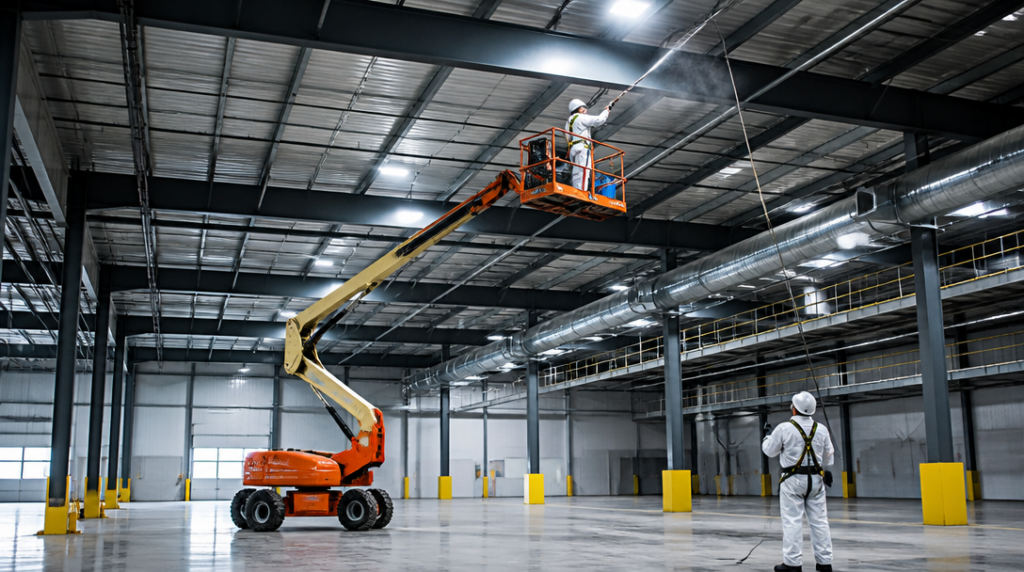
A warehouse manager stands beneath a row of steel beams, looking up at a layer of dust that has been quietly gathering for years. The floor below is reasonably clean. The ceiling, however, appears to be developing its own weather system. A standard mop will not be much help up there, which is where high-level industrial cleaning enters the picture—and where the bill usually becomes more interesting.
For ordinary industrial or warehouse cleaning in the United States, a typical price in 2026 is around $0.04 to $0.12 per square foot per visit. That range covers routine work such as sweeping, floor cleaning, waste removal and general housekeeping in a relatively accessible facility. A warehouse measuring 50,000 square feet could therefore cost roughly $2,000 to $6,000 for a single visit if the entire area were priced within that range, although actual quotes depend on the frequency, scope and condition of the site.
Many warehouse and industrial jobs fall into a broader complete-visit range of about $1,000 to $5,000. The lower end may suit a smaller or more straightforward facility, while the upper end is more plausible for a large site requiring several cleaners, machinery and a longer work window. A building does not become cheap to clean merely because its walls are made of corrugated metal. In fact, industrial spaces have a talent for hiding dirt in places nobody can reach without a ladder, lift or a very long conversation with a safety officer.
Specialized industrial cleaning is commonly priced at approximately $0.10 to $0.30 per square foot. This can include more demanding work around production equipment, elevated structures, difficult residues or areas that need a higher level of control than routine warehouse housekeeping. For a 50,000-square-foot facility, a contractual cleaning arrangement may come to around $6,000 to $15,000 per year, depending on the agreed scope and schedule. That annual figure should not be read as a simple multiplication of the per-square-foot rate by the building’s total area and the number of visits. Commercial cleaning contracts package the work in different ways, and the quoted rate may apply only to defined tasks or scheduled service areas.
The most important question is not simply how large the building is. It is what has to be cleaned, how often, and how difficult it is to reach. A wide, open floor with light dust is a different job from a manufacturing plant with oily residue, overhead pipework and equipment that cannot be switched off for half a day. Two buildings can have the same footprint and produce wildly different estimates. Square footage is useful, but it is not psychic.
Labor makes up a large part of the price. A standard industrial cleaning crew in 2026 generally costs around $25 to $45 per worker per hour. That rate can rise when the job requires certifications, specialized machinery or additional safety procedures. A basic crew may handle floors and accessible surfaces with conventional equipment. A high-level team may need fall-protection training, lift operation skills, protective clothing, respirators or other equipment suited to the site. The mop bucket remains inexpensive. Everything around it is less sentimental.
Work at height, confined-space cleaning and hazardous-material cleaning are typically priced at roughly $50 to $75 or more per worker per hour. These tasks carry extra risk and often require planning before anyone begins spraying, vacuuming or scraping. A confined space may need atmospheric monitoring and specific entry procedures. A hazardous area may require containment, decontamination and disposal controls. High-level work can also involve coordination with the facility’s operations team, especially if machinery, forklifts or production lines remain active nearby.
Access equipment is another major variable. Cleaning a reachable ledge with an extension tool is one thing. Cleaning beams, ductwork, roof structures or high walls may require a cherry picker, scissor lift or scaffolding. High-level cleaning that needs a cherry picker or scaffolding is usually quoted separately, either at an hourly rate or as an individually calculated fixed price. The equipment itself may be billed directly, or its cost may be folded into the labor and project total.
That separate pricing is sensible. A lift cannot simply be summoned like a taxi, parked beneath a beam and forgotten. It has to be delivered, positioned, operated safely and sometimes moved repeatedly through the facility. The building may also need to be cleared around the work zone. If the task is scheduled outside normal operating hours, overtime or night-work costs can affect the quotation as well.
Frequency changes the economics too. A facility that receives regular cleaning may avoid the heavy buildup that makes one-off deep cleaning expensive. A contractor can often work faster when the condition of the site is familiar and the scope is clearly defined. By contrast, an initial deep clean may reveal layers of dust, grease or residue that were invisible from the floor. The first visit is often the least flattering one for the building and the most revealing one for the budget.
A regular contract might include floor care, touchpoint cleaning, restroom service, waste handling and periodic attention to selected industrial areas. High-level work may be scheduled monthly, quarterly or annually rather than included in every routine visit. That distinction matters. Cleaning every floor on a frequent schedule does not automatically mean the ceiling beams, light fittings and overhead pipework are being cleaned at the same time. If the quote does not name those areas, they may be enjoying a long and comfortable contract of their own.
The condition of the site also affects preparation. Heavy dust may require industrial vacuum systems rather than dry sweeping. Grease can call for degreasers, longer dwell times and additional rinsing. Sensitive machinery may need to be covered or isolated. Some surfaces cannot tolerate aggressive chemicals or high-pressure water. A professional estimate should account for the type of contamination, the surfaces involved and the method required to remove it without damaging the equipment underneath.
Safety requirements can add cost before the actual cleaning begins. A contractor may need a site induction, risk assessment, method statement, permit-to-work process or coordination with a plant manager. Those tasks are not decorative paperwork. They help determine whether a cleaner can work safely above an active production area or enter a restricted space. On a complicated site, the planning may take longer than the cleaning itself, which is not as absurd as it sounds once a person is suspended several metres above a factory floor.
The clearest way to compare quotes is to ask each company to describe the work in the same terms. The proposal should state the areas included, the expected frequency, the number of workers, the equipment required and whether high-level access is priced separately. It should also clarify whether consumables, waste disposal, travel, after-hours work and specialist safety equipment are included. Otherwise, two quotes can look dramatically different while covering completely different jobs.
For a straightforward warehouse service, the practical starting point is the $0.04-to-$0.12-per-square-foot-per-visit range or the broader $1,000-to-$5,000 complete-visit range. Specialized work may move toward $0.10 to $0.30 per square foot, while elevated, confined-space or hazardous cleaning is better considered through labor and equipment requirements, with specialist labor often reaching $50 to $75 or more per worker per hour. A 50,000-square-foot facility under a defined annual contract may fall around $6,000 to $15,000, but the scope behind that figure matters more than the number printed at the bottom.
The dust on the beam is still there, of course. It is simply waiting for the quote to explain how the cleaning crew plans to reach it.