
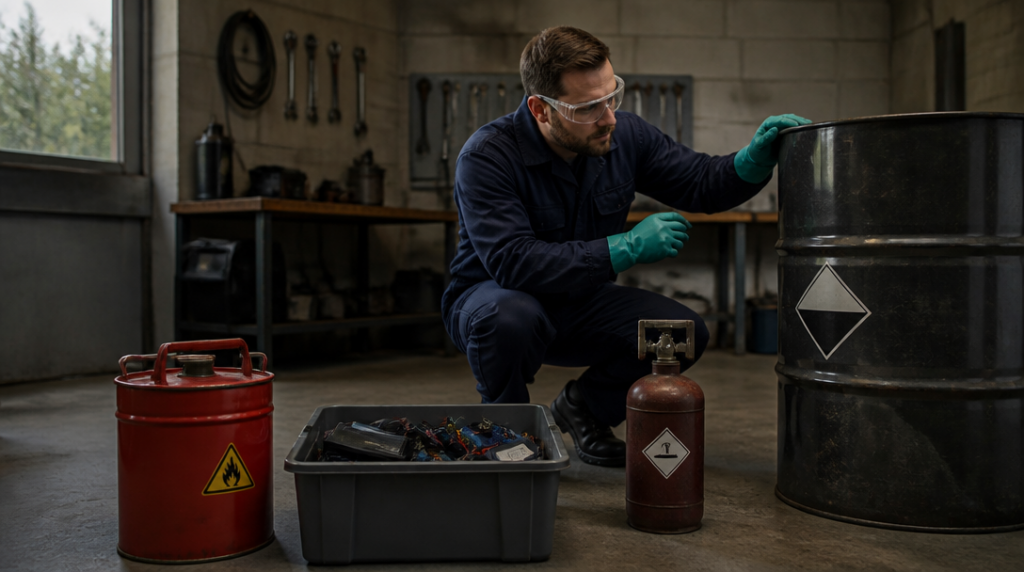
How much would it cost to get rid of a leaking drum in the corner of a workshop before anyone gets hurt?
That question usually arrives too late. The container may have been sitting there for months, its label faded and its contents only partly known. Someone has found a contractor, asked for a quote and discovered that hazardous waste disposal is not priced like an ordinary dumpster pickup. The waste itself is only one part of the bill.
The first figure depends on what is inside. A liquid that burns, an acid that eats through metal, an oxidizer that reacts violently with other materials, a box of lithium batteries and an old electrical component may all require different handling. Even two containers holding the same chemical can cost different amounts if one is properly identified and the other needs testing before anyone will accept it.
A published disposal schedule in Tehama County, California, gives a useful glimpse of how those charges can look. Flammable liquids are listed at $4.64 per gallon. Corrosive acids and bases cost $7.36 per gallon, while oxidizing substances reach $10.95 per gallon. The difference is not cosmetic: each category creates its own storage, compatibility and treatment problems.
The same schedule uses a different unit for solid or specialized waste. Lithium batteries are charged at $4.70 per pound, and PCB ballasts at $6.50 per pound. Small acetylene cylinders cost $75 each, while medium cylinders cost $150 each. A few boxes of batteries may therefore be manageable, but a pile of cylinders can turn into a serious expense before transport is added.
Those figures are not a universal price list. They are an example of how a local program may charge for specific waste streams. Private contractors, industrial treatment plants and municipal facilities can use different rates, minimum charges and acceptance rules. Still, the structure is familiar: the more difficult the material is to classify, move, store or process, the more it tends to cost.
Imagine the workshop manager holding a half-full five-gallon container of solvent. On paper, the disposal fee might look straightforward: multiply the volume by the rate. In practice, the invoice could include a minimum service charge, labor to inspect and package the container, a compliant drum, transportation, documentation and any treatment or recycling fee. The five gallons are not traveling alone; they are bringing an entire chain of obligations with them.
Transportation is often the first surprise. Hazardous waste cannot simply be placed in the back of a pickup and driven to a facility. The carrier may need appropriate equipment, trained personnel, route planning and shipping paperwork. A contractor collecting one small container may charge more per gallon than a contractor filling a truck with material from a large industrial site. The waste occupies little physical space, but the trip still requires time, fuel and regulatory controls.
Distance matters as well. A business located near an approved facility may pay relatively little for transport. Another company with the same material may face a much higher bill because the nearest suitable facility is far away. Rural locations can be especially expensive when a contractor must send a vehicle for a small load or arrange a special pickup window.
Packaging can add another layer. Damaged, corroded or leaking containers may need to be overpacked before they can be moved. Waste streams that must be kept apart cannot share a drum just because they fit. Acids and bases, oxidizers and flammable liquids are not interchangeable cargo. A disposal company may need to repackage the material, label it, secure it and prepare it for a facility with the right permit and equipment.
Identification is just as important. A clear label describing a known product makes the job easier. An unmarked drum does the opposite. If the contents cannot be confirmed, a contractor may require sampling or laboratory analysis. Testing can involve a separate charge, and the disposal route may remain uncertain until the results are available. The cheapest-looking container is sometimes the one with the least reliable information.
This is why a disposal quote based only on a photograph can change after the contractor arrives. A picture may show a drum, but not whether its lid is secure, whether the liquid has separated, whether the label matches the contents or whether other incompatible materials are stored nearby. Hazardous waste pricing has a habit of revealing details one at a time, much like opening a cupboard and finding that the small leak has reached the shelf below.
Quantity changes the economics. Large generators may negotiate rates for regular pickups, use standardized containers and keep each waste stream separated from the start. A small business with one occasional drum has less leverage and often pays a minimum charge. That does not mean the small load is inherently harder to treat. It means the fixed costs of mobilizing a trained contractor and completing the paperwork are spread over fewer gallons, pounds or individual items.
Frequency can make an even bigger difference. A company that waits until hazardous waste has accumulated in several corners may face an urgent cleanup, extra handling and difficult sorting. A company that schedules routine collection can keep containers compatible, labeled and within their storage limits. Regular service does not remove the disposal fee, but it can reduce the expensive surprises surrounding it.
The material’s potential for recovery also affects the price. Some waste can be recycled, reclaimed or sent for specialized treatment rather than destroyed. Used solvents, certain metals and some batteries may follow different routes from mixed or contaminated waste. The possibility of recovery does not guarantee a credit, however. The waste still has to be separated, described accurately and accepted by a facility equipped to handle it.
Businesses should ask for a quote that separates the major components instead of accepting one unexplained total. The useful questions are practical: Is the price based on gallons, pounds, drums or individual items? Is there a minimum pickup fee? Does it include packaging and labor? Is transportation included? Will testing be required? What happens if the waste is rejected or found to be different from the description?
A good inventory makes those questions easier to answer. Record the product name, approximate amount, physical form, container type and any hazard information available. Keep acids away from bases, oxidizers away from flammable materials and damaged batteries away from anything that can ignite. Do not mix unknown liquids to save space. Mixing can turn a modest disposal job into a dangerous cleanup.
For households, community collection events may offer a lower-cost route for limited amounts of paint, solvents, batteries or household chemicals, depending on local rules. Businesses generally face stricter requirements and should not assume that a household program will accept commercial waste. The same bottle can be treated differently depending on who generated it, how much exists and how it is presented for collection.
So how much does hazardous waste disposal cost? A few published local rates show the lower-level arithmetic: $4.64 per gallon for flammable liquids, $7.36 for corrosive acids and bases, and $10.95 for oxidizers. Other materials are priced by weight or item, including lithium batteries at $4.70 per pound, PCB ballasts at $6.50 per pound, and acetylene cylinders at $75 for a small cylinder or $150 for a medium one. The final charge begins there, then grows or shrinks according to the work required around the waste.
Back in the workshop, the manager now has two choices. The leaking drum can remain an anonymous problem in the corner, or its contents can be identified, isolated and quoted properly. The second choice costs money. The first can cost much more.