
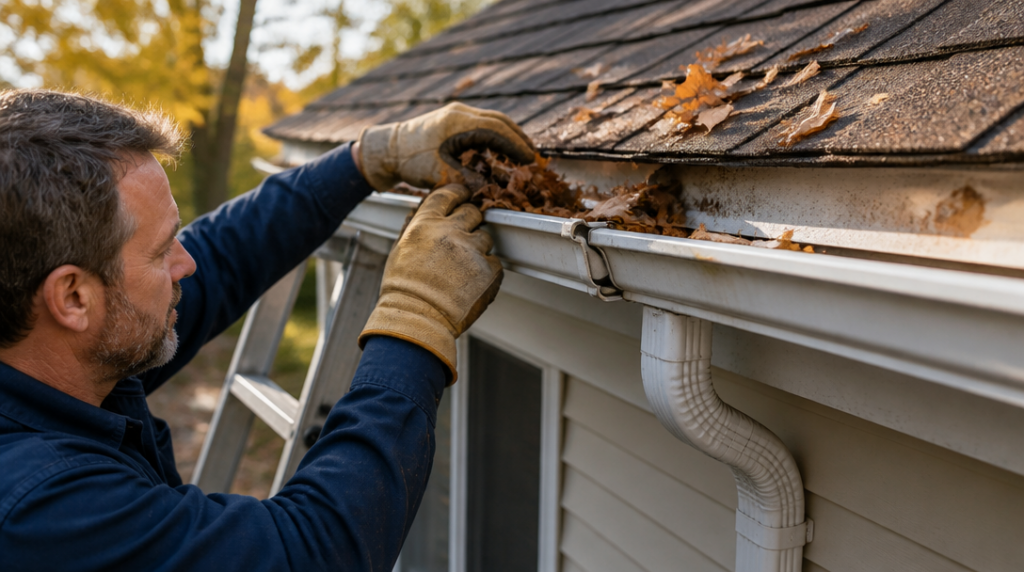
Last fall, a homeowner named Megan noticed water spilling over one corner of her roof during a storm. She assumed the gutters were simply full of leaves, so she put off calling anyone until the weekend. By then, the fascia board behind the gutter had started to rot, and the repair was no longer just a matter of scooping out debris. The gutters needed cleaning, one section needed replacement, and the damaged wood had to be dealt with too.
That is how a small maintenance job can turn into a repair bill. A gutter cleaning is usually manageable, but neglected gutters can send water into places it was never meant to reach. So what should you budget for?
In the United States, professional gutter cleaning costs an average of about $168 in 2026, with most visits falling between $119 and $234. For a typical one-story home, that same $119-to-$234 range is a useful starting point. A small, easily accessible house may land near the lower end, while a roof covered in wet leaves can push the price higher.
The height of the house matters because the crew needs taller ladders, more setup time, and additional safety precautions. The amount of debris matters too. A light layer of dry leaves is a quick job. Thick, compacted sludge made from leaves, dirt, and roof grit takes considerably longer. A steep roof can add another layer of difficulty, especially if the gutters are difficult to reach from the ground.
Downspouts are sometimes included in a full gutter cleaning, but not always. If you are paying for the downspouts alone, the work typically costs around $50 to $100. That service may involve clearing a blockage, flushing the pipe, and checking whether water can flow freely away from the house. A gutter that looks clean on top can still be useless if its downspout is packed solid.
You might be tempted to compare a professional quote with the price of a ladder, gloves, and a free Saturday. That comparison is fair, particularly for a low, simple roof. But gutters are awkward to work on, and a fall can turn a modest maintenance task into a serious accident. There is also the practical nuisance: the debris is wet, heavy, and somehow ends up everywhere. I have yet to meet anyone who describes gutter cleaning as the relaxing part of homeownership.
Repair costs are less predictable because the word repair can mean several different things. A contractor may need to tighten loose fasteners, reseal a leaking joint, adjust a sagging section, replace a damaged hanger, or remove and install part of the gutter. Those jobs do not require the same amount of labor or materials.
Gutter repair averages about $398 in 2026, with a common range of roughly $194 to $640. A minor leak or loose section may stay near the lower end. Multiple leaks, poor drainage, damaged mounting points, or hard-to-reach areas can move the estimate upward. If a contractor has to remove a long section of gutter before installing a new one, labor becomes a larger part of the bill.
Replacing damaged gutter sections generally costs about $6 to $17 per linear foot. That figure is useful for a rough calculation, but it is not the entire invoice. A short replacement may still involve a minimum service charge, removal of the old material, new end caps, connectors, hangers, sealant, and disposal. A seamless gutter section may also need to be made or fitted specifically for the house rather than pulled from a standard shelf.
The material and condition of the existing system can change the price as well. Aluminum gutters are common and relatively easy to work with, while heavier or less common materials may require different tools and more specialized labor. A contractor may also recommend replacing nearby hangers or fasteners if they are corroded. Installing a shiny new section onto weak supports is a little like putting a new door on a crumbling frame; it may look better briefly, but the underlying problem remains.
The most expensive surprises usually appear behind the gutter. Water that repeatedly overflows or leaks against the house can damage the fascia, soffit, and other exterior wood. Repairing soffits and fascia boards may cost anywhere from $600 to $6,000, depending on how much material is damaged and how difficult it is to access. Once rot has spread, the job may include removing decayed wood, installing replacement boards, repainting, and correcting the gutter problem that caused the damage in the first place.
That wider repair is why a quote for a leaking gutter can look disproportionate to the size of the visible defect. The crack may be only a few inches long, but the water may have been entering the structure for months. A contractor who checks behind the gutter is not necessarily padding the estimate; they may be looking at the part of the problem that cannot be seen from the driveway.
Before approving work, ask what the price includes. Does cleaning cover the downspouts? Will the crew bag and remove the debris? Is the quote for repairing one leak or for replacing an entire section? Does it include new hangers and sealant? If fascia or soffit damage is suspected, will that be priced separately?
A written estimate should distinguish maintenance from repair. Cleaning might be listed as one service, while replacement materials, labor, disposal, and wood repairs appear as separate charges. That breakdown makes it easier to decide whether you need the full recommendation immediately or whether a smaller repair can safely wait.
Timing can affect the experience, even if it does not always change the basic cost. Gutters are often busiest after leaves fall, and waiting until water is already pouring over the edge can limit your scheduling options. After a storm, it is sensible to check for detached sections, bent corners, and pools of water sitting in the gutter. You do not need to climb onto the roof to spot every warning sign. Look for staining on exterior walls, sagging lines, water collecting near the foundation, or gutters pulling away from the house.
A cleaning is usually the right response to leaves and sediment. A repair is needed if the system leaks, sags, separates, or cannot drain properly even after it is clear. If the wood behind it feels soft or shows visible rot, the gutter is no longer the only item on the work order. The sooner that distinction is made, the better the chance of keeping a $168 cleaning from becoming a much larger project involving replacement boards and exterior repairs.