
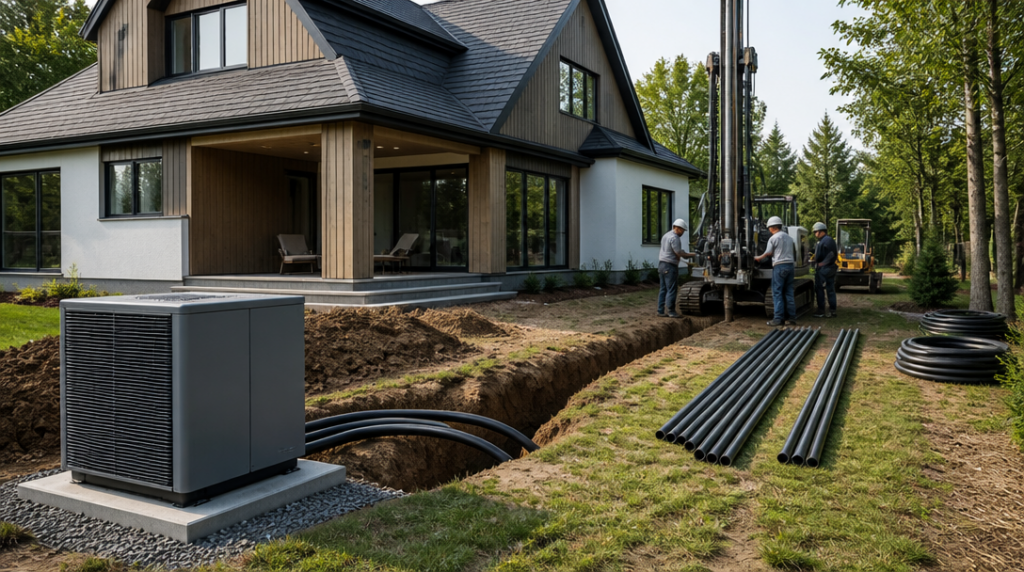
A homeowner in Pennsylvania recently received two quotes for the same basic idea: replace an aging furnace and air conditioner with a ground-source heat pump. One contractor proposed horizontal trenches across part of the yard. The other recommended drilling vertical boreholes because the property was too compact for extensive excavation. The equipment looked similar on paper. The prices did not.
That difference captures the central reality of geothermal heating: the heat pump itself is only part of the project. Most of the uncertainty lies outside the house, beneath the lawn, driveway, or parking area.
In the United States, residential installation costs in 2026 generally fall between $18,000 and $35,000 before incentives. That is a substantial upfront expense, especially compared with replacing a conventional furnace or installing a standard air-source heat pump. A ground-source system can still make financial sense over a long service life, but the payback depends heavily on the site, the building, local energy prices, and the amount of excavation or drilling required.
What the Installation Price Includes
A ground-source heat pump transfers heat between a building and the ground. In winter, it draws heat from the soil or rock and moves it indoors. In summer, it reverses the process, sending heat from the building into the ground. The system relies on the relatively stable temperature below the surface, which typically remains around 40–70°F, or roughly 4.5–21°C, depending on location and depth.
The indoor equipment includes the heat pump unit, circulation components, controls, and connections to the building’s distribution system. If the home already has suitable ductwork or hydronic heating infrastructure, the indoor portion may be relatively straightforward. If the contractor must modify ducts, replace distribution equipment, upgrade electrical service, or install new controls, the project becomes more involved.
The underground loop is usually the biggest variable. A horizontal loop can require extensive trenching and is best suited to properties with enough open land. A vertical loop uses drilled boreholes and can work on smaller lots, but drilling equipment, access, geology, and borehole depth all affect the price. A pond or other water-based design may be possible in unusual circumstances, although it depends on the site and local requirements.
This is why two homes with the same heating load can receive very different estimates. A rural property with open soil and easy equipment access may be simpler to develop than a smaller suburban lot surrounded by pavement, mature landscaping, retaining walls, or buried utilities. Rock, groundwater conditions, slope, and local drilling requirements can push the underground portion higher without changing the size of the heat pump inside the home.
The ground loop also creates much of the project’s physical disruption. Trenching can disturb lawns and gardens, while vertical drilling brings heavy machinery onto the property. Restoration may be included in the quote, priced separately, or left partly to the homeowner. A detailed proposal should make clear who handles soil removal, surface repair, landscaping, permits, and utility locating.
Electrical work is another possible addition. The heat pump may require a suitable circuit, disconnect, or panel capacity. Older homes can need upgrades before the new equipment is connected. Existing ductwork may need sealing or resizing, and homes without compatible distribution systems may require a different indoor arrangement. None of these items is automatically part of the headline installation figure.
The contractor’s design process matters as much as the equipment brand. A proper estimate should account for the building’s heating and cooling load rather than sizing the system from floor area alone. Oversizing or undersizing the equipment can affect comfort, operating performance, and the required loop field. A site evaluation should also identify the proposed loop type, drilling or trenching assumptions, expected restoration work, electrical changes, and warranty terms.
A low quote is not necessarily a bargain if it leaves out the difficult parts. An estimate that excludes drilling, duct modifications, electrical upgrades, or landscaping can look attractive until those costs appear later. Comparing proposals line by line is more useful than comparing the first number on each page.
Incentives, Commercial Projects, and Long-Term Value
The tax picture changed for homeowners in 2026. The federal residential geothermal heat pump credit under Section 25D ended for installations placed in service after December 31, 2025. That means a new residential project completed in 2026 cannot automatically be priced on the assumption that the former 30% federal credit will reduce the bill.
State, utility, and local programs may still exist, but they vary by location and can carry their own eligibility rules, application deadlines, equipment requirements, or income limits. Those programs should be treated as potential reductions, not guaranteed deductions, until the homeowner confirms the details for the specific property and installation date.
Commercial buildings follow a different federal framework. The basic federal credit is 6% of total project costs. If the project satisfies the relevant requirements, bonus provisions can raise the total credit as high as 30%. For a large office, school, retail building, or industrial facility, that difference can materially change the financial model, particularly because commercial ground loops can represent a major share of the capital budget.
Commercial pricing is difficult to generalize. The cost of the underground loop depends strongly on the site and the type of subsurface material. Drilling conditions, available land, the required heating and cooling capacity, access for construction equipment, and the building’s existing mechanical systems all influence the final figure. A commercial project may also involve engineering, permitting, controls integration, and phased construction around an occupied building.
The long-term calculation begins with the installation price but does not end there. Ground-source heat pumps have a typical service life of more than 20 years. The underground loop can last much longer than the indoor mechanical equipment, although the exact lifespan depends on the materials, installation quality, and system design. That durability spreads the initial investment over many years and can reduce the frequency of major replacement work.
Operating costs depend on the building and the local utility market. A well-designed system may provide heating and cooling from one set of equipment, avoiding separate fuel-burning and cooling systems. It also avoids the outdoor temperature swings that make air-source systems work harder during very cold or very hot weather. Those advantages do not erase the installation premium, but they help explain why geothermal projects are judged over decades rather than by the first year’s invoice.
The most useful financial comparison is not simply “geothermal versus a cheaper replacement.” It is a comparison of complete systems over their expected lives. That analysis should include installation, financing, electricity or fuel use, maintenance, replacement timing, available incentives, and the value of cooling equipment that may no longer need to be purchased separately.
For a homeowner, the practical question is whether the property can support the loop design without turning the yard into the most expensive line item in the project. For a commercial owner, the question is often larger: how the loop field, building controls, tax treatment, and long-term operating strategy fit into the capital plan. In both cases, the underground design deserves more scrutiny than the polished equipment brochure. The quiet machinery in the basement is only the visible end of the system; the expensive part may be the work nobody sees once the grass grows back.