
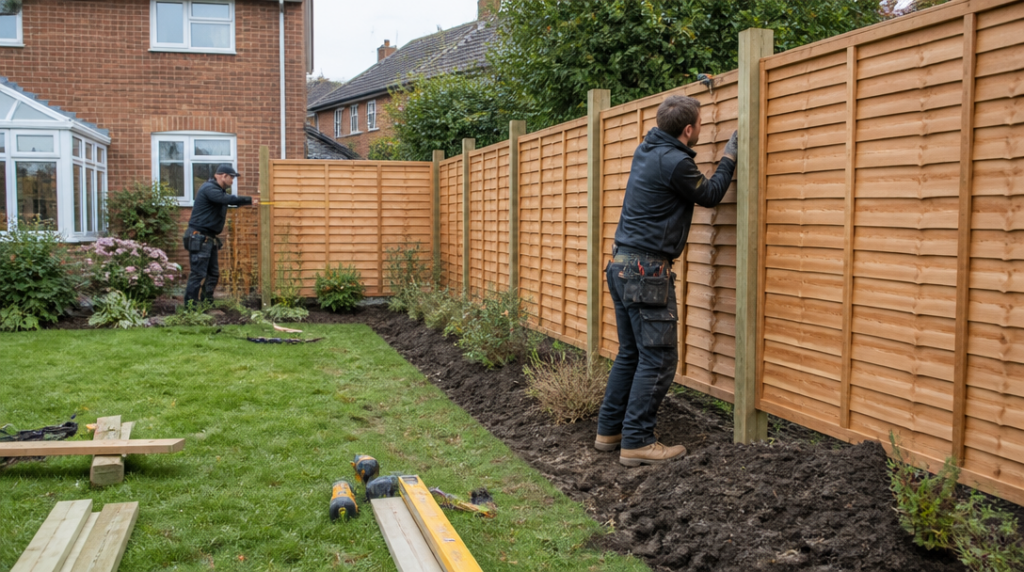
A professionally installed fence in the UK costs roughly £60–£150 per metre in 2026. That puts a standard 15-metre garden fence at about £1,200–£2,700, which is a wide enough gap to make two seemingly similar quotes feel like they belong to different projects.
The price is not controlled by the panels alone. Fence height, timber quality, post type, access to the garden, ground conditions and the amount of preparation work can all push the figure up or down. A straight run across a clear lawn is a very different job from replacing a leaning boundary beside a narrow alley, dense planting and uneven paving.
The panel type sets the starting price
For many homeowners, the biggest pricing decision is the material. Timber remains the most common choice for garden boundaries because it is practical, familiar and relatively easy to repair. Even within timber fencing, though, the cost varies sharply.
Lap or overlap panels are usually the more affordable option. Installed prices tend to fall around £60–£100 per metre. These panels are made from overlapping horizontal boards, creating a traditional garden-fence appearance. They are often the sensible choice for a long boundary where keeping the budget under control matters more than achieving a highly tailored finish.
Closeboard, also called featheredge fencing, generally costs more, at around £90–£150 per metre installed. Its vertical boards are fixed individually or assembled into a sturdier panel system, giving the fence a more solid and substantial look. Closeboard fencing also handles the visual demands of prominent front gardens well, where a basic overlap panel might look a little lightweight.
Composite fencing sits at the premium end of the common residential market. Expect approximately £120–£220 per metre, including installation. Composite boards are designed to resist rot and usually need less routine treatment than timber, but the initial outlay is noticeably higher. The finish can be striking, especially in a modern garden, although the supporting posts, rails and trim can form a significant part of the total cost.
Those figures are useful for comparing materials, but they are not a complete quotation. A supplier may price the panels separately from posts, gravel boards, gates, concrete and labour. Ask whether the metre rate includes every part of the finished installation or only the visible panels. That single question prevents a surprising number of budget shocks.
Why two fences of the same length cost different amounts
Length is only the beginning. A 15-metre fence installed across level, open ground might be relatively straightforward. The same length running along a slope can require stepped panels, extra cutting and more concrete around the posts. Sloping ground often creates more waste and takes longer to set out accurately, especially if the finished line must look neat from both sides.
Access matters just as much. If installers can bring materials directly through a side gate, the job is faster and less tiring. If every panel has to pass through the house, travel up stairs or be carried through a narrow passage, labour may increase. The same applies to old walls, sheds, conservatories and dense borders that restrict where workers can dig and stand.
The condition of the ground can cause trouble beneath an otherwise ordinary-looking garden. Tree roots, buried rubble, hard clay and existing concrete all make post holes slower to excavate. Rocky ground may require specialist equipment, while soft or waterlogged soil can demand deeper or more carefully supported posts.
Height changes the calculation too. A standard garden fence is cheaper than a taller privacy fence because it uses less material and is usually easier to handle. Extra height can also increase wind loading, which may call for stronger posts and more robust foundations. A tall fence that looks elegant on paper can become a much more substantial construction job once the posts are in the ground.
The hidden extras that appear on the quote
Removing the existing fence is one of the most common additions. Taking down an old boundary and disposing of it can add approximately £4.50–£25 per metre, depending on the material, access and amount of debris. A few damaged timber panels are quick to remove. Concrete posts set deep in the ground, tangled vegetation and piles of broken masonry are not.
Waste disposal deserves particular attention because old fencing is awkward to store and transport. Timber panels, posts and bags of rubble can quickly fill a van. If the contractor has included disposal in the estimate, the price should say so clearly. If not, you may be left arranging a skip or paying a separate collection charge after the installation is complete.
Gates are another easy-to-miss cost. A simple timber gate may be relatively modest, while a wide, framed or composite gate with heavy-duty hinges and a lock can add considerably more. Gate posts usually need stronger foundations than ordinary fence posts because the gate moves, pulls and catches in the wind every day.
Gravel boards are not always included in a basic panel price either. Concrete gravel boards keep timber away from wet soil and can extend the useful life of the lower edge of the fence. They add material and installation costs, but they are particularly useful where the ground stays damp or where soil and mulch regularly pile against the boundary.
Decorative posts, trellis panels, painted finishes and bespoke spacing all move the project away from a standard installation. None of these features is inherently extravagant, but several small upgrades can turn a £70-per-metre fence into a far more expensive one.
What a realistic 15-metre budget looks like
For a straightforward garden boundary using lap panels, a 15-metre project may land toward the lower end of the usual range, at roughly £1,200–£1,800. That assumes ordinary access, no major ground problems and a relatively simple layout.
A closeboard fence across the same distance could sit closer to £1,500–£2,250, depending on the design and supporting structure. Composite fencing can take the total to around £1,800–£3,300, particularly when the installation includes premium posts, edging or a matching gate.
The broader guide for a standard 15-metre garden fence is approximately £1,200–£2,700. That range makes sense once the different materials and site conditions are considered. It is broad, but fencing is one of those jobs where the physical setting can matter almost as much as the product selected.
A useful way to compare quotes is to split the price into four parts: materials, labour, removal and disposal, and extras such as gates or gravel boards. You do not need a complicated spreadsheet. Even a handwritten breakdown can show why one contractor is £500 cheaper or whether the cheaper quote has simply left out work that another installer has included.
How to keep the price under control without buying a flimsy fence
The cheapest panel is not always the cheapest fence. If thin boards start to warp, rot or pull away from their fixings, repairs arrive sooner and the original saving disappears. A better approach is to choose a suitable material, then simplify the design around it.
Keep the fence line straight where possible. Avoid unnecessary changes in height, decorative sections and awkward corners unless they solve a real problem. If you need a gate, decide its position before requesting quotes, since moving it later can alter the number of panels, posts and concrete foundations required.
Clear vegetation and movable garden items before the installers arrive. Do not remove anything structural or attempt to dig out established roots without advice, but clearing pots, stored timber and overgrown branches can make access easier. A clean working area gives the crew more room to work and reduces the chance that preparation time will be added to the bill.
It can also be worth repairing a section rather than replacing the entire boundary. If the posts are sound and only a few panels have failed, selective replacement may be perfectly adequate. On the other hand, fitting new panels to rotten or leaning posts is a false economy; the fence may look fixed for a season and then begin to sag again.
Ask for written confirmation of the fence height, panel style, post material, gravel boards, gate specifications, removal work, waste disposal and any treatment or finishing included. The most useful quote is not necessarily the shortest one. It is the one that leaves the fewest unanswered questions before the first post hole is dug.