
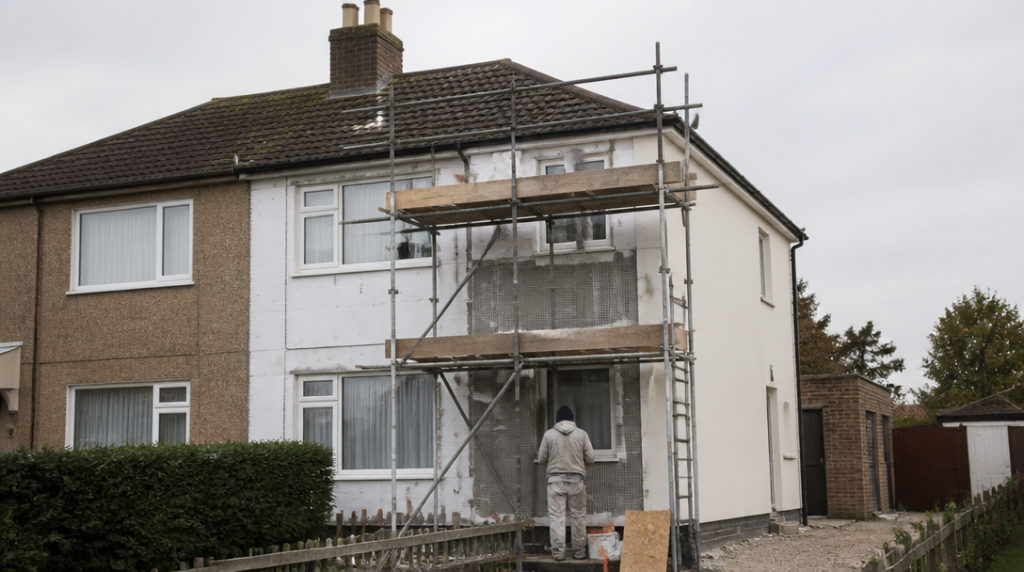
I can imagine the scene: a homeowner stands outside a three-bedroom semi-detached house, looking at a wall that is about to disappear beneath insulation boards, reinforcement mesh and a fresh render finish. The contractor has handed over a quote for £10,000. It is a large number, but not an extraordinary one for this kind of work.
External wall insulation is rarely priced like a simple decorating job. The final bill covers the insulation system, preparation, fixings, render or cladding, scaffolding, labour and the awkward details around windows, doors, gutters and roof edges. A house may look fairly modest from the pavement and still present a surprisingly large surface area to insulate.
For work carried out in the UK in 2026, I would expect complete external wall insulation to cost roughly £90–£160 per square metre, with about £120 per square metre acting as a useful typical figure. Some current calculations use a higher range of £150–£200 per square metre, averaging around £175, depending on the material, surface finish and scope of the work. Those figures are not contradictory so much as a reminder that “external wall insulation” can describe several different specifications.
Why the same wall can produce very different quotes
The insulation boards are only one part of the system. A contractor first has to deal with the existing wall, then build up a weather-resistant external finish that will remain exposed for years. Uneven masonry, cracks, old render and awkward corners all add time before the visible transformation begins.
The chosen finish matters too. A straightforward render system will not be priced in exactly the same way as a more decorative or durable finish. The insulation material also affects the rate, as can the thickness required and the detailing around openings. A wall covered in windows, pipes, vents and external fittings takes more care than a broad, uninterrupted gable end.
Scaffolding is another cost that is easy to underestimate when looking at a house from ground level. The installers need safe access to the full working area, and the scaffolding may have to remain in place while several layers are applied and allowed to dry. Moving or temporarily removing items such as downpipes, lights and satellite equipment can add further labour.
This is why I would be wary of comparing two quotes by looking only at the price per square metre. One may include preparation, scaffolding and the final finish, while another may leave some of those items outside the headline figure. A low number can become less attractive once the missing work appears as a list of extras.
The house type usually tells you more than the headline rate
For a standard three-bedroom semi-detached house, a complete installation costs approximately £10,000. A realistic range is about £8,000–£14,000. That is the figure I would keep in mind when testing whether an initial estimate feels broadly plausible, rather than expecting every semi-detached property to land in the middle of the range.
A terraced house is often cheaper because fewer external walls are exposed. Typical costs sit around £6,000–£12,000. The saving is not automatic, though. Access can be tight between neighbouring properties, and the front and rear elevations may have their own complications. A narrow passageway can make a job more labour-intensive even when there is less wall to cover.
At the other end of the scale, a large detached house can cost £20,000–£30,000. Detached properties expose more walls to the weather, usually require more scaffolding and often have more corners, roofline details and architectural features. Every bay, extension and change in height gives the installer another junction to finish properly.
I find it helpful to think of the building as a three-dimensional object rather than a floor plan. Two houses with the same number of bedrooms can have completely different external areas. An extended semi-detached house with a side return, conservatory and rear addition may need more insulation than a compact detached property with a simple rectangular shape.
London can shift the calculation before materials are chosen
In London, the average figure is often around £160 per square metre, approximately 30% above the UK average. Labour costs, access, parking, congestion and the practical difficulty of working in dense streets can all influence the final price.
A London quote may also involve more coordination around neighbouring properties and restricted access. Scaffolding beside a pavement or in a tightly packed terrace is not the same logistical exercise as setting it up on a spacious suburban plot. Even when the insulation system itself is identical, the working conditions can change the price substantially.
That regional difference does not mean every London project will cost exactly £160 per square metre, just as a property elsewhere in Britain will not automatically fit a £120 rate. It gives me a useful warning: location should be treated as part of the specification, not as a minor detail added at the bottom of the quote.
What I would check before accepting a £10,000 estimate
The first thing I would ask is whether the price covers the entire external wall insulation system or only the insulation and installation. A complete quote should make clear what happens to the existing surface, which finish will be applied and whether scaffolding is included.
I would also look for a clear description of the finish. “Rendered exterior” is not enough information to compare proposals if one contractor is allowing for a basic finish and another is pricing a more substantial system. The colour, texture and method of application can affect both appearance and cost.
Windows deserve particular attention. External insulation changes the relationship between the wall and the window reveals, so the detailing around frames needs to be considered. Doors, sills, gutters and downpipes may also need adjustment. If a quote says nothing about these areas, I would ask directly rather than assume they are included.
Preparation should be visible in the breakdown as well. Minor cleaning and making good are different from repairing damaged render or dealing with a badly uneven wall. I would want to know what the contractor has allowed for and what could trigger an additional charge once the old surface is exposed.
The same applies to extensions and less obvious elevations. A price based on a quick visual estimate may change if the rear of the house, side passage or upper gable has not been measured carefully. Square-metre pricing is useful, but only when the area itself has been assessed accurately.
The cheapest quote may leave the most important questions unanswered
I would not automatically choose the highest quote, but I would be suspicious of a large gap between otherwise similar proposals. If one company is offering a complete job for far less than the broad market range, I would examine the exclusions before celebrating the saving.
The sensible comparison is not simply £120 per square metre against £175. It is the total scope: insulation type, thickness, preparation, access, scaffolding, detailing, finish and any work needed around fittings. A quote that looks expensive on the first page may include tasks that another contractor expects the homeowner to arrange separately.
The price also needs to make sense for the shape and location of the house. Roughly £8,000–£14,000 for a typical three-bedroom semi-detached property sits comfortably within the usual range. A £6,000–£12,000 estimate for a terrace may be reasonable. A large detached house priced at only a few thousand pounds would deserve very close scrutiny, particularly if the proposal claims to include a complete system.
For me, the most reassuring quote would be the one that explains the work in plain language and leaves fewer mysteries behind. External wall insulation is a major visual change to a house, and the workmanship is hidden beneath the finished surface once the scaffolding comes down. The rendered wall may look simple in the end, but getting every edge, opening and junction right is where much of the cost lives.