
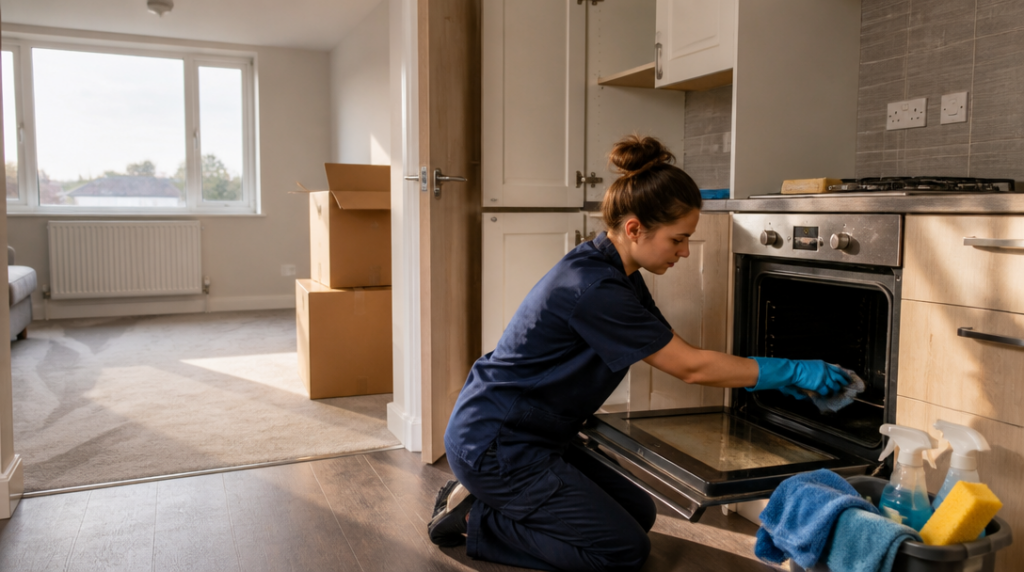
The question waiting at the end of the tenancy
How much can a cleaner charge for a home that already looks clean?
That is the awkward question many tenants face as the last boxes leave the hallway and the rooms begin to echo. The kitchen worktop may shine, the bathroom may appear presentable, and the carpet may look fine beneath the furniture marks. Yet an end-of-tenancy clean is judged in a different light. Grease gathers along the oven door, dust sits on skirting boards, fingerprints cloud the edges of windows and the space behind appliances suddenly becomes impossible to ignore.
Across the UK, a professional end-of-tenancy clean typically costs between £150 and £400 in 2026. That is a broad range, but it reflects the way these jobs are priced. A small, lightly used flat can sit near the lower end. A larger home, a property with stubborn dirt or a booking in London can move quickly towards the top.
The number on the quote is rarely just payment for someone to run a vacuum through empty rooms. It covers the concentrated work of making a property feel reset, often under the pressure of a moving date and a landlord’s inspection.
What different property sizes usually cost
For a studio or one-bedroom flat, the usual price is around £120 to £200, with an average close to £160. These homes may be compact, but compact does not always mean easy. A small kitchen can contain the same oven, extractor hood, cupboard fronts and tiled splashback as a larger property, only packed into a tighter space. Cleaning products, cloths and a vacuum still have to be carried in, and the bathroom still demands careful attention.
A two-bedroom flat generally costs about £180 to £300. Typical prices sit around £240 to £260. The extra bedroom adds more than floor area: there are additional doors, skirting boards, light fittings, windows and often another stretch of carpet that needs checking for marks. If the flat has been occupied for several years, the difference can feel particularly sharp around kitchen grease and bathroom limescale.
For a three-bedroom house, the usual range is £250 to £450, with typical averages around £270 to £325. Houses can bring their own complications. There may be stairs, several bathrooms, a utility room, a larger kitchen and outdoor-facing entrances where mud has collected along the edges. A quote at the lower end may assume a property in reasonable condition and a fairly straightforward layout; the higher figure is more likely where the clean is intensive or the home needs additional services.
These figures describe typical pricing rather than a fixed tariff. Two homes with the same number of bedrooms can require very different amounts of labour. One might be empty, bright and recently maintained. The other might have a cooker coated in baked-on residue and carpets marked by years of daily traffic.
Why London can change the calculation
Location can add a noticeable premium. End-of-tenancy cleaning in London is often around 20 to 50 percent more expensive than the national average. That does not mean every London cleaner applies the same uplift, but it helps explain why a quote that seems high beside a national price guide may still be normal for the capital.
The final figure can also be shaped by access. A flat several floors up, limited parking, a narrow staircase or a building with difficult loading arrangements can make a job slower before the first surface is wiped. These details are easy to overlook while comparing prices on a screen. A cleaner arriving with equipment sees them immediately.
The feel of the neighbourhood matters too, though not in a sentimental way. In a busy central flat, dust from open windows and street traffic can settle on sills and floors faster. In a family house, the marks may be lower down: fingerprints on doors, scuffs near the stairs and a darker strip of carpet along the busiest route through the home.
The extras that push the price higher
The oven is one of the most common additions. Oven cleaning usually costs an extra £50 to £80. That can seem steep beside the price of an ordinary kitchen clean, but the appliance is a separate, time-consuming task. Racks need removing, grease has to be loosened, and the glass door often reveals a layer of residue that was invisible from across the room. Anyone who has knelt in front of an oven with a cloth in one hand and a scraper in the other knows this is not a five-minute job.
Carpet cleaning is another frequent extra, generally priced at £25 to £50 per room. A quick vacuum can lift crumbs and surface dust, but it will not necessarily remove ground-in marks or revive flattened fibres. If the tenancy agreement or inspection expects carpets to be professionally cleaned, this cost needs to be considered separately rather than assumed to be part of the standard package.
Other possible additions include particularly dirty appliances, heavy limescale, internal window cleaning, upholstery or the removal of rubbish left behind after moving. Prices vary for these tasks, and they may not be included in a basic end-of-tenancy package. The useful question is not simply whether a company offers a low headline price, but what that price actually covers.
The condition of the property matters more than people expect
A cleaner can work quickly through an empty, well-maintained home because every surface is visible and accessible. Furniture does not need moving. Cupboards are easier to open. There are no bags in the hallway or half-packed drawers blocking the bathroom cabinet.
Heavy dirt changes the rhythm of the job. A stained shower screen, neglected extractor fan or greasy cupboard handle may need repeated treatment rather than one quick pass. Smoke residue, pet hair and thick dust can also demand extra attention. Some companies price these conditions after viewing photographs or asking for details, while others may add a surcharge if the property is substantially worse than described.
That is why photographs can be useful when requesting a quote. A clear image of the oven, bathroom, carpets and kitchen surfaces gives the cleaner a better idea of the work involved. It also reduces the chance of a tense conversation at the door when the property turns out to need much more than the original description suggested.
The same principle applies to the size of the home. Bedroom count is a convenient starting point, not a complete measurement. A large one-bedroom apartment with two bathrooms and tall windows may take more work than a modest two-bedroom flat. A three-bedroom house with mostly hard floors may be easier than a smaller property covered in worn carpet.
Why the cheapest quote may not be the cheapest option
A low price is tempting when moving costs have already swallowed deposits, transport fees and replacement household items. But a stripped-back clean may exclude precisely the areas that attract complaints: the inside of appliances, the edges of floors, cupboard interiors or difficult bathroom fittings.
It is worth asking for the scope of the service in writing before booking. Check whether the price includes the oven, inside windows, skirting boards, appliances, carpet treatment and removal of leftover rubbish. Ask whether the company returns if a particular area is missed, and whether the quote can change after inspection.
This is not about demanding hotel-level perfection from an ordinary rental. It is about knowing what is being purchased. A cleaner may deliver a perfectly competent standard clean while leaving an oven or carpet untouched because those items were never included.
A little clarity before the appointment can save a surprisingly large amount of stress on moving day.
A realistic budget for the final clean
For a small studio or one-bedroom property, budgeting around £160 is a sensible starting point, with room above that figure for condition or extras. For a two-bedroom home, £240 to £260 is a useful expectation, although the full range can run from £180 to £300. A three-bedroom house often falls around £270 to £325, but more demanding jobs can reach £450.
Add £50 to £80 for the oven if it is not included, and another £25 to £50 for each room requiring carpet cleaning. In London, allow for the possibility that the base price will be roughly a fifth to half higher than a comparable job elsewhere in the UK.
The quietest moment in an empty rental often comes just after the last piece of furniture has gone. That is when the marks show themselves: a grey line along the wall, crumbs beneath the radiator, a dull patch where the sofa stood. The final price is determined by those small discoveries, room by room, until the property is ready for someone new to walk through the door.