
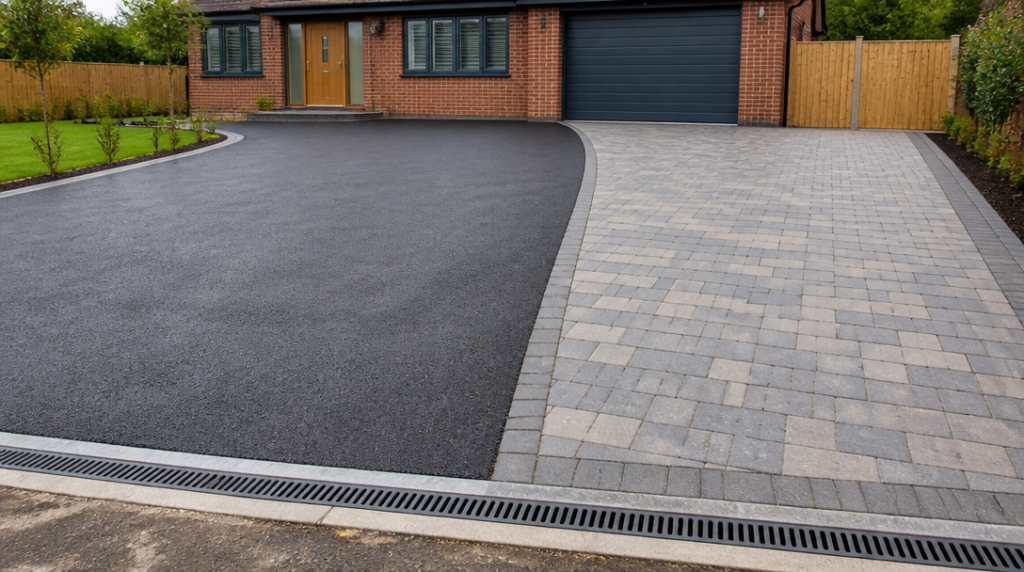
A new driveway in the UK can cost as little as £40 per square metre or as much as £140 in 2026. That wide range is not caused by a single expensive material. It reflects the difference between a straightforward resurfacing job and a fully excavated, carefully drained driveway built with a premium finish.
For a typical project, the surface you choose sets the broad price bracket. Tarmac is usually the most economical option, while concrete block paving and natural clay paving sit higher. The size of the driveway matters too, but it does not tell the whole story. A small driveway can still be expensive if access is awkward or the existing ground needs substantial work.
Tarmac remains the budget-friendly benchmark
Tarmac, also called asphalt, generally costs about £45–£90 per square metre, including installation. It is popular because contractors can cover a large area relatively quickly, and the finished surface is practical for everyday vehicle use.
The lower end of the range is more likely on a simple, accessible site with sound ground beneath the existing driveway. The higher end may apply where the old surface has to be removed, the sub-base needs replacing or the site requires additional drainage. Edging, kerbs and a more involved layout can raise the price as well.
Tarmac is not usually chosen for intricate visual detail. Its strength is the broad, clean surface it creates. A well-installed driveway can look neat and understated, particularly when bordered with brick or concrete edging. For homeowners who want reliable vehicle access without paying for a decorative pattern, it is often the sensible starting point.
A 40-square-metre double driveway would cost roughly £1,600–£2,600 in tarmac. That is a useful working figure, although a quotation can move outside it if the contractor discovers poor drainage or unstable ground.
Block paving costs more because the work is slower
Standard concrete block paving typically falls between £70 and £120 per square metre, including excavation, the supporting sub-base and laying the blocks. Premium concrete paving is usually priced at around £75–£130 per square metre.
The extra cost is not simply the price of the blocks. Block paving involves preparing and compacting the ground, installing a stable base, setting the edge restraints and laying individual units accurately. The labour takes longer than covering the same area with tarmac, especially where the design includes curves, borders or more than one colour.
That additional work buys flexibility. Block paving can be arranged in different patterns and repaired in sections if a small area later sinks or becomes damaged. Individual blocks can also be lifted to reach underground services, then relaid. Those practical advantages are easy to overlook when comparing material prices alone.
For a 40-square-metre double driveway, premium concrete block paving would cost approximately £3,600–£5,200. The gap compared with tarmac is substantial, but so is the difference in visual finish and installation time. A more elaborate pattern, unusual edging or a bespoke colour mix could push the price higher.
Natural clay paving sits at the premium end
Natural clay pavers cost approximately £110–£180 per square metre. They are among the most expensive common choices for a driveway, partly because the material itself costs more and partly because the installation needs to be precise.
Clay paving has a distinctive appearance that tends to become more characterful as it ages. Its colour is produced during firing rather than added as a surface coating, so the finish can retain its depth over time. It works particularly well with traditional houses, period properties and garden designs that use brick, stone or warm-toned materials.
This is a surface selected for appearance as much as function. The cost can be difficult to justify on a purely practical basis, especially for a large driveway, but it may suit a property where the frontage is a prominent architectural feature. At this price level, details such as the border, jointing and drainage should be planned carefully; a premium surface can look poorly considered if those elements are treated as afterthoughts.
The hidden cost is usually below the surface
Homeowners often compare the price of tarmac with the price of paving and assume the material explains the entire difference. In practice, preparation is one of the biggest variables.
A contractor may need to break out and remove the existing driveway, excavate to the required depth, dispose of waste and improve the ground before the new surface is installed. A weak or waterlogged subsoil can require additional aggregate and deeper excavation. If water currently runs towards the house or collects at the bottom of the drive, drainage work may be necessary too.
The supporting sub-base is especially important. It spreads the weight of vehicles and helps prevent rutting, cracking and sinking. A driveway that looks perfect on completion can fail prematurely if it has been laid over poorly compacted material. Cutting corners here is a false economy, even if the initial quotation looks attractive.
Site access can affect the bill in less obvious ways. If a large lorry cannot reach the driveway, materials may have to be moved through a narrow passage or transported in smaller loads. Terraced properties, steep slopes and homes with limited front access often take longer to prepare. The area may be small, but the labour is not necessarily simple.
Drainage rules can also influence the design and price. A new impermeable driveway may need to direct rainwater into suitable drainage within the property rather than allowing it to flow onto the public pavement or road. Permeable paving, drainage channels or a redesigned slope may be considered, depending on the site.
How to compare driveway quotations properly
A low per-square-metre rate is not useful if it covers only the visible surface. Ask whether the quotation includes removal of the old driveway, excavation, waste disposal, the sub-base, edging, drainage and final finishing. The wording should make clear what depth of excavation and foundation the contractor has allowed for, particularly if the existing ground is uncertain.
Check whether the quoted rate includes VAT and whether there are separate charges for delivery, skips or difficult access. These items can make a noticeable difference on a smaller project, where fixed costs are spread over fewer square metres.
The specification should also identify the surface itself. “Block paving” can describe a wide range of products, from basic concrete blocks to premium designs with unusual textures and colours. “Tarmac driveway” may or may not include a decorative edge, fresh kerbs or a resin-bound border. Two quotes that appear to describe the same driveway may be pricing rather different finishes.
It is sensible to ask how the contractor will handle rainwater and what happens if the ground is found to be unsuitable after excavation. A quotation cannot always predict every concealed problem, but it should explain which items could change and how additional work would be agreed.
For many houses, the most useful comparison is not the cheapest material against the most expensive one. It is the cost of a properly prepared driveway in each finish. Tarmac may deliver the lowest upfront price, while block paving offers more design control and easier local repairs. Clay pavers create a high-end traditional look, but their cost makes careful groundwork and detailing even more important.
I have always found driveway estimates easier to understand when reduced to a simple question: how much of this price will still be there after the first winter? The surface is what you see, but the compacted layers underneath are what keep the driveway level when rain, frost and vehicle weight begin testing it.