
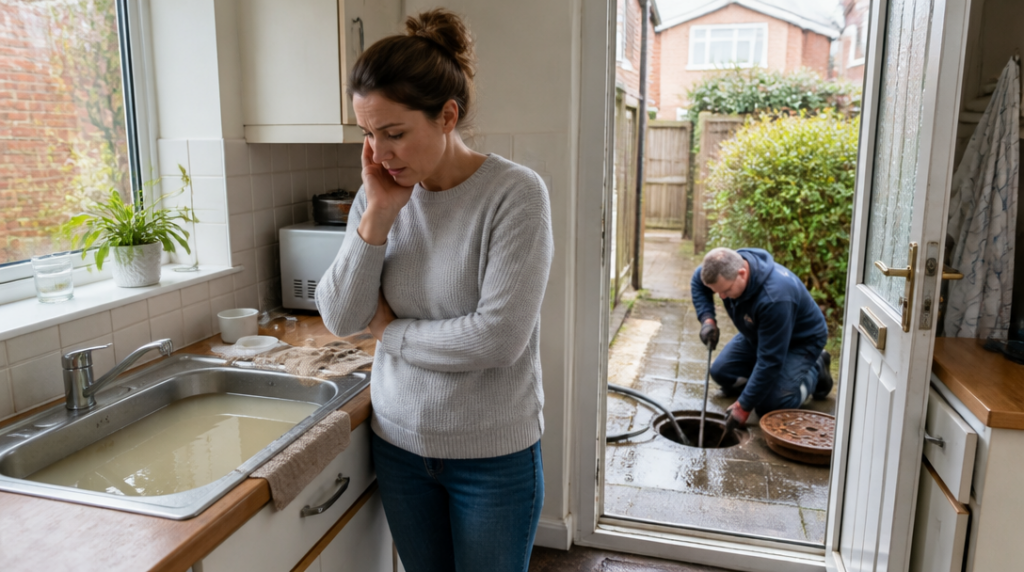
The first sign is usually small: the kitchen sink takes longer to empty, the toilet rises a little higher than usual, or a faint gurgle comes from somewhere beneath the floor. Then, often at the least convenient moment, the water stops moving altogether. I picture a sink full of cloudy water, a plunger leaning uselessly against the cupboard and the uncomfortable realisation that this is no longer a five-minute household job.
For a standard drainage blockage in the UK, I would expect to pay roughly £80–£175 in 2026, with the average sitting at about £85. That figure covers the kind of straightforward obstruction a drainage professional can clear without excavating, replacing pipework or carrying out a detailed investigation.
The price can move quickly, though. The location of the blockage, the equipment required and the time of day all make a noticeable difference. A blocked kitchen waste pipe is a different job from a collapsed underground drain, even if both begin with water refusing to disappear.
What a typical drainage unblocking service costs
For a relatively simple blockage, a drainage company may use a drain snake, flexible auger or set of rods to break through and remove the obstruction. This type of work usually costs around £75–£150, with an average price of about £85. It is often the most economical option when the blockage is close to an accessible drain or pipe and there is no sign of structural damage.
That price does not necessarily mean the problem is minor. Grease, food waste, hair, paper and accumulated debris can form a stubborn mass over time. Rods or a mechanical spiral may clear the immediate obstruction, but a recurring blockage can point to a broader issue inside the pipe. I would be wary of treating a drain that blocks every few months as though it were simply having bad luck.
Water jetting costs more because it uses high-pressure water to scour the inside of the pipe. The usual range is approximately £120–£250, averaging around £185. It can be useful when deposits have built up along the pipe walls or when a basic rodding job has failed to restore proper flow.
The difference between a basic clearance and jetting is easy to underestimate. A rod may create a narrow passage through the blockage, while jetting can clean a larger section of the pipe. That does not make it the right choice every time, and a professional should consider the condition of the pipe before using high pressure. Old, damaged or fragile drainage systems may need more careful handling.
Emergency attendance is where many household budgets take the hardest hit. An emergency call-out averages about £180, and work outside normal hours commonly costs 50–100% more than a standard appointment. A blockage discovered late at night, during a weekend or on a public holiday can therefore become considerably more expensive before any clearing work begins.
I would ask whether the quoted emergency price includes the actual unblocking or only the engineer’s arrival. Some companies separate the call-out fee, labour and equipment charges, while others offer a single price for a defined job. The wording matters. A cheap-looking first figure can become less attractive once every extra service is added.
Access also affects the bill. A blockage in an easily reached external drain is generally simpler to deal with than one beneath a kitchen floor, behind fitted units or somewhere along a long underground run. If the engineer cannot locate the obstruction immediately, the visit may turn from a basic clearance into diagnostic work.
Before agreeing to anything, I would ask four plain questions: What is the total price? Is the call-out included? Will there be an extra charge for jetting or camera work? What happens if the blockage cannot be cleared during the first visit? A reputable contractor should be able to explain the charging structure without turning the conversation into a guessing game.
There is one possibility that homeowners sometimes overlook. If the blockage is in a shared sewer or outside the boundary of the property, the local water company may be responsible for clearing it at no charge. That depends on the location and ownership of the drain, so it is worth checking before paying a private contractor to deal with a problem that may not belong to the household.
When the blockage needs investigation rather than brute force
A drain that clears once and then blocks again is asking a different question. The obstruction may be caused by damaged, displaced or badly aligned pipework, tree-root intrusion or a problem further along the system. Repeatedly pushing through the blockage can restore flow temporarily without explaining why it keeps returning.
A basic CCTV camera inspection of the pipe costs approximately £150–£300. A more complete survey with a written report usually costs around £250–£400. That additional detail can be useful when buying a property, dealing with an insurance claim or trying to establish responsibility between neighbouring properties.
I like the idea of a camera survey because it replaces vague suspicion with something visible. Instead of being told that there might be a crack somewhere underground, the homeowner can see what the engineer has found and understand whether the next step is cleaning, repair or replacement. It is a little like looking under the bonnet before paying for a new engine.
A camera inspection is not automatically necessary for every slow sink. If a professional clears a one-off blockage quickly and the drainage works normally afterwards, an expensive survey may add little value. If the same drain blocks repeatedly, foul smells return or several outlets are affected at once, investigation becomes much easier to justify.
Repair work is where the overall cost can move beyond ordinary unblocking prices. Clearing an obstruction is one task; repairing or replacing a damaged section of underground pipe is another. The final price will depend on what is wrong, how deep the pipe lies, how accessible it is and whether excavation is needed. Without an inspection or a clear diagnosis, I would not trust anyone who presents a precise repair total too confidently.
The safest way to compare quotes is to compare the work included rather than the headline number. One company may offer a basic rodding service, while another includes jetting, a follow-up check or a short report. Those are not equivalent jobs. A low quote may be perfectly fair for a simple blockage, but it is not necessarily the better deal if the drain has already failed several times.
I would also keep an eye on the difference between an urgent response and a planned visit. If water is backing up into the home, delaying can create hygiene and property-damage concerns, and paying for faster attendance may be unavoidable. If the drain is merely slow and still usable, arranging work during normal hours can avoid the 50–100% out-of-hours premium.
The most realistic budget for a normal, accessible blockage is therefore around £80–£175. Rodding or a mechanical spiral generally sits near £75–£150, while water jetting is more likely to fall between £120 and £250. An emergency visit can average £180 before higher out-of-hours rates are applied, and camera inspections add roughly £150–£400 depending on how detailed the survey needs to be.
A sensible first step is not always reaching for the phone. I would check whether the affected drain is shared, note which fixtures are backing up and ask for a clear total price before work begins. The difference between a modest household repair and a costly drainage saga often starts with one simple detail: knowing exactly which pipe is blocked.