
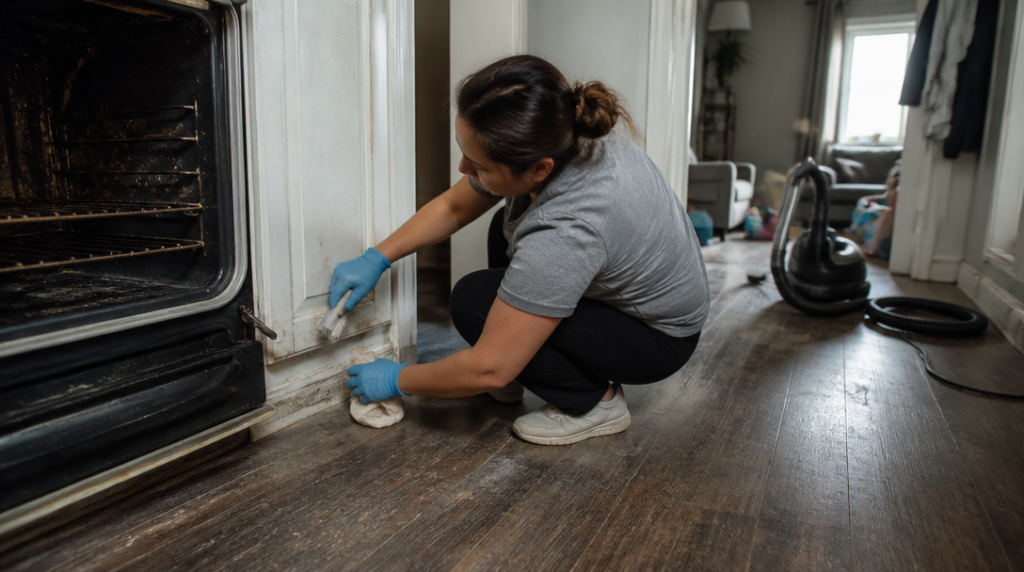
A cleaner lifts the oven door and finds the part of the kitchen most homeowners never see: a dark strip of grease along the hinge, crumbs packed beneath the racks, and dust gathered behind the appliance. In the bathroom, the grout has changed color. The baseboards are gray. Nothing looks disastrous from the doorway, yet a routine cleaning would barely touch the buildup.
That is the gap between standard house cleaning and deep cleaning, and it is also where the pricing gets slippery. In the United States, a professional deep cleaning costs about $260 on average in 2026, with many visits falling between $180 and $375. Other estimates put the typical range at $200 to $400. For a larger home or one that has been neglected for a long time, the bill can rise to between $230 and $600.
Why such a wide spread for what sounds like one service? The answer is hiding in the definition. “Deep cleaning” is not a tightly regulated package with the same checklist everywhere. One company may include baseboards, cabinet fronts, doors, and a detailed bathroom scrub. Another may charge extra for the oven, refrigerator, interior windows, or heavy pet hair. A customer comparing only the headline price may be comparing entirely different jobs.
House size is the most obvious factor, but it is not the only one. A small home under 1,000 square feet may have a starting price near $70, while a full-house cleaning can reach about $380 depending on the scope. That apparent contradiction makes sense once labor is considered: a compact, lightly soiled home can be completed quickly, while a larger property may require several workers and repeated passes over the same surfaces.
The condition of the home matters just as much. Dust that has accumulated for months is one problem. Grease baked onto a range hood, soap scum hardened around a shower, or pet hair pressed into carpet fibers takes more time and stronger products. A house being prepared for sale may need an especially detailed treatment because buyers inspect corners that residents have learned to ignore. Move-out cleaning can be even more demanding, particularly if the property has been occupied for years.
Labor explains why the estimate changes so quickly. Cleaning companies commonly charge around $50 to $90 per hour for a team, while an individual cleaner may cost roughly $25 to $90 per hour. Those figures do not translate neatly into a final bill because a two-person crew can finish faster than one cleaner, and businesses may include transportation, supplies, insurance, supervision, and minimum service charges. A low hourly rate is not automatically cheaper if the job takes twice as long.
This is where customers should read the quote like an investigator rather than a shopper looking for the largest discount. Does the company charge by the hour, by the number of bedrooms and bathrooms, by square footage, or by the condition of the property? Is there a minimum charge? Are stairs, difficult access, or unusually heavy dirt treated as separate complications? A quote that says “deep clean: $225” may sound clear while leaving the most expensive details unstated.
The phrase “deep clean” often becomes a marketing umbrella. Inside it, the actual work can range from a more thorough version of a regular visit to an intensive top-to-bottom service. Some cleaners dust ceiling fans and light fixtures, wipe doors and trim, scrub shower walls, clean cabinet exteriors, and remove buildup from kitchen surfaces. Others will not move appliances, wash walls, or touch the inside of cabinets unless those tasks are requested in advance.
That distinction is not cosmetic. A cleaner might spend an hour on a kitchen that has been maintained weekly, but much longer in a kitchen with sticky cabinets and years of residue. The same applies to bathrooms. A quick wipe removes visible grime; deep cleaning requires attention to grout, fixtures, edges, drains, and the areas behind or beneath objects. A person who has spent an afternoon trying to restore an old shower knows how quickly “just one bathroom” turns into a serious labor bill.
Add-on services create another layer of confusion. Carpet cleaning, for example, may cost approximately $150 to $200 per room. That can be a substantial addition to a $260 deep-cleaning visit, especially in a home with several carpeted rooms. Inside-oven cleaning, refrigerator cleaning, interior windows, wall washing, and detailed blinds may also be priced separately. These extras are not necessarily unreasonable; they simply require equipment, chemicals, and time beyond ordinary surface cleaning. The problem comes when customers discover them only after the cleaners arrive.
The number of rooms can matter less than their condition and accessibility. A small home packed with furniture may take longer than a larger, sparsely furnished property. Narrow staircases, cluttered floors, and rooms that cannot be reached easily slow the work. Heavy belongings may prevent cleaners from reaching the baseboards or corners that the customer expects them to clean. Some companies will move light items, but few will rearrange large furniture without a separate agreement.
Pets can push the price higher too, especially when hair is embedded in upholstery or carpets. Homes with smokers, fireplaces, renovation dust, or long-term moisture problems may require specialized treatment rather than ordinary deep cleaning. A cleaner can remove surface dirt, but persistent mold, pest infestations, damaged flooring, and serious odors may call for a different professional entirely. Treating every problem as a cleaning problem is a good way to pay for disappointing results.
Geography changes the numbers as well. The provided national-style estimates offer a useful baseline, but local labor markets do not all behave the same way. A quote in a high-cost metropolitan area may sit above the national average, while prices in a smaller market may be lower. Travel distance, parking, demand, and the size of the local workforce can all appear in the final price without being listed as separate line items.
There is also a difference between an independent cleaner and a larger cleaning company. An independent worker may offer a lower price and a more personal service. A company may charge more because it carries insurance, supplies, scheduling staff, and backup workers if someone is sick. Neither model guarantees better work. Reviews can help, but they do not replace a written description of what the visit includes. A polished website and a low introductory price reveal very little about how carefully someone cleans behind a toilet or under a bed.
Before booking, a homeowner should describe the property honestly. Mention the square footage, number of bedrooms and bathrooms, pets, stairs, the last time the home received a thorough cleaning, and any areas that need special attention. Photos can be more useful than vague assurances, particularly if there is heavy grease, clutter, or visible buildup. Asking whether the estimate is fixed or subject to change prevents an awkward negotiation at the door.
A sensible comparison asks for the same scope from several cleaners. One quote should not include oven cleaning while another quietly excludes it. Ask how many workers will arrive, how long the appointment is expected to take, whether supplies are included, and which tasks count as add-ons. If the company refuses to explain the price, the low number may be less of a bargain than it appears.
The cheapest option can also create a false economy. A rushed crew may clean only the most visible surfaces, leaving the areas that justified the deep-cleaning fee untouched. A higher quote may reflect more labor rather than a larger profit margin, especially in a neglected home. The useful question is not simply, “How much does deep cleaning cost?” It is, “What work will be done for that amount, by how many people, and under what conditions?”
For many households, a realistic budget is somewhere around $200 to $400 for a standard professional deep clean, with smaller homes potentially starting below that range and larger or heavily soiled properties moving toward $600. Carpet cleaning alone can add $150 to $200 per room. Those numbers do not remove the uncertainty, but they expose where it comes from: square footage, labor, condition, location, and the growing list of tasks hidden behind two words that sound more precise than they are.