
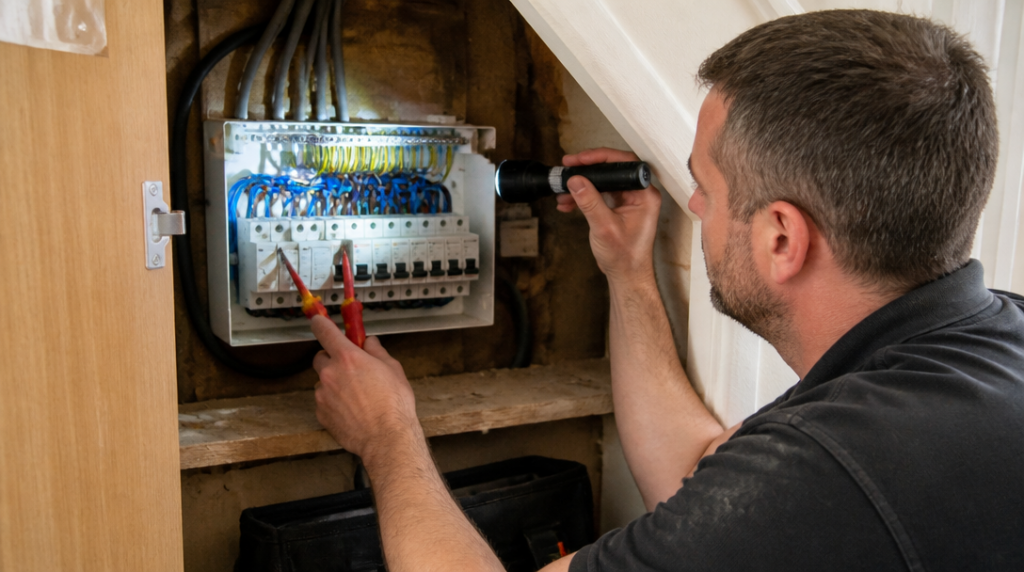
The first sign is often not dramatic. An electrician opens the cupboard beneath the stairs, removes the faded plastic cover and shines a torch across a row of ageing switches. Dust has settled into the corners. One label has curled away from the board, another is written in handwriting no one in the house recognises. The electrician pauses before explaining that the consumer unit is due for replacement.
For a typical UK home, replacing a consumer unit in 2026 costs around £350–£750, including materials and labour. That range covers a fairly standard installation, but it does not describe every job. A compact, accessible board serving a straightforward house may sit near the lower end. A larger property with awkward cable routes, more circuits or upgraded protection can move well beyond it.
The consumer unit is the central distribution point for the home’s electrical circuits. It contains the switches and protective devices that control power to sockets, lights, the cooker, the heating system and other fixed equipment. Replacing it is not simply a matter of unscrewing one box and attaching another. The electrician must identify the circuits, inspect the existing wiring, select suitable protection and test the installation after the new board is fitted.
That is why two homes with similar-looking boards can receive very different quotes.
What the Main Price Ranges Cover
A standard replacement generally means a modern consumer unit with familiar protective equipment, installed in the existing position. If the surrounding wiring is in reasonable condition and the cables reach the new board without major alterations, the work may be relatively contained. The electrician isolates the supply, removes the old unit, connects the existing circuits to the new equipment and carries out the required testing.
The physical work can still be dusty and cramped. Consumer units are often fitted under stairs, in hallways or inside small utility cupboards where there is barely enough room to kneel. The board itself may look tidy once installed, but the process involves tracing each circuit and checking that its connections are secure. A neat row of labelled switches is the visible part of the job; the testing behind the cover is what determines whether the installation is safe.
A standard dual-RCD consumer unit usually costs about £500–£800. Dual-RCD protection divides the circuits between two residual-current devices, so a fault on one side does not necessarily cut power to every circuit in the house. It is a common configuration and often represents the middle ground between a basic replacement and a more individually protected system.
Fully equipped RCBO consumer units cost more, typically around £800–£1,200. An RCBO combines residual-current protection and overcurrent protection for an individual circuit. Instead of several circuits sharing one RCD, each circuit can have its own protective device. That arrangement can make fault-finding less disruptive: a problem affecting one circuit is less likely to switch off unrelated parts of the house.
The extra equipment takes up space and adds to the material cost. It may also influence which consumer unit is suitable, particularly where there are many circuits to accommodate. A house with a lighting circuit, several socket circuits, an electric shower, an oven, an outbuilding and future equipment has a different set of requirements from a small flat with only a handful of ways.
Surge protection is another common addition. Installing a surge protection device, or SPD, generally adds around £80–£150 to the price. Its purpose is to help protect electrical and electronic equipment from transient overvoltage. That can be especially appealing in a home filled with expensive, permanently connected devices: a modern kitchen can contain more sensitive electronics than the old consumer unit was ever designed to protect.
Arc-fault detection devices are a further step up. An AFDD monitors a circuit for electrical arcing, which can occur when a connection is damaged or deteriorating. Installation costs roughly £40–£60 per module. Since a module is needed for each protected circuit, the total depends on how many circuits receive this protection rather than on a single flat charge.
A more elaborate configuration using RCBOs, AFDDs and an SPD can reach approximately £1,200–£1,650. That is a long way from the lowest standard replacement price, but the difference is explained by the number and sophistication of the protective devices rather than by the box alone. The consumer unit may still occupy the same small patch of wall; most of the extra cost is hidden behind its cover.
The electrician may also need to replace or extend cables if the existing conductors are too short for the new layout. Poorly identified circuits, damaged accessories or an overcrowded enclosure can add time. In older properties, the installation may reveal issues that were not visible from the outside, such as deteriorated insulation or connections that no longer meet current requirements. A responsible quote should make clear what is included and what would be treated as additional work.
The location matters as well. A board positioned beside the front door is usually easier to reach than one buried behind stored boxes or fixed cabinetry. If the electricity supply must be isolated for the work, the household may spend several hours without power. The fridge goes quiet, the boiler stops responding and every phone charger in the house becomes suddenly important. A replacement is often completed in a day, but the exact duration depends on the installation and any remedial work discovered during testing.
Why One Quote Can Be Twice Another
The word “replacement” hides several decisions. One electrician may quote for a dual-RCD board with standard protection. Another may recommend RCBOs on individual circuits, add an SPD and allow for more testing or remedial work. Both quotes can be technically coherent while describing different levels of equipment.
The number of circuits is one of the clearest price drivers. Each circuit needs a connection and suitable protection, and a larger home may need a bigger enclosure. Electric vehicle charging, electric heating, solar equipment, garden buildings and high-powered kitchen appliances can all make the arrangement more complex. Even when those systems are not being installed at the same time, the homeowner may want the new board to leave room for future changes.
The existing wiring is just as important. A new consumer unit cannot turn unsafe cables into safe ones. During the installation, the electrician tests the circuits and may find a fault that explains an old nuisance trip or a warm-smelling socket. In that situation, the board replacement may proceed, but repairs to the affected circuit could be charged separately. The cheapest quote is not necessarily the cheapest job if it leaves necessary faults unresolved or excludes work that another electrician has included from the start.
Ask for the quote to identify the board type, the protective devices, the number of ways, testing, labelling and certification. It should also state whether any cable alterations or remedial work are included. Vague wording such as “new consumer unit fitted” leaves too much room for disagreement once the old board is on the floor and the circuits are exposed.
The electrician’s qualifications and registration matter more than a glossy brand name on the enclosure. Consumer unit work involves isolating the supply, making safe connections and verifying the completed installation. The final checks should not be treated as a formality. They establish whether the protective devices operate correctly and whether the circuits have been connected as intended.
Prices can also differ according to local labour rates and the condition of the property. A tidy modern installation may be quick to work on. A board mounted in a dark corner with tangled cables, missing labels and limited access is a different proposition. I have seen enough electrical cupboards to know that the outside can be deceptively calm; behind a plain cover, a few centimetres of cramped wiring can dictate the whole afternoon.
For a homeowner comparing prices, the useful question is not simply “How much is a consumer unit?” It is “What protection is included, how many circuits will be covered, and what happens if testing finds a fault?” A standard replacement may fall within £350–£750. A dual-RCD installation commonly sits around £500–£800, while RCBOs, SPDs and AFDDs can push a carefully specified system into the £1,200–£1,650 range.
The board’s cover may be the final thing the electrician screws into place, but the meaningful work is the chain of decisions underneath: which circuit goes where, which device protects it and whether the old wiring is ready to be trusted again.