
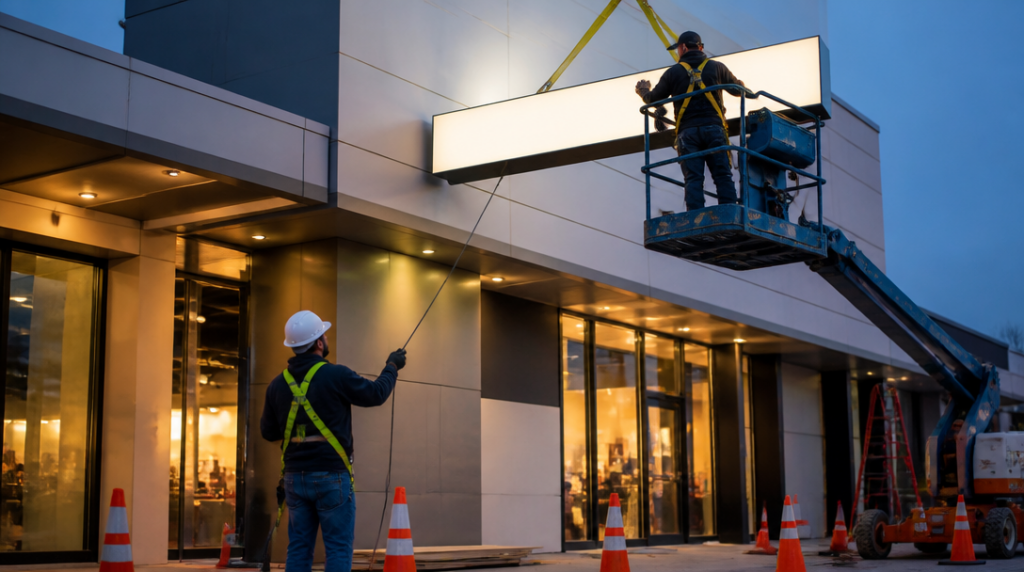
A simple wall sign can be installed for a few hundred dollars. A large illuminated sign may require permits, specialized electricians, lift equipment, and a five-figure budget before it ever goes up.
That gap is what makes commercial signage installation difficult to price from a distance. The sign’s size matters, but so do its weight, location, lighting, mounting surface, electrical needs, and the rules set by the local authority.
Typical Commercial Sign Installation Costs
In the United States, commercial sign installation averages about $464, with a common range of roughly $181 to $804. That figure suits many standard jobs, such as mounting a modest exterior sign on an accessible storefront.
It does not describe every project. A basic installation without electrical work may start near $100, especially when the sign is light, the mounting surface is straightforward, and the installer can work from the ground or a small ladder.
Specialized installation is a different category. More complicated work commonly runs from about $2,000 to $5,000. That range can include heavier signs, difficult access, structural reinforcement, electrical connections, or equipment that turns a quick mounting job into a coordinated construction project.
The average is useful as a starting point, not as a promise. Commercial signs are often custom-built, and two signs with nearly identical dimensions can have very different installation bills.
The Sign Type Sets the Pace
Flat panels, acrylic graphics, dimensional lettering, cabinet signs, monument signs, and channel letters all require different installation methods. A lightweight panel attached to a prepared wall is usually far simpler than a large sign that must be anchored into masonry or steel.
Custom or illuminated signs commonly cost around $10 to $300 per square foot. That figure may cover the sign fabrication and related work, but installation can still add a separate charge, particularly when the sign needs wiring, a dedicated circuit, or access equipment.
Illuminated channel letters are a major jump in price. Installed channel letters for a commercial property typically cost about $4,000 to $12,000. Each letter may need individual wiring, precise alignment, a power supply, and a weather-resistant connection to the building.
The finished sign can look almost weightless from the sidewalk. Up close, it may involve dozens of mounting points and a surprising amount of electrical work. That contrast is one reason a glowing storefront can cost much more than its clean, minimal appearance suggests.
Installation Access Can Change Everything
A sign mounted above an open storefront is relatively easy to reach. A sign on a tall façade, over a busy entrance, or beside an obstructed loading area is not.
Installers may need a bucket truck, scaffold, boom lift, or crane. Rental costs rise with the size of the equipment, the length of the job, and the conditions at the property. A large sign may also require traffic control or a temporary closure of part of a parking lot or road.
Crane rental for installing a large sign typically costs about $1,000 to $5,000. If the lift requires a separate engineered plan, that plan alone may cost $950 or more.
Those costs are easy to underestimate because they may appear as separate line items rather than part of the installation labor. A quote that looks reasonable for mounting the sign can change quickly once the contractor determines that a crane, rigging crew, or formal lift plan is necessary.
Electrical Work Adds Labor and Risk
A non-illuminated sign avoids one of the most expensive parts of the process: electrical installation. Lighted signs may need new wiring, conduit, disconnects, timers, transformers, or connections to an existing electrical panel.
The building’s current electrical capacity matters, too. If the panel is full or too far from the sign location, the installer may need to coordinate with an electrician for additional work. Older buildings can introduce more complications, particularly when wiring routes are concealed behind finished walls.
Electrical work also has to be weatherproof and code-compliant. A sign that flickers, trips a breaker, or allows moisture into its connections is not merely unattractive. It can create a maintenance and safety problem.
This is why an illuminated sign should not be priced by its visible face alone. The letters or cabinet may be the most noticeable part of the project, but the wiring behind them can determine the schedule and the final labor charge.
Permits and Local Sign Rules
Many cities regulate commercial signage through zoning and building departments. A permit may be required for the sign’s size, projection from the building, lighting, placement, structural attachment, or visibility from a public street.
Commercial sign permits commonly cost about $400 to $2,500. Some cities also charge a separate fee based on sign area, often around $1 to $5 per square foot.
Permit fees are only part of the administrative cost. The application may require drawings, dimensions, mounting details, electrical information, property-owner approval, or proof that the sign complies with local design rules.
A sign can be perfectly legal in one city and prohibited in the next. Historic districts, shopping centers, and multi-tenant properties may have additional restrictions on colors, illumination, projection, and placement. The installer may handle the paperwork, but the permit cost still belongs in the project budget.
Structural Conditions Matter More Than They Seem
A contractor needs to know what the sign will attach to. Brick, concrete, steel, wood framing, stucco, and insulated wall systems each call for different fasteners and mounting techniques.
A wall may look solid from the outside while offering limited support behind the finish. If the sign is heavy, the installer may need to locate structural members, add reinforcement, or use a specialized attachment system.
The same issue appears with monument and freestanding signs. Their installation may involve excavation, concrete footings, underground utilities, and coordination with the property’s landscape or paving. These jobs can move well beyond the cost of simply setting a sign in place.
Wind exposure is another concern, especially for tall signs and projecting cabinets. A professional installer has to account for the sign’s weight and the forces acting on it, not just make sure it sits level.
What a Commercial Sign Installation Quote Should Include
A useful quote should separate the sign from the work required to install it. Look for the cost of mounting hardware, labor, electrical connections, equipment rental, permit handling, removal of an existing sign, and disposal.
The quote should also describe the installation conditions. Is the contractor working from a ladder, lift, scaffold, or crane? Is the site accessible during business hours? Will the crew need to protect landscaping, close parking spaces, or coordinate with a building manager?
Ask whether the price includes testing and cleanup. For illuminated signs, the installer should confirm that the lighting operates correctly and that connections are secured. For large or elevated signs, the quote should make clear whether engineering, rigging, traffic control, and lift planning are included.
A vague line reading “installation: $500” may be accurate for a simple project. It becomes much less useful when the sign is heavy, elevated, illuminated, or subject to strict local regulations.
How to Keep the Installation Budget Under Control
Start by confirming the sign rules before finalizing the design. A sign that exceeds local size limits or uses unapproved lighting can create redesign costs, permit delays, and fabrication changes.
Give the installer clear information early. Photos of the building, approximate mounting height, wall construction, sign dimensions, electrical access, and site obstacles can make an initial estimate far more realistic.
If several signs are going onto the same property, schedule the work together when possible. One mobilization, one lift rental, and one permit process may be more efficient than separate visits for each sign. The savings will vary, but coordination can prevent duplicated setup costs.
It also helps to distinguish appearance from complexity. A smaller non-illuminated sign may deliver the desired visibility without requiring a new electrical circuit or heavy equipment. On the other hand, if the property depends on nighttime visibility, cutting illumination from the plan may undermine the entire purpose of the sign.
The most useful question is not simply, “How much does installation cost?” It is, “What has to happen at this building before the sign is secure, legal, connected, and ready to use?” That answer reveals whether the project belongs near the $181-to-$804 range or closer to the $2,000-to-$5,000 level, with large illuminated installations reaching $12,000 and beyond once the full scope is counted.