
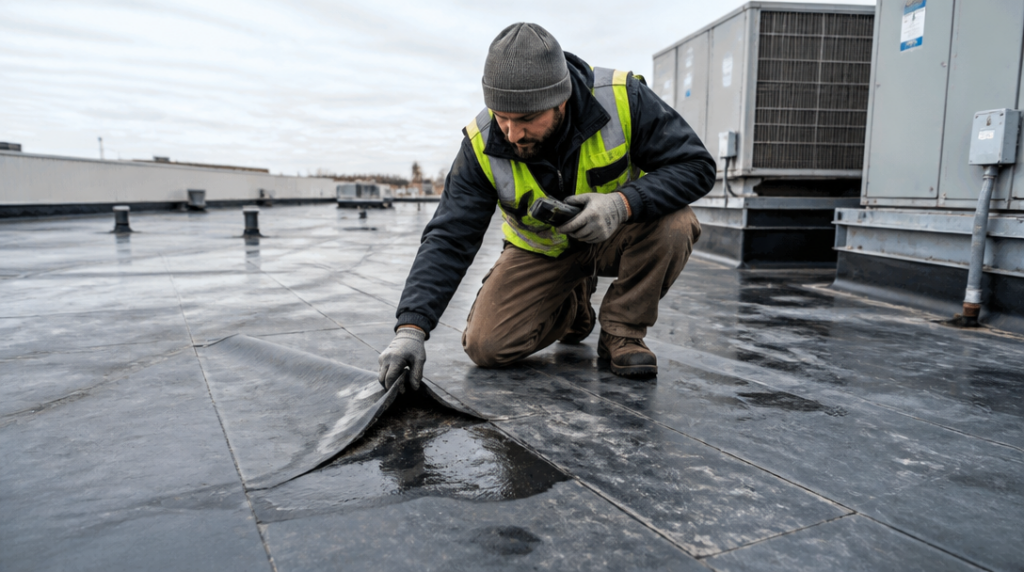
The first sign was not a dramatic waterfall through the ceiling. It was a damp cardboard box in the corner of a warehouse, followed by a brown stain above a row of shelving. By the time someone placed a bucket beneath it, the leak had already found its way through several layers of the roof.
That is the frustrating part of commercial roofing repair: the visible problem is often smaller than the problem that caused it. A patch over a puncture may be inexpensive. Finding wet insulation beneath the membrane, repairing damaged fasteners, and making sure the water has not traveled across the roof deck is a different job entirely.
For a typical commercial roof leak in the United States, I would expect a repair bill of roughly $400 to $2,500, with many ordinary jobs landing between $750 and $1,200. Those figures describe a manageable leak, not a roof that has been neglected for years or suffered major structural damage. The final estimate can climb quickly once the contractor has to open up the roof and investigate what is underneath.
The repair category matters more than the word “leak”
A minor repair commonly costs around $300 to $1,500. This range might cover sealing a small puncture, replacing a limited section of membrane, repairing a flashing detail, or dealing with a small area of loose material. It may still require a site visit, diagnostic work, and a return trip, so the price is rarely based only on the few minutes spent applying sealant.
A medium-sized repair generally falls between $1,500 and $7,000. This is where the work starts to involve several roof sections, more extensive membrane damage, failed seams, deteriorated flashing, or water that has already reached the insulation. The roof may look acceptable from the parking lot while concealing a surprisingly large wet area.
Large repairs can run from $7,000 to $25,000 or more. At that level, the contractor may be removing substantial portions of roofing, replacing insulation, repairing the deck, correcting drainage problems, or rebuilding sections around rooftop equipment. A large repair does not necessarily mean the entire roof needs replacement, but it does mean the job has moved well beyond a simple patch.
I find these ranges more useful than a single average because commercial roofs fail in different ways. A leak near one vent is not financially comparable to a membrane failure stretching across several thousand square feet.
Why contractors quote by square foot
Commercial roof repairs are often priced at approximately $3 to $12 per square foot. The number can seem alarming if it is applied to the entire roof, but repair pricing usually refers to the affected area rather than every square foot of the building.
That distinction matters. A contractor might repair a 100-square-foot section, not reroof a 20,000-square-foot warehouse. At $3 to $12 per square foot, the basic area-based portion would be about $300 to $1,200 before access, disposal, inspection, equipment, and other job costs are added.
The lower end is more plausible when the damage is easy to reach and the existing roofing system is straightforward to repair. The higher end reflects more difficult materials, multiple layers, tight working conditions, extensive preparation, or damage that cannot be isolated cleanly. A roof crowded with HVAC units, vents, pipes, and electrical equipment takes longer to work on than a broad, unobstructed surface.
This is also why two contractors can inspect the same building and produce noticeably different estimates without either one necessarily being dishonest. They may be proposing different repair boundaries or using different assumptions about what they will find after the roof is opened.
Membrane and metal repairs have different price patterns
Many commercial buildings use single-ply membranes such as TPO, EPDM, or PVC. Repairing one of these systems typically costs about $500 to $1,500. The job may involve cleaning and preparing the surface, patching a damaged section, welding or sealing seams, and checking nearby details that could be allowing water to enter.
The material itself is only part of the calculation. Matching the existing membrane, reaching the damaged area safely, and making a durable seam can matter more than the price of the patch. A cheap repair that fails after the next heavy storm is expensive in a way that does not show up on the first invoice.
Metal roofs bring another set of problems. Loose fasteners, failed seams, corroded panels, and damaged penetrations are common trouble spots. Repairs to metal connections and anchors often cost about $500 to $2,000. Rust may be cosmetic in one location and a warning of deeper deterioration in another, so the contractor needs to distinguish between surface treatment and actual metal replacement.
I am especially cautious with metal roof estimates that describe everything as “resealing.” Sealant can solve a small, localized failure, but it cannot restore metal that has lost its strength or fix movement that keeps reopening the joint.
Wet insulation is where the budget changes
Water that reaches the insulation can turn an ordinary leak repair into a much larger project. Removing wet insulation and completing the associated repair often costs around $1,500 to $4,000 or more. The range rises when the affected area is broad, the roof assembly is difficult to access, or the deck beneath the insulation has also deteriorated.
Wet insulation is not just a cosmetic concern. It can lose performance, add weight, and make it harder to identify the true path of the leak. Moisture may also travel sideways before appearing inside the building, which explains why an interior stain is not always directly below the damaged roof surface.
Some contractors use infrared scanning to identify areas that may be holding moisture. Infrared leak detection typically costs about $500 to $2,000. That expense can feel unnecessary when the leak appears obvious, but it may prevent a series of random patches across a large roof. On a big commercial building, locating the extent of the wet area before removing materials can be cheaper than opening the roof in several wrong places.
The repair estimate should explain what happens if moisture is found. Does the quoted price include a limited amount of insulation replacement? Is deck repair excluded? Will additional work require written approval? I would want those answers before the crew starts cutting into the roof.
A low initial quote can become expensive when every hidden condition is treated as an extra.
What pushes the price higher
The roof’s material and the size of the damaged area are obvious factors, but they are not the only ones. Access can have a substantial effect. A single-story retail building with clear roof access is simpler than a tall facility where materials must be lifted, secured, and carried around rooftop equipment.
Weather can complicate scheduling and preparation. A repair that requires a dry, clean surface may be delayed, while an emergency response during bad weather may involve temporary protection before permanent work can begin. That first visit may stop active water intrusion without solving the underlying failure, so the estimate should distinguish emergency stabilization from completed repair.
Drainage problems deserve particular attention. Ponding water can keep stressing a repaired area and may indicate blocked drains, inadequate slope, or a design problem. If the contractor repairs the leak but ignores the water that repeatedly collects there, the building owner may soon be paying for the same location twice.
Rooftop equipment, penetrations, parapet walls, skylights, and edge metal are frequent sources of difficulty because they interrupt the roof surface. Repairs around these details often require more careful flashing work than a plain field patch. The more complicated the roof geometry, the less useful a simple per-square-foot comparison becomes.
Labor and material prices have not stayed still, either. Average commercial roof repair costs in 2025 were reported to be 25.2% higher than the average for the years 2021 through 2024. That does not mean every local estimate rose by exactly that amount, but it helps explain why an older budget or a repair price remembered from a few years ago may no longer be realistic.
How I would evaluate an estimate
I would first check whether the proposal describes the location and cause of the damage rather than merely saying “repair leak.” A useful estimate should identify the roofing system, the affected area, the planned repair method, and whether insulation or decking will be removed and replaced.
I would also look for separate prices for inspection, temporary protection, demolition, disposal, materials, labor, and additional concealed damage. A proposal does not need to be padded with technical language, but it should make clear what the contractor believes is included.
The warranty deserves a close read. A workmanship warranty on a patch is not the same as a promise that the entire roof will remain watertight. If the contractor is repairing a seam, flashing detail, or penetration, the warranty should correspond to that specific work rather than imply broader coverage.
For a straightforward leak, I would be suspicious of an estimate that immediately jumps to a full roof replacement without showing why a repair is not practical. I would be equally cautious about a bargain patch that provides no explanation of moisture testing, damaged insulation, or the condition of nearby seams.
Commercial roofs punish delay, but they also punish guesswork. The best repair is not necessarily the one with the smallest number at the bottom of the page; it is the one that addresses the entry point, the wet materials, and the reason the failure happened there in the first place.