
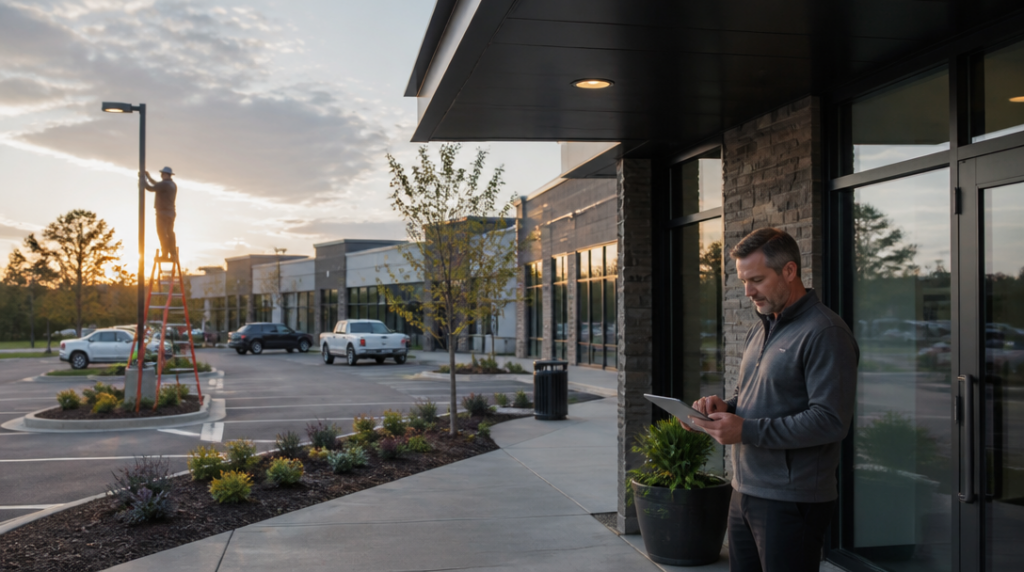
A small office tenant may see maintenance as a few hundred dollars added to the monthly rent. A retailer or industrial operator may view the same line item as a major annual expense that affects every pricing decision. Both impressions can be accurate. Commercial property lease maintenance costs vary sharply with the building type, location, lease structure, and responsibilities assigned to each party.
The most common charge is CAM, short for common area maintenance. It covers the shared parts of a property: parking lots, landscaping, corridors, lobbies, elevators, security, snow removal, lighting, cleaning, and repairs. In a multi-tenant building, these costs are usually divided among tenants according to the space they occupy. A tenant leasing 10% of the property may pay roughly 10% of eligible shared expenses, although the exact formula depends on the lease.
For offices and retail properties, CAM commonly runs from about $5 to $20 per square foot per year. Industrial properties tend to be less expensive, often around $1 to $5 per square foot annually, because they generally have fewer shared amenities and less elaborate common space. A basic warehouse with a large parking area can still produce a meaningful bill, but it usually does not carry the same maintenance profile as a polished downtown office tower.
A broader typical CAM range in the United States in 2026 is approximately $3 to $12 per square foot per year, depending on the property type and location. That range is useful for early budgeting, but it is not a substitute for reading the lease. A building with modest base rent can have unusually high operating expenses, while a more expensive property may include certain services in the quoted rent.
Consider a 1,000-square-foot commercial unit. At a CAM rate of $5 to $12 per square foot, the annual charge would be $5,000 to $12,000. That works out to roughly $417 to $1,000 per month, before considering other pass-through expenses. For a small business, the gap between those two figures is not a technical detail. It can determine whether the premises fit comfortably within the operating budget.
The lease structure often matters more than the word “maintenance” suggests. Under a gross lease, the landlord typically absorbs many operating expenses, although the tenant may still pay for utilities, repairs inside the premises, or increases above a defined expense base. A modified gross lease divides responsibilities in its own way. Under a triple-net, or NNN, lease, the tenant generally pays base rent plus property taxes, building insurance, and maintenance costs.
NNN expenses commonly add about $3 to $9 per square foot per year to the base rent for maintenance, insurance, and taxes. That amount can sit beside the advertised rent and make the first quote look deceptively attractive. A listing might highlight a base rent of $20 per square foot, but the effective occupancy cost may be considerably higher once the three net charges are added.
Property taxes are especially powerful in the calculation. In areas with high commercial tax burdens, the tax portion alone can reach $4 to $6 per square foot annually. That means a tenant may face a substantial increase even if the building’s landscaping, cleaning, and repair costs remain stable. Taxes are not usually something the landlord can simply eliminate through better maintenance management, so tenants should examine the tax history and the lease language governing increases.
Insurance can move as well, particularly in markets exposed to severe weather or other property risks. Maintenance contracts may rise when labor, materials, or energy become more expensive. A landlord may pass these increases through the operating expense statement, provided the lease allows it. The result is a bill that changes from year to year rather than staying fixed for the full lease term.
One expense that deserves close attention is the property management fee. A common management charge is about 3% to 5% of operating expenses. Some contracts charge 10% to 15%, which is above the usual market range. The percentage may appear small on paper, but it becomes substantial when applied to a large expense pool. A tenant should check whether the fee is calculated on actual costs, estimated costs, or a broader category that includes items such as capital work.
That distinction matters because not every building expense is ordinary maintenance. Replacing a roof, installing a new elevator, resurfacing a parking deck, or upgrading a major mechanical system may be treated as a capital expense. Some leases exclude capital improvements entirely. Others allow the landlord to pass them through over the useful life of the improvement, while a few permit broader recovery. The language can turn a one-time project into a recurring charge on the tenant’s statement.
A reasonable lease should make the accounting understandable. Look for definitions of operating expenses, exclusions for the landlord’s own costs, rules for capital expenditures, and a process for reviewing annual reconciliations. Administrative charges, legal fees, financing costs, costs caused by another tenant, and expenses related to correcting the landlord’s negligence may receive different treatment under different contracts. Those details are not decorative legal wording; they determine which invoices eventually reach the tenant.
The estimated monthly charge also deserves scrutiny. Landlords often collect estimated CAM or operating expenses throughout the year and reconcile the account later against actual costs. If actual expenses are higher, the tenant receives a bill for the difference. If they are lower, the tenant may receive a credit. A low estimate can make a property appear affordable during lease negotiations, only for the reconciliation to produce an unpleasant surprise months later.
This is where a simple spreadsheet can be more revealing than a glossy leasing brochure. Put base rent, CAM, taxes, insurance, utilities, management fees, and any known repairs in separate columns. Then model a conservative increase in variable expenses rather than assuming every line will remain flat. I have seen people spend more time comparing carpet colors than asking how a parking lot repair will be allocated, even though the parking lot has a much greater effect on the budget.
Tenants should also separate shared-area costs from expenses inside their own premises. A retail tenant may be responsible for its storefront, glass, doors, plumbing fixtures, and interior systems. An office tenant may pay for janitorial service, HVAC repairs, or after-hours heating and cooling. In an industrial building, the tenant may carry responsibility for loading areas, specialized equipment, or systems tied directly to its operations.
The physical condition of the property changes the risk profile. A newer building may have lower repair needs, but it can still carry substantial taxes, insurance, landscaping, or amenity costs. An older building may offer attractive rent while requiring more frequent work on the roof, elevators, plumbing, or mechanical equipment. Age alone does not settle the question. Maintenance records, recent capital projects, and the allocation language in the lease tell a more useful story.
Location plays a similar role. A suburban warehouse with limited shared space may sit near the low end of the CAM range. A central retail property with extensive landscaping, security, parking management, and customer-facing common areas can sit much higher. Office buildings with staffed lobbies, elevators, conference facilities, and shared amenities may also produce larger operating expense bills than a plain commercial unit.
The safest way to compare properties is to compare total occupancy cost, not base rent. Ask for the latest operating expense statement, the current estimate, and an explanation of unusual increases. Check whether taxes and insurance are included in the quoted CAM number or billed separately. Confirm whether the quoted figure is an annual amount per square foot, a monthly amount, or a projected total for the entire premises.
For a 1,000-square-foot unit, a difference of a few dollars per square foot can add thousands of dollars each year. Across a large office, retail store, or warehouse portfolio, the same difference becomes a serious operating expense. The maintenance line may look ordinary, but its real cost is hidden in the property’s design, the local tax environment, and the lease clauses that decide who pays when something breaks.