
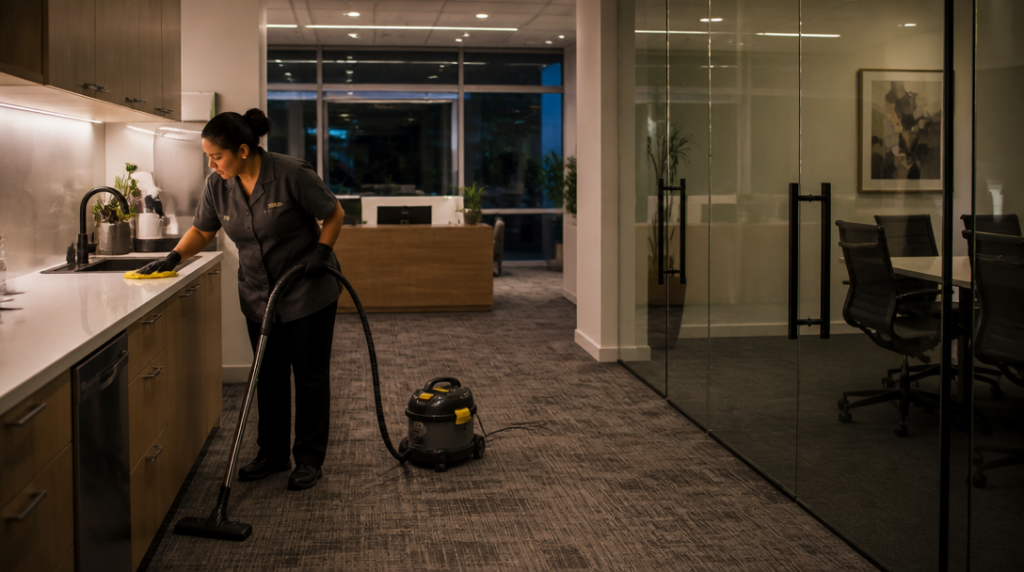
At 6:30 p.m., the office is finally quiet. The last employee has left a coffee cup beside the printer, fingerprints cover the glass conference-room door, and crumbs have gathered beneath the break-room table. A cleaner arrives with a vacuum, a mop, and a short window in which to make the place presentable before everyone returns the next morning.
That visit might cost $100. It might cost several hundred. In a large office with specialized requirements, it could be far more. Commercial office cleaning has no single price tag because the bill reflects more than square footage. Frequency, staffing, floor surfaces, restrooms, supplies, security procedures, and the standard of cleanliness expected by employees and clients all shape the quote.
In the United States, commercial office cleaning in 2026 generally costs about $0.08 to $0.20 per square foot per visit. That figure is useful as a starting point, but it is not a promise. A company cleaning a lightly used office twice a week is solving a different problem from a crew maintaining a busy workplace every evening.
The realistic price range for a cleaning visit
A single commercial cleaning visit commonly falls between $70 and $1,500. The range is wide because “office cleaning” can describe anything from a quick service in a small suite to a coordinated operation across a sizable commercial floor.
At the lower end, a cleaner may vacuum, empty bins, wipe visible surfaces, and handle a small restroom. At the upper end, several workers may be responsible for multiple floors, kitchens, restrooms, glass partitions, high-traffic entrances, and detailed touchpoint cleaning. The work may also include moving light furniture, restocking consumables, or following strict access and safety procedures.
Hourly pricing offers another way to view the market. Commercial cleaners commonly charge between $20 and $90 per hour. A low hourly rate does not automatically mean a cheap final bill, just as a high rate does not guarantee exceptional work. The real question is how long the team needs to meet the agreed standard and how much labor the company assigns to the job.
A vague request such as “make the office clean” invites vague pricing. A detailed scope—floors vacuumed, desks wiped, bins emptied, restrooms disinfected, kitchen surfaces cleaned—gives both sides something measurable.
What a typical office pays each month
For many offices, recurring cleaning costs roughly $200 to $2,000 per month. Small offices with limited traffic may remain near the lower end, especially if service is scheduled once or twice a week. Larger workplaces, offices with several restrooms, and businesses that need frequent evening visits can move toward the upper end quickly.
One useful example is a 2,500-square-foot office cleaned three times a week. A typical monthly price falls around $800 to $1,500. That is a substantial range for a workplace that may look relatively modest on a floor plan, but three weekly visits create a regular labor commitment. The office is not paying for one dramatic deep clean. It is paying to prevent dirt, waste, and clutter from accumulating between visits.
This is where office managers can misread quotes. A monthly price may look expensive beside the cost of buying cleaning products and asking employees to tidy up. Yet those are not equivalent arrangements. Employees can wipe their own desks, but they are unlikely to clean restrooms consistently, maintain floors, sanitize shared touchpoints, or take responsibility for the quality of the entire workplace.
The more uncomfortable question is whether the office needs professional cleaning every day—or whether management is simply afraid to reduce a service that nobody has measured properly.
That question deserves an honest answer.
Why the cheapest quote can become expensive
Price comparisons often fail because competing cleaners are not quoting the same job. One proposal may include supplies, labor, insurance, quality checks, and regular restroom service. Another may cover only vacuuming and trash removal. The cheaper document wins on paper because it quietly leaves work out.
Flooring is a common source of confusion. Carpet, tile, polished concrete, and hardwood each demand different equipment and time. A carpeted office may need routine vacuuming but occasional extraction. Hard floors may require mopping, edge work, or periodic treatment. These extra services are not always part of the standard recurring visit.
Restrooms also change the economics. A small private office with one bathroom is not comparable to a busy workplace with several restrooms used throughout the day. Kitchens and break rooms create their own workload, particularly when food residue, overflowing bins, and shared appliances are involved.
Security can affect cost as well. Cleaning before or after business hours may require keys, access codes, alarm procedures, or an on-site contact. Offices that handle sensitive materials may need additional screening or tighter restrictions on where cleaners can work. None of that appears in a square-foot measurement, but it can influence the quote.
A serious proposal should explain what happens during a standard visit and what is excluded. If the provider cannot describe the work clearly, a low price may be little more than an incomplete promise.
Add-on services can change the bill
Routine cleaning is only part of the budget. Carpet cleaning, window washing, and disinfection of high-touch surfaces can add approximately $150 to $2,500 to the total cost, depending on the scale and complexity of the work.
These services are usually periodic rather than part of every visit. A company might schedule carpet cleaning after months of heavy traffic, arrange interior window washing before an important event, or request extra disinfection when illness has moved through the workplace. A quote that includes all of these tasks can look dramatically higher than a basic maintenance contract, even though the two packages are designed for different purposes.
The timing matters. Adding every possible service to a recurring contract may create a bloated monthly bill. Ignoring them entirely can leave the office looking neglected and force management into expensive emergency work later. A better arrangement separates routine maintenance from occasional projects and states how often each one is expected.
How to judge a commercial cleaning quote
Start with the area that actually needs service, not the total size of the building. A tenant may occupy 5,000 square feet but use only part of it every day. Conversely, a smaller office with a crowded reception area, heavily used kitchen, and constant client traffic may need more attention than its size suggests.
Then define frequency. Once-weekly cleaning, three visits a week, and nightly service are not minor variations. They create different labor schedules and different expectations about what the office should look like each morning.
Ask whether the price includes cleaning chemicals, paper products, equipment, and disposal fees. Find out whether the same crew will usually handle the office, how missed visits are treated, and who checks the work. These questions are not bureaucratic details. They reveal whether the provider has a functioning operation or is simply selling access to a person with a mop.
It is also sensible to separate appearance from hygiene. A desk-free showroom may look spotless while shared keyboards, door handles, faucet levers, and refrigerator doors receive little attention. If the office has public-facing staff or a large workforce, touchpoints may deserve more attention than surfaces that merely photograph well.
The best quote is rarely the cheapest one. It is the one that makes the promised level of cleanliness specific enough to challenge.
A practical budget for different office types
A very small office with light use may fit within the lower part of the general $200-to-$2,000 monthly range. A growing office with several weekly visits could land in the middle. A larger workplace with frequent service, multiple restrooms, varied flooring, and periodic deep cleaning may exceed $2,000 without anything unusual happening.
For a 2,500-square-foot office cleaned three times weekly, the $800-to-$1,500 monthly range provides a grounded planning figure. It should not be treated as a fixed national rate. Local labor costs, the condition of the premises, and the exact scope can push a quote outside it.
The per-visit estimate of $0.08 to $0.20 per square foot is similarly best used as a benchmark rather than a calculator that settles every negotiation. Different contracts bundle labor and services in different ways, and recurring arrangements may not line up neatly with a simple one-visit formula.
That messy variation is not a flaw in the market. It is a reminder that office cleaning is a labor service disguised as a measurement exercise. Square footage starts the conversation, but the daily behavior of the people inside the office usually determines how much work the cleaner must actually do.