
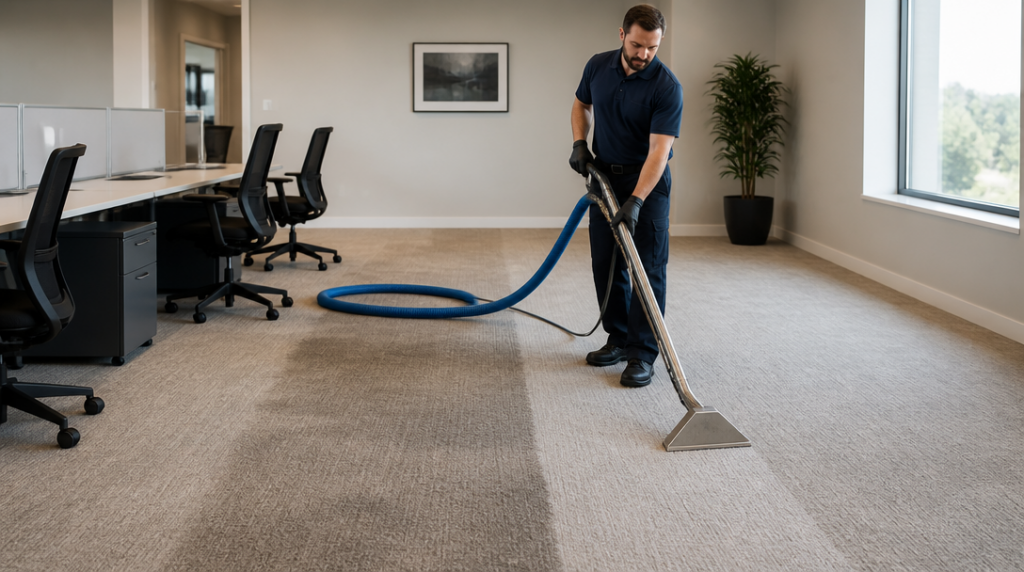
A 5,000-square-foot office can produce a cleaning quote anywhere from $750 to $2,500. That wide range is normal. The price depends less on the square footage alone than on how dirty the carpet is, which cleaning method the contractor uses, and how much preparation the job requires.
For commercial properties in the United States, carpet cleaning in 2026 generally costs about $0.15 to $0.50 per square foot. A lightly soiled office with clear access may sit near the lower end. Heavy traffic lanes, stains, furniture, and difficult scheduling can push the price higher.
Typical commercial carpet cleaning prices
A standard office usually falls in the range of $0.18 to $0.38 per square foot, depending on the level of soiling. This range covers many routine jobs, especially in offices that receive regular cleaning and do not have years of built-up grime.
At $0.18 per square foot, a 5,000-square-foot office would cost about $900. At $0.38 per square foot, the same space would cost roughly $1,900. Those figures are useful for planning, but they do not replace a written quote because contractors may measure usable carpet differently or add charges for preparation and access.
A larger 10,000-square-foot office commonly costs around $1,500 to $5,000. The lower figure reflects a relatively efficient, lightly soiled job. The upper figure is more plausible when the carpet needs intensive treatment or the building creates logistical problems.
Many companies also set a minimum charge of about $200 to $300 per visit. This matters to smaller offices, retail units, and individual suites. A contractor may calculate the job at a low per-square-foot rate but still bill the minimum because the crew, equipment, travel, and setup make a very small visit uneconomical.
Extraction cleaning versus low-moisture cleaning
The cleaning method has a direct effect on the price and the time required before employees can use the space again.
Extraction cleaning usually costs about $0.15 to $0.50 per square foot. The process applies cleaning solution, agitates the carpet, and removes soil and moisture with powerful equipment. It is often chosen for carpets with substantial dirt, visible stains, or long-neglected traffic areas.
The main drawback is drying time. A business may need to limit access to the cleaned areas until the carpet is sufficiently dry. That can be awkward in a busy office, particularly when corridors, entrances, or shared workspaces are involved.
Low-moisture cleaning generally costs less, at about $0.06 to $0.25 per square foot. It uses much less water and can be practical for routine maintenance, lightly soiled carpet, and workplaces that cannot remain closed for long.
The lower rate does not automatically make low-moisture cleaning the better choice. A carpet with deeply embedded soil may need a more intensive process, and trying to save money with a light method can leave the property owner paying for another treatment sooner than expected. Cleaning a neglected carpet with low-moisture equipment can be a bit like dusting a muddy boot.
What changes the final quote?
The first factor is carpet condition. Dirt accumulates most quickly in entrances, hallways, elevators, break rooms, and areas near desks. A contractor may charge a uniform rate for the whole property, or may price heavily soiled sections separately when they require extra passes, pre-treatment, or stain removal.
Furniture is another common cost driver. Moving chairs and small tables may be included in the quoted price, while moving desks, filing cabinets, display cases, or other heavy items may cost extra. Public commercial price schedules show extraction rates around $0.09 to $0.30 per square foot in some cases, rising to approximately $0.15 to $0.79 per square foot when furniture must be moved.
Access can matter as much as the carpet itself. Multiple floors, narrow elevators, long corridors, restricted loading areas, and limited parking all add labor to a job. A large open office is usually easier to clean than a smaller building divided into many rooms.
The timing of the work can affect the quote as well. Evening, overnight, weekend, and emergency appointments may require additional labor or scheduling costs. A business that can give the crew clear access during normal service hours may receive a more efficient price.
Stain treatment is often handled separately. Coffee, grease, ink, gum, pet accidents, and tracked-in outdoor soil may require different chemicals or repeated treatment. A contractor should explain whether stain removal is included, billed by area, or charged according to the time involved.
How to estimate the cost yourself
Start with the carpeted area rather than the total size of the building. If an office occupies 8,000 square feet but half the space has hard flooring, the contractor should not charge the full building area for carpet cleaning.
Multiply the carpeted square footage by a realistic rate. For example, 5,000 square feet at $0.15 per square foot equals $750, while the same area at $0.50 equals $2,500. If the calculation falls below the contractor’s $200 to $300 minimum, the minimum charge will usually control the invoice.
Then allow for services that may not be included in the base rate. Ask about furniture moving, stairs, spot treatment, deodorizing, protective treatments, travel, and after-hours work. These details can turn an apparently inexpensive quote into a much larger bill.
A useful quote should state the measured carpet area, cleaning method, price per square foot or flat project price, minimum charge, included preparation, expected drying time, and any extra fees. Vague wording such as “commercial carpet service” does not tell you enough to compare contractors fairly.
Why two contractors may quote very different amounts
One company may use low-moisture cleaning for routine maintenance, while another recommends extraction cleaning because the carpet is heavily soiled. Both may be acting reasonably, but they are not pricing the same service.
Measurement practices can differ too. Some contractors estimate the total carpeted area from a floor plan. Others inspect each room and exclude areas covered by permanent fixtures or furniture. Small differences are expected, but a major gap deserves an explanation.
Equipment and labor also shape the price. A crew handling a large open floor may work quickly with commercial equipment. A smaller team working around furniture, partitions, and occupied rooms faces a slower process even when the total square footage is modest.
The cheapest quote can be misleading if it excludes the work that makes the result acceptable. A low base rate followed by separate charges for pre-spray, spot treatment, furniture moving, and travel may cost more than a higher all-inclusive quote.
Ways to control the cost
Regular cleaning usually keeps the price more predictable. Carpet that receives routine attention generally requires less aggressive treatment than carpet cleaned only after traffic lanes become dark and stains are obvious. Scheduled maintenance can also reduce the amount of furniture and equipment that must be dealt with during a major restoration-style visit.
Clear the area before the crew arrives when the contract allows it. Removing small personal items, wastebaskets, boxes, and lightweight chairs can reduce labor and help cleaners reach more carpet. Larger furniture should be moved only if the contractor confirms that it is safe and included in the plan.
Group work into one visit when possible. Cleaning several suites, floors, or nearby locations together may make the minimum charge less significant, although the contractor still needs to confirm how the combined areas will be priced.
Ask for a method suited to the carpet’s actual condition rather than requesting the most powerful treatment by default. Lightly soiled carpet may not need full extraction, while badly soiled carpet may not respond well to the cheapest maintenance process.
The best comparison is not between two numbers at the bottom of separate estimates. It is between two clearly described scopes of work: the same carpet area, the same cleaning method, the same preparation, and the same expectations for drying and stain treatment.