
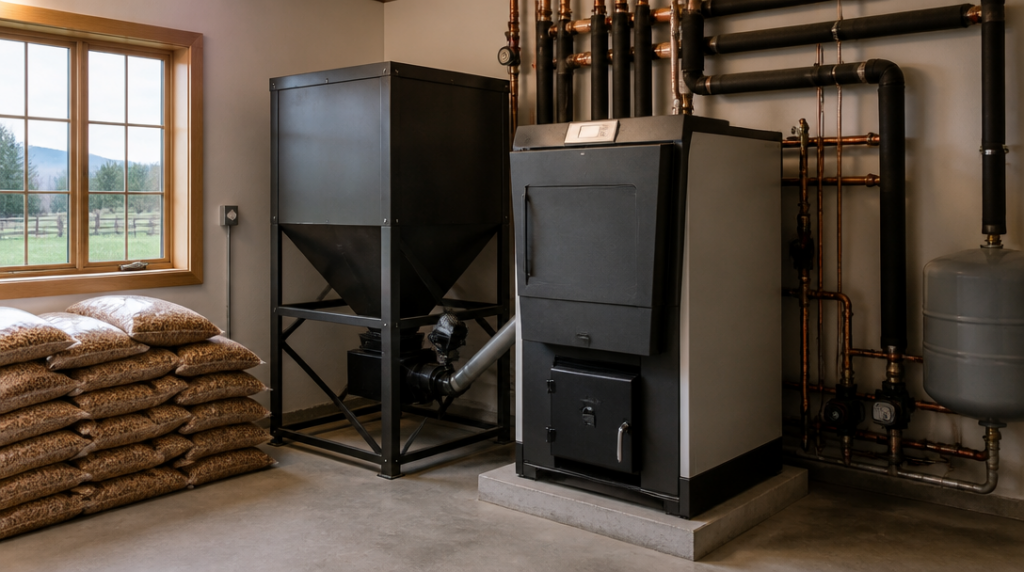
A biomass boiler installation in the United States can cost $60,000 or more, and that figure is not reserved for factories. For a larger home or a small commercial building, a realistic installed budget in 2026 is often between $30,000 and $50,000.
That is a very different proposition from replacing a conventional boiler. I would not approach biomass heating as a simple equipment swap, because the boiler is only one part of the system. Fuel storage, delivery equipment, controls, ventilation, flue work, electrical connections, permits, and site preparation can all change the final bill.
Across the U.S., the broad price range for a complete residential biomass boiler installation is roughly $12,000 to $60,000. Smaller or less complicated systems may sit near the lower end. Larger homes, demanding heating loads, difficult access, and premium turnkey packages push the cost upward. Some fully finished systems exceed $60,000.
The number that matters most is not the price printed on a boiler listing. It is the cost of getting a working heating system into the building and keeping it supplied with fuel.
What a Residential Biomass Boiler Installation Usually Includes
A basic installation quote may cover the boiler, labor, connection to the existing heating system, and the flue. That does not guarantee that the quote includes every part needed for daily operation. Biomass equipment generally needs somewhere to store pellets, chips, or another solid fuel, along with a method for moving that fuel into the combustion chamber.
The storage arrangement can be modest or substantial. A homeowner might have room for a relatively compact pellet hopper, while another property may require a separate storage room, outdoor bunker, or delivery system. Creating that space can involve concrete work, structural changes, weatherproofing, or excavation. Each addition moves the project further away from the lower end of the price range.
The boiler's output is another major factor. A small, efficient unit for a well-insulated home will not cost the same as a larger system designed to heat an older property with several buildings. Oversizing the boiler is not a clever way to create extra capacity; it can lead to inefficient operation and unnecessary expense. A proper heat-load assessment is one of the least exciting parts of the project, but it can prevent a very expensive mistake.
Installation labor in the U.S. varies widely by boiler type and project complexity. For a conventional boiler installation, labor and related installation work can range from about $600 to $12,000, with an average of roughly $5,912. Biomass projects often demand more work than a straightforward gas or electric replacement because the installer may need to handle fuel storage, ash removal arrangements, specialized controls, and larger flue requirements.
Permits usually add another $150 to $300. That is a relatively small part of the overall budget, although permit requirements vary by location and the total may be higher if several approvals are needed. I would treat permitting as a planning question rather than an afterthought. Discovering that a proposed boiler room needs additional ventilation or fire protection after the equipment has been ordered is a miserable way to spend money.
The chimney or flue can become a surprisingly large cost. An existing flue may be unsuitable for the new appliance, especially if its dimensions, lining, or condition do not meet the requirements of the biomass boiler. A new flue, modifications to the chimney, and roof or wall penetrations all add labor. The same applies to electrical work, pumps, buffer tanks, and changes to radiators or underfloor heating circuits.
A quote that looks inexpensive may simply leave more of these elements outside the headline price. I tend to read installation estimates from the bottom upward: first checking what is excluded, then looking at the equipment price. That habit is less glamorous than comparing brochures, but it gives a much clearer sense of the real budget.
Fuel costs and maintenance should sit beside the installation cost in the planning process, although they are not part of the initial purchase. Biomass boilers need regular ash removal and servicing, and the owner needs a dependable fuel supply with enough storage to avoid frequent deliveries. A system can be economical to run and still be inconvenient if the storage area is too small or deliveries are difficult in winter.
Why Commercial and Industrial Systems Cost So Much More
Small commercial biomass systems can begin below $50,000, but the range expands quickly. A system for a workshop, agricultural building, office, or small institution may need more heating capacity than a house, along with larger fuel storage and more robust controls. The installation may also need to integrate with existing commercial heating equipment rather than replace it completely.
Industrial biomass boilers occupy a different financial category. Equipment and installation can cost approximately $18,000 to more than $350,000, depending on output, automation, fuel-handling requirements, and emissions filtration. A small industrial installation may stay near the lower end, while a fully automated plant with advanced filtration can exceed $300,000.
The boiler itself is only the visible centerpiece. Industrial systems may include conveyors, metering equipment, large storage silos, automated ash handling, heat exchangers, control systems, and emissions equipment. The site may require foundations, reinforced access areas, new pipework, electrical upgrades, and extensive commissioning. At that scale, a low equipment price tells me very little about the final project cost.
Automation has a particularly noticeable effect. Manual loading can make sense for a small operation with available staff and modest fuel demand. It becomes impractical when the system must run continuously or serve a large facility. Automated fuel feeding, monitoring, cleaning, and ash removal reduce daily labor, but they add equipment and installation complexity upfront.
Emissions control can produce another substantial jump. The required setup depends on the fuel, boiler design, operating conditions, and applicable rules. A system with more sophisticated filtration costs more than a basic unit, yet industrial buyers may have little choice if the installation must meet stricter emissions requirements. Designing the plant around those requirements from the beginning is usually less painful than trying to retrofit them later.
The building itself can dictate the budget. A new facility designed around biomass heating may accommodate fuel deliveries and storage efficiently. An older site may have no suitable boiler room, limited access for heavy equipment, or insufficient space for fuel handling. In that situation, construction and logistics can rival the cost of the boiler.
I have always thought biomass heating makes the most sense when the building, fuel supply, and operating routine are considered as one system. A cheap boiler installed in the wrong room is not a bargain; it is an awkward centerpiece that creates problems every time fuel arrives or ash needs to leave.
For a homeowner, the sensible first step is to request a detailed quote based on the building's heat demand and the intended fuel. The estimate should identify the boiler, storage, flue, controls, pumps, electrical work, labor, permits, commissioning, and any changes to the existing heating system. For a commercial or industrial buyer, the same principle applies at a larger scale, with fuel handling and emissions equipment given their own line items.
A residential project may fit within $12,000 to $60,000, with many larger homes and light commercial buildings landing around $30,000 to $50,000. Premium turnkey systems can move beyond that range. Industrial installations start at a much lower price than the largest plants, but automation, filtration, and capacity can take the total past $350,000. The distance between those figures is not mysterious; it is built from the practical machinery required to turn solid fuel into dependable heat.