
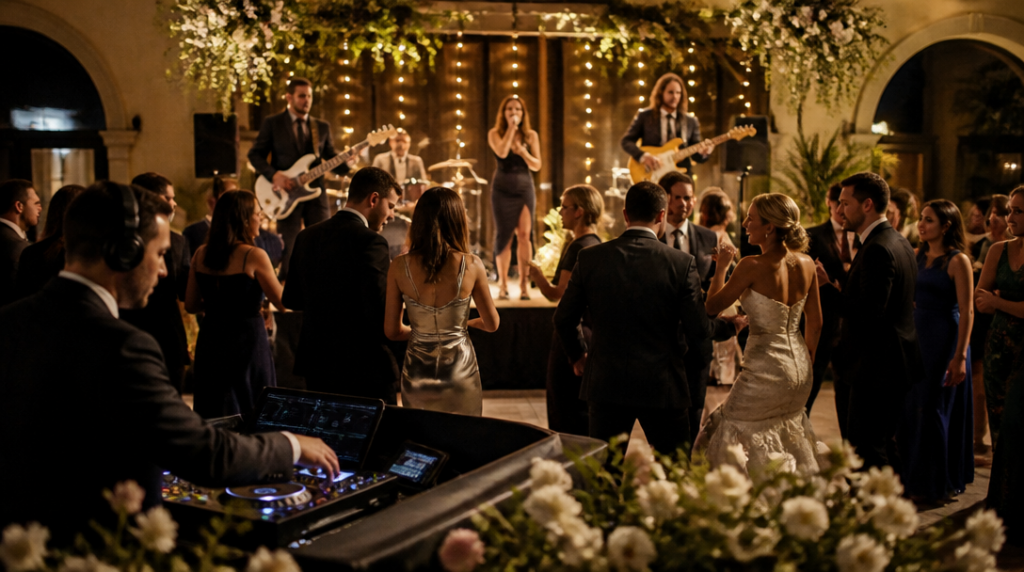
The room is ready, dinner plates have been cleared, and your guests are sitting with the familiar hesitation of people waiting for something to happen. Then the DJ raises the volume, the first beat lands, and suddenly half the room is on the dance floor. A live band can create the same shift with a different kind of electricity: real musicians, visible energy, and a sound that feels built for the room.
Music is one of the biggest decisions in a wedding reception budget. It is also one of the few expenses guests experience for several hours, rather than simply seeing in photographs. A DJ usually costs far less than a live band, but the final price depends on far more than pressing play or showing up with instruments.
The average cost of a wedding DJ
A recent U.S. wedding-cost study based on 10,474 couples who married in 2025 puts the average wedding DJ price at $1,800. That figure generally reflects professional reception services rather than a friend handling a playlist from a laptop.
A DJ may guide the evening as an emcee, announce the wedding party, introduce dinner and speeches, coordinate key moments with the venue, and keep the dance floor moving. Those responsibilities are part of what couples are paying for. The music itself is only one piece of the job.
Another major wedding pricing survey reports a lower average of $1,000 for a DJ. The difference between the two figures is a useful warning: there is no single standard price across the country. Location, experience, event length, equipment, and the scope of the package can all move the quote considerably.
A DJ who arrives with a compact setup for a short reception is offering something different from a seasoned entertainer bringing multiple sound systems, wireless microphones, dance-floor lighting, and a detailed planning process. Both may call themselves wedding DJs. Their invoices will not look alike.
The average cost of a live wedding band
Live music sits in a different part of the budget. The same study places the average cost of a wedding band at $4,500, making a band about $2,700 more expensive than a DJ and roughly two and a half times the price.
The lower average from the other major wedding pricing survey is $2,050. Its typical reported range stretches from $489 to $5,720, showing just how wide the live-music market can be. A small local group playing a limited set is not comparable to a full-service wedding band with several performers, an emcee, a sound engineer, and hours of live entertainment.
Band size is often the first obvious price difference. A trio has fewer people to pay, fewer instruments to transport, and usually a simpler stage setup. A larger group creates a fuller sound and more visual impact, but every additional performer can affect fees for labor, travel, meals, setup, and breakdown.
The style of music matters, too. A group specializing in a narrow genre may have a very different business model from a versatile wedding band expected to move between soul, pop, rock, country, and classic dance music throughout the night. Some bands also bring professional production equipment, while others expect the venue to provide much of it.
Why a DJ is usually cheaper
A DJ can cover an entire reception with one primary performer and a carefully prepared music library. That makes the basic operation more efficient than hiring several musicians, even before the costs of instruments, rehearsals, transportation, and stage equipment enter the picture.
A strong DJ also offers something a band cannot always match: instant access to thousands of recorded tracks. If your guests suddenly want a particular dance song, a decade-spanning throwback, or an obscure favorite, the DJ may be able to play it immediately. A band has to work within its repertoire and arrangement choices.
That flexibility does not make a DJ automatically better. It simply makes the service easier to scale. A couple with a tight budget can often spend less on a DJ and still get music for the ceremony, cocktail hour, dinner, and reception, depending on the package.
The least expensive DJ quote is not necessarily a bargain, though. Ask what equipment is included, whether setup and teardown are covered, how many hours of service you receive, and who will actually perform at the wedding. A low price can become less appealing if basic items appear later as add-ons.
What makes a live band worth the extra money
A live band changes the atmosphere before the first song is finished. Guests watch performers react to the room, and a good singer or bandleader can turn a familiar song into a shared moment rather than background audio. That presence is the main reason couples accept the higher price.
Bands can also create a distinctive identity for the reception. A funk group, jazz ensemble, string quartet, or high-energy cover band gives the evening a sound that feels more personal than a general playlist. Even guests who do not dance may pay attention when the performance itself becomes part of the entertainment.
The trade-off is musical range. Most bands do not perform every song exactly as recorded, and they may take breaks between sets. Many couples solve that gap by using a DJ, playlist, or recorded music during breaks, cocktail hour, or portions of the dinner service.
Some bands offer this as part of their package. Others charge separately or require the couple to arrange it. The contract should make that distinction clear before the deposit is paid.
Extra charges that can change the quote
The headline price rarely tells the whole story. Travel is an obvious variable, especially for a band bringing several performers and a large amount of equipment. A venue with difficult loading access, stairs, limited parking, or strict setup windows can also create additional labor requirements.
Reception length matters as well. A band may quote one price for a set number of performance hours and another for the time needed to remain on site. A DJ may have separate rates for ceremony audio, cocktail-hour music, overtime, or an additional sound system in another part of the venue.
Lighting is another detail worth asking about. Some entertainers include dance-floor lighting, uplighting, or a basic effect package. Others treat lighting as a separate service. A dramatic room can require more equipment and more setup time than a simple speaker-and-microphone arrangement.
Special song requests can carry a fee for live musicians. The survey that recorded the $489-to-$5,720 band range found that 24 percent of bands charge extra to learn new songs. That cost may be perfectly reasonable if the band has to arrange, rehearse, and perform a song outside its usual repertoire, but couples should discover it before submitting a long request list.
Ceremony music can bring another layer of planning. The sound requirements for a ceremony are often different from those for a reception, particularly if the ceremony takes place outdoors or in a separate space. A band may not be the practical choice for every part of the day, while a DJ can sometimes provide multiple audio setups with less complexity.
How to compare DJ and band packages
Start with the experience you want guests to remember. If the reception should feel like a concert, a live band may justify the larger investment. If you want a broad playlist, smooth transitions, and a host who can manage announcements, a DJ may fit the event better.
Then compare contracts rather than just prices. Check the number of performers, performance and service hours, sound equipment, microphones, lighting, setup, breakdown, travel, overtime, breaks, meals, cancellation terms, and backup plans. A quote that looks higher may include services another vendor lists separately.
Pay attention to the person running the room. A DJ is not simply a human music app, and a band is not automatically a good emcee. Ask how the entertainer handles awkward pauses, delayed dinner service, a packed dance floor, or a schedule that slips by twenty minutes. Weddings rarely run exactly on time.
For bands, listen to live recordings rather than relying only on polished promotional clips. Look for performances with the full lineup and a sound similar to what you are considering. For DJs, ask for examples of their mixing style and emcee work. Some keep announcements crisp and unobtrusive; others make themselves a central part of the show.
A practical way to set the budget
Using the national averages as a starting point, a DJ budget of around $1,800 and a live-band budget of around $4,500 reflect the broad gap many couples will encounter. The lower reported averages of $1,000 for DJs and $2,050 for bands show why local quotes matter more than any single national figure.
Set aside room for the details that matter most to your venue and schedule. A couple planning a short reception in one location may need a very different package from one hosting an outdoor ceremony, cocktail hour, dinner, and late-night dancing across several spaces.
Music is one of those wedding decisions that reveals itself in real time. A centerpiece may look perfect in a photograph, but the band or DJ is working while everyone else is laughing, eating, dancing, and making memories. The right choice is the one that gives the evening its pulse without leaving you staring at the final invoice in disbelief.