
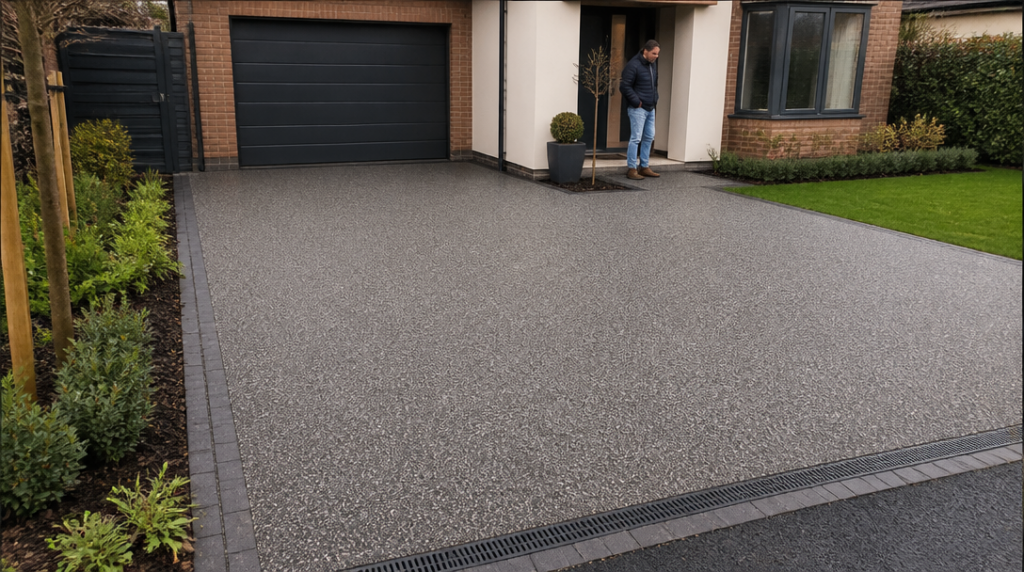
A homeowner measures the front drive at 40 square metres, imagines a smooth amber-and-grey resin surface, and starts doing the maths. At first, the project looks manageable. Then the installer asks about the existing base, drainage, edging and access, and the estimate shifts noticeably.
That is the central issue with resin driveway pricing: the visible surface is only part of the job. In the UK, a resin-bound driveway costs approximately £90–£160 per square metre in 2026, including installation. A 40 m² driveway therefore sits in a broad top-line range of roughly £3,600 to £6,400, although other estimates for the same size project can be lower when the work is priced by its exact scope.
The surface price is only the starting point
Resin-bound surfacing is made by combining resin with aggregate and spreading the mixture over a suitable base. The finished surface has a relatively clean, continuous appearance, without the loose-stone movement associated with ordinary gravel. It is the kind of driveway that can make an untidy front garden look instantly more deliberate.
The installation rate changes sharply depending on what is already beneath the driveway. If the existing base is sound and prepared for the new surface, installation is estimated at around £40–£70 per square metre. For a 40 m² area, that works out at approximately £1,600–£2,800 before any major reconstruction of the base.
A new sub-base adds roughly £25–£45 per square metre. Across 40 m², that is another £1,000–£1,800. A simple calculation therefore places surface installation plus a new base at about £2,600–£4,600, which is a useful working range for a typical 40 m² driveway requiring full preparation.
These figures do not contradict the broader £90–£160 per m² range. They describe different pricing approaches and different levels of work. A contractor may quote a narrower rate for a straightforward installation, while a wider market estimate may allow for more expensive materials, additional preparation or a more demanding site. The written quotation matters more than a headline rate.
Why a 40 m² driveway can produce very different quotes
Two drives with identical measurements can require completely different amounts of labour. One may have a stable tarmac or concrete base that needs cleaning, repairing and priming. Another may have cracked paving, soft ground or an uneven surface that must be removed before the new construction begins.
The base is not a minor technical detail. Resin-bound surfacing needs a firm, stable foundation. If the underlying structure moves, the finished surface can crack or fail, regardless of how attractive the aggregate looked on installation day. A contractor assessing the site will usually look for signs of settlement, standing water, damaged paving and weak edges.
Drainage can add another layer of work. Water must have somewhere to go, and changes to the driveway’s slope or drainage arrangements may affect the design and cost. Edging also matters. Existing kerbs may be usable, while some projects need new brick, stone or concrete borders to contain the surface and create a clean transition to paths or lawns.
Access affects labour as well. A front garden with direct access from the road is easier to clear and prepare than a site where materials must be moved through a narrow passage. Removing an old driveway, disposing of broken material and working around walls, gates or planted areas can all push the final quotation above a basic per-square-metre calculation.
Comparing the cost of different driveway sizes
The most useful way to understand the scale of the expense is to compare common areas. Indicative figures put a 20 m² resin driveway at about £2,800, a 50 m² driveway at around £6,000 and a 100 m² driveway at approximately £10,000.
The figures do not rise in a perfectly straight line. A small driveway can still carry fixed costs for delivery, preparation, equipment and labour, so its price per square metre may be relatively high. A larger project spreads some of those costs across more surface area, although it may require substantially more excavation, materials and construction time.
That is why a 20 m² drive should not simply be priced by taking the 100 m² figure and dividing it by five. The smaller job may have awkward access or require the same site visit, preparation work and finishing details. Conversely, a large, open site with an excellent existing base may be more efficient to install than a smaller but complicated driveway.
For a homeowner planning a 40 m² project, the practical comparison is between a prepared-base installation at roughly £1,600–£2,800 and a more complete job in the region of £2,600–£4,600 when a new base is included. The wider 2026 market range of £3,600–£6,400 reflects the fact that many real projects include more than those two simple stages.
The details that push the quotation upwards
The aggregate and resin colour affect the appearance and can affect the price, particularly if the chosen finish uses less common materials or a more complex blend. Darker, lighter and mixed-colour finishes can create very different effects in changing weather; a pale surface may make a small frontage feel larger, while a heavily speckled blend can disguise everyday dirt more effectively.
The area’s shape is just as relevant as its size. A rectangular drive is relatively easy to measure and lay. Curves, narrow strips and several small sections take more time to edge and finish. A driveway that wraps around the side of a house may have the same total area as a simple rectangle but require more careful detailing.
Old surfaces create another variable. If a suitable base can remain in place, the work may be limited to preparation and installation. If it cannot, the contractor may need to break out the old material, excavate, remove waste and build a new foundation. That difference can account for thousands of pounds on a medium-sized driveway.
Unexpected repairs should be treated cautiously. A quotation that looks unusually low may exclude excavation, waste removal, drainage work or repairs to the base. Those exclusions are not necessarily a problem, but they should be clear before work begins. A homeowner should know whether the price covers the complete build-up or only the resin-bound layer.
How to read a resin driveway estimate
A useful quote should describe the measured area, the condition of the existing surface and the proposed construction beneath the resin. It should also state the aggregate blend, the edging treatment, drainage provisions, waste removal and any preparation included in the price.
Ask whether the figure includes the new sub-base if the existing one is unsuitable. The difference between approximately £40–£70 per m² for installation on a prepared surface and an additional £25–£45 per m² for a new base is too large to leave vague. On a 40 m² driveway, that distinction alone represents about £1,000–£1,800.
It is sensible to compare quotations by scope rather than by total alone. One contractor may offer a lower figure because the old base remains in place; another may include excavation and reconstruction from the outset. The second quote may be better value even if its headline price looks higher.
The final measurement should be checked too. A 40 m² driveway is not always the area a homeowner estimates by eye, particularly where the design includes turning space, a path to the front door or widened entrance sections. Measuring the whole proposed surface before requesting quotes prevents the first conversation from being based on a guess.
A resin driveway is therefore best budgeted as a small construction project, not as a decorative coating bought by the bucket. For a straightforward prepared base, installation may sit near the lower end of the available figures. Once the foundation, drainage, access and removal of an old surface enter the brief, the cost moves quickly towards the middle or upper end of the range.