
One boat owner sees a survey as an annoying extra expense added just before closing. Another sees it as the cheapest way to avoid buying a floating repair project. Both reactions are understandable, especially when the quoted price seems to jump from a few hundred dollars to well over $2,000.
In the United States, a typical pre-purchase boat survey in 2026 costs about $25 to $35 per foot. For a 40-foot boat, that works out to roughly $1,000 to $1,400. That figure usually covers the main survey, not every inspection that may be sensible or required. Haul-out, an engine check, a sea trial, and additional testing can all push the final bill higher.
The length of the boat gives you a useful starting point, but it does not tell the whole story. A simple 25-foot fiberglass cruiser and a complex 40-foot motor yacht may require very different amounts of time and expertise. A surveyor has to inspect the structure, systems, machinery, safety equipment, and general condition of the vessel. The older, more complicated, or more unusual the boat, the less useful it is to think of the price as a simple multiplication exercise.
For a standard pre-purchase survey, the per-foot model is still the easiest way to estimate the basic cost. A 30-foot boat at $25 to $35 per foot would place the survey somewhere around $750 to $1,050. A 40-footer would land near $1,000 to $1,400. Some surveyors set a minimum charge for smaller boats, so a short vessel may not be as inexpensive to inspect as the length suggests.
For example, one marine surveying company lists a rate of $30 per foot with a minimum charge of $750. Its sea trial is not included in that price. That kind of minimum matters if you are looking at a 22- or 24-foot boat. The arithmetic may suggest a lower fee, but the surveyor still has to travel to the boat, arrange access, inspect it properly, and prepare a written report.
Rates can vary by the type of survey, too. A pre-purchase survey is usually the most detailed general inspection because the buyer needs a clear picture of the boat’s condition before committing money. An insurance survey has a different purpose. It may focus more heavily on safety, structural condition, and whether the vessel meets the insurer’s requirements.
One survey company, for instance, charges about $28 to $30 per foot for a pre-purchase survey and $22 to $24 per foot for an insurance survey. Those figures give you a realistic sense of the difference, although individual surveyors may price their work differently depending on the boat and the local market.
A survey performed for an insurance renewal may not involve the same level of investigation as a buyer’s survey. It may not include the same amount of systems testing or the same detailed assessment of every component. If you are purchasing a boat, ask exactly what the quoted service includes before treating an insurance survey price as a bargain pre-purchase option.
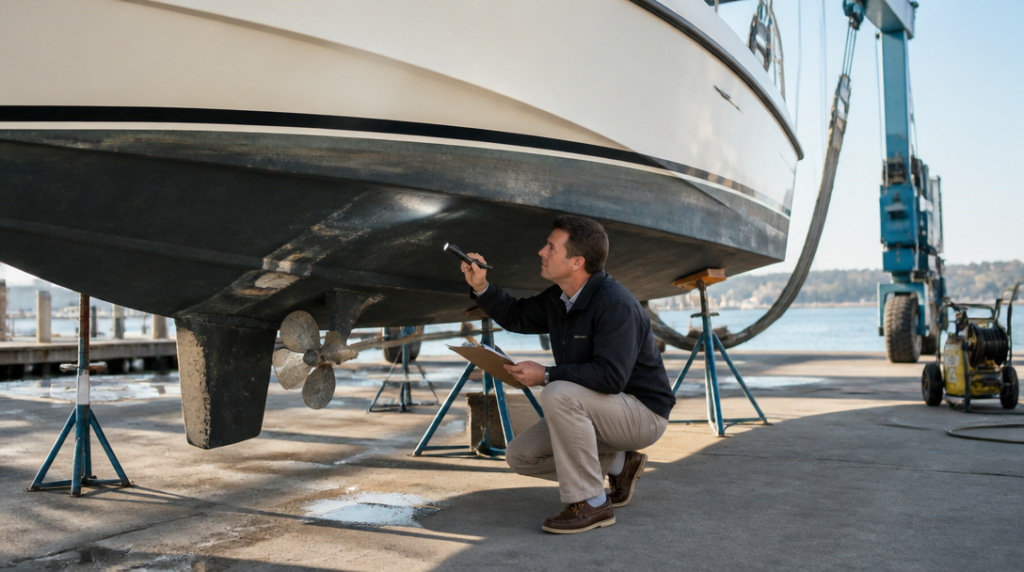
The main survey is only one part of the inspection budget. If the boat is hauled out, the yard may charge separately for lifting it, blocking it, and pressure-washing the bottom. Haul-out and pressure-washing commonly run about $14 to $20 per foot. On a 25-foot boat, that is approximately $350 to $500.
This expense can feel especially irritating when the boat looks clean and well cared for in the water. The underwater parts tell a different story, though. A surveyor needs access to the hull, running gear, rudder, through-hulls, and other components that cannot be properly examined from the dock. A shiny topside and a tidy cabin do not say much about the condition of the hull below the waterline.
Some yards charge a flat fee rather than a strict per-foot rate, and local prices can vary. The yard may also charge for storage on the hard if the inspection takes longer than expected or if repairs are needed after the survey. Ask for the haul-out price, the pressure-wash charge, and any relaunch fee as separate items.
The engine deserves its own line in the budget. A general boat survey can identify visible problems and may include a basic operational check, but it is not the same as a detailed mechanical inspection by a qualified marine technician. A separate engine inspection costs approximately $500 per engine.
That distinction becomes important on a twin-engine boat. A buyer who hears “the engine inspection is about $500” may imagine a single charge, while the actual cost could be around $1,000 for two engines. The technician may examine fluid condition, belts, hoses, mounts, exhaust components, cooling systems, wiring, and signs of leaks or overheating. The exact scope varies, so get it in writing.
A sea trial may also be billed separately. Running the boat under way can reveal issues that remain hidden at the dock, including overheating, vibration, poor shifting, steering problems, unusual smoke, and performance that does not match the seller’s description. A surveyor may charge extra for the time involved, fuel, travel, or the use of a captain or crew.
Before booking anything, ask a plain question: “What is not included in this quote?” That question often tells you more than the headline price. Clarify whether the survey includes a haul-out, sea trial, moisture readings, electrical testing, rig inspection, engine inspection, oil analysis, and a written report. A low initial quote can become much less attractive once essential extras appear on the invoice.
Sailboats can bring another layer of specialist work. A standard survey may not include a full rig inspection, especially if the mast has to be stepped or a rigger must climb it. Likewise, boats with complicated electrical systems, generators, air conditioning, stabilizers, pods, or hydraulic equipment may need additional specialists. A surveyor can often identify symptoms, but diagnosing a specialized system may require someone who works with that equipment every day.
The boat’s size is not the only driver of cost. Condition matters. So does location. A surveyor traveling several hours to reach a remote marina may add travel expenses, while a busy coastal market may have higher rates than a smaller inland area. Timing can matter as well. A rushed inspection arranged around a closing date may be harder to schedule and more expensive if it requires unusual hours or multiple trips.
You should also separate the cost of finding problems from the cost of fixing them. The survey itself may cost $1,200, but the report could reveal worn seacocks, soft deck sections, old hoses, damaged wiring, or neglected maintenance. Those repairs are not part of the inspection fee, yet they may be the most financially important result of the process.
That is why trying to save a few hundred dollars by skipping a haul-out or engine inspection can be a false economy. A survey is not a guarantee that the boat will never need work. It is a way to understand what you are buying while you still have negotiating power. If the findings are serious, you may renegotiate the price, ask the seller to make repairs, or walk away before ownership turns a hidden defect into your problem.
For a rough planning figure, a buyer might budget the base survey first, then reserve money for the haul-out and pressure wash, followed by any engine or specialist inspections. A 25-foot boat could need a survey in the several-hundred-dollar range before the yard and mechanical costs are added. A 38-foot boat’s hull survey alone may cost about $950 to $1,330, without other specialist checks. A 40-foot boat can reach $1,000 to $1,400 for the basic pre-purchase survey before those extras enter the picture.
The best quote is not necessarily the cheapest one. It is the one that clearly explains what the surveyor will inspect, what the report will contain, and which services are outside the fee. A vague estimate is hard to compare, while a detailed quote lets you build a realistic budget and avoid awkward surprises when the boat is already hanging in the travel lift. Personally, I would rather wince at a clear inspection bill than smile at a low quote that leaves the most important parts of the boat unexamined.