
The first time I priced a boat survey, I made the classic mistake: I looked only at the surveyor’s fee. The number seemed manageable until the yard added haul-out, pressure-washing and relaunching, and the mechanic quoted a separate price for the engine. Suddenly, the inspection cost much more than the line I had first circled.
That experience changed the way I look at survey quotes. The survey itself is only one part of the bill. For a typical pre-purchase inspection in the United States, a realistic budget in 2026 is about $25 to $35 per foot of boat length, before several common extras are added.
A 38-foot boat therefore comes with a basic survey range of roughly $950 to $1,330. That figure generally refers to the hull and general condition inspection, not every service that may be useful before completing a purchase.
The price is usually calculated by length because a larger boat takes more time to inspect. There is simply more hull, more machinery, more electrical equipment and more interior space to examine. A small sailboat and a 50-foot motor yacht may both be called “boats,” but they are very different jobs for a surveyor.
Some surveyors charge by the foot, while others use a minimum flat fee for smaller vessels. For boats under 28 feet, a minimum charge can apply even when the per-foot calculation would produce a lower number. One published example is a $900 minimum, which makes the final price for a compact boat less predictable than many buyers expect.
The market examples I have seen sit comfortably inside the broader range. Several surveyors list pre-purchase or condition-and-value work at about $28 to $30 per foot, while another quotes $28 per foot for a pre-purchase C&V survey. For a 38-foot boat, that puts the surveyor’s fee near $1,064 to $1,140 when calculated at those rates.
That is a useful planning figure, but it is not the full inspection budget.
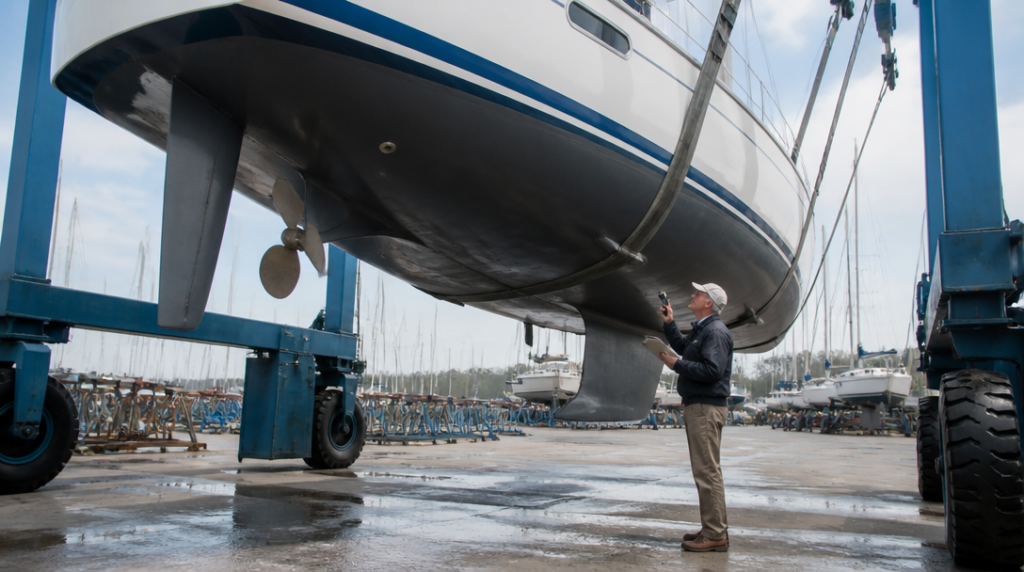
The boat usually needs to come out of the water if the survey is going to cover the underwater hull, running gear, through-hulls and other components below the waterline. Haul-out and pressure-washing the bottom add approximately $14 to $20 per foot. On a 38-foot boat, that works out to about $532 to $760.
I would not treat that expense as an optional luxury when buying an unfamiliar boat. A clean, dry bottom gives the surveyor access to areas that cannot be properly assessed from the dock. The haul-out also creates a brief, revealing moment when the boat is stripped of its usual disguise: no reflections hiding the hull, no waterline concealing fittings, and no growth covering the bottom.
For the same 38-foot vessel, the hull survey and haul-out together come to approximately $1,482 to $2,090. That is before an engine specialist is involved and before any repairs are ordered.
An engine inspection is commonly billed separately. A standalone inspection costs about $500 per engine. A single-engine boat would therefore bring the estimated inspection total to approximately $1,982 to $2,590 when the hull survey, haul-out and engine check are combined.
Twin-engine boats can add another $500 to that calculation. I have always considered this one of the easiest costs to underestimate, especially on older cruisers with two engines, generators and complicated propulsion systems. The boat may look modest from the outside, but its machinery can turn the inspection into several separate jobs.
A surveyor’s report and a mechanic’s report are not interchangeable. The surveyor assesses the boat as a whole, including the hull, structure, systems, safety equipment and general condition within the agreed scope. The engine specialist concentrates on the machinery and may identify issues that do not show up during a general survey.
That distinction matters during negotiations. A clean-looking engine compartment does not prove that an engine is healthy, just as a strong engine does not tell me whether the hull has structural or moisture-related problems. I want both sides examined before I commit serious money.
The exact contents of a “boat survey” can vary, so I would ask for the scope in writing before booking. A pre-purchase survey may include an inspection while the boat is afloat, a haul-out inspection, a sea trial or a review of onboard systems, but the details should never be assumed from the label alone.
The same applies to testing. If I want an engine survey, oil analysis, moisture readings, rig inspection or a more detailed electrical assessment, I ask whether each item is included and whether it carries an additional charge. A vague quote creates room for unpleasant surprises, even when nobody is acting improperly.
Travel can affect the bill as well. A surveyor working near the boat may include local travel, while a specialist coming from another area may charge for mileage, accommodation or travel time. I would rather pay a clear travel fee upfront than discover later that the cheapest initial quote was based on an unrealistic assumption about location.
The boat’s condition can also change the amount of time required. A well-maintained vessel with accessible systems is easier to inspect than one with locked compartments, poor lighting, cluttered engine spaces or years of improvised wiring. A surveyor may not always increase the fee for every complication, but difficult access can affect the scope, schedule and cost of additional testing.
A buyer should also separate inspection costs from repair costs. The survey identifies defects; it does not normally include fixing them. If the report finds damaged seacocks, worn hoses, corroded wiring or an engine problem, those repairs belong in a separate budget and may require quotes from contractors.
This is where the survey earns its keep. The fee may feel painful when nothing dramatic is found, but that clean result gives the buyer useful confidence. If serious defects appear, the report provides information for renegotiating the price or walking away before the problem becomes the buyer’s responsibility.
I would be particularly cautious about comparing survey prices as if they were identical products. A low quote may cover only a limited inspection, while a higher quote may include more time, a haul-out visit, detailed reporting or a broader review of systems. The number at the bottom matters, but the work behind it matters more.
For a 38-foot boat, my working budget would start with roughly $1,500 to $2,100 for the hull survey and haul-out. I would then reserve another $500 for each engine inspection. That gives a practical starting range without pretending that every boat, yard and survey scope will produce the same bill.
For smaller boats, I would check the minimum fee first. A per-foot estimate can look pleasantly low until the surveyor applies a flat minimum, such as $900 for boats below 28 feet. The total may still be reasonable, but the calculation is different from simply multiplying length by a rate.
Before agreeing to the inspection, I would ask four plain questions: What exactly is included? Is haul-out billed separately? Is the engine inspection included or performed by someone else? Which travel, testing or report fees could be added?
I would also confirm whether the price covers one visit or multiple stages. A surveyor may inspect the boat afloat, return after haul-out and then complete the report. That arrangement can be perfectly normal, but it should be reflected in the quote so the buyer knows what has actually been purchased.
The final cost is rarely determined by the boat’s length alone. Length sets the starting point, then the number of engines, the inspection scope, the location and the condition of the vessel fill in the rest. I now treat the survey budget as part of the purchase price, not as a small administrative expense that appears after the serious decisions have been made.