
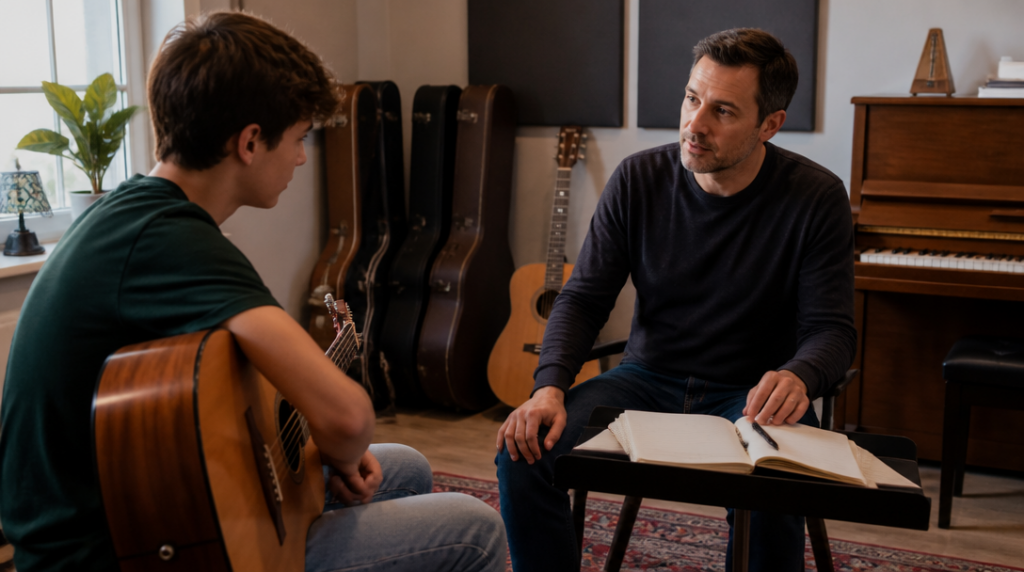
You are standing in a music shop with a beginner guitar case at your feet when the price finally appears: $67 for one 60-minute lesson. The number looks manageable until you multiply it by four. Suddenly, a casual attempt to learn guitar has become a recurring bill of more than $250 a month, before the cost of the instrument, books, strings, and registration fees.
That price is not unusual in the United States. Private music lessons typically cost about $40 to $90 for 60 minutes, with the final figure shaped by the teacher, the instrument, the student’s level, and the local market. A lesson in a major city may sit near the top of the range, while a newer instructor or teacher working outside a high-cost area may charge less. Online lessons can also be cheaper, although a lower price does not automatically make them a better deal.
The uncomfortable question is whether families are paying for better instruction or simply paying for a more polished setting. A studio with a waiting room, branded curriculum, and formal enrollment process can feel more trustworthy than an independent teacher in a spare bedroom. Sometimes it is. Sometimes the extra cost buys administration and atmosphere rather than a more capable musician standing in front of the student.
Music & Arts, for example, charges between $26 and $49 for a 30-minute lesson. Its average price is $37 for half an hour or $67 for a full hour, and it adds a $30 registration fee. That makes the shorter lesson look affordable at first glance, especially for a young beginner who may struggle to concentrate for 60 minutes. But four half-hour lessons at the average rate come to $148 before registration, while four full-hour lessons reach $268. The choice is not merely about the clock. It changes the shape of the monthly commitment.
A 30-minute lesson can be enough for a child learning basic notes, simple rhythms, or the first chords on guitar. It may also be a sensible way to test whether the student actually wants to practice. Paying for an hour every week makes little sense if the instrument spends the other six days untouched. On the other hand, more advanced students often need enough time to play, receive corrections, work through difficult passages, and discuss what to practice next. A short appointment can become a rushed exchange in which the teacher spends more time setting up than teaching.
Some schools publish a clearer progression of prices. For the April 2026 through March 2027 period, Fantasia School of Music lists $38 for 30 minutes, $57 for 45 minutes, and $76 for 60 minutes. That pricing makes the basic calculation easy: every additional 15 minutes costs $19. It also reveals something that advertisements often hide. The hourly rate can remain broadly consistent while the monthly bill rises quickly with lesson length.
The guitar market offers another useful benchmark. In the United States in 2026, the average private guitar lesson costs $66 per hour, while the median is $50. The gap between those figures matters. An average pulled upward by expensive instructors does not necessarily describe what most students pay. Anyone budgeting for lessons should ask whether a quoted price is typical, median, or simply the teacher’s preferred rate.
A $50 lesson and a $90 lesson may both be reasonable, but they are not selling exactly the same thing. The more expensive teacher might have years of professional performance experience, specialized training, or a strong record of working with a particular age group. Yet a famous performer is not automatically a gifted teacher. Being able to play a difficult piece and being able to explain it to a nervous beginner are different skills. I would rather take a clear, patient lesson from a good communicator than sit silently beside a virtuoso who treats every mistake as a personal insult.
The teacher’s experience is only one part of the calculation. Location raises prices because rent, wages, and operating costs are higher in some areas. In-home lessons may cost more because the teacher loses travel time between students. Online lessons can eliminate that travel, but they introduce their own limitations: poor sound quality, awkward camera angles, and the simple problem of not being able to adjust a student’s hand position directly. For voice, piano, guitar, and many other instruments, remote instruction can work well. For a complete beginner who needs physical guidance, the first few sessions may be easier in person.
The instrument itself can shift the price. Piano, guitar, violin, drums, voice, and brass instruction all require different forms of expertise, and teachers with a narrow specialty may charge more than generalists. Exam preparation, auditions, conservatory applications, and advanced repertoire usually bring higher rates as well. A student preparing one difficult violin piece for an audition needs a different kind of help from a child learning where middle C is located.
There is also a difference between a private teacher’s quoted lesson price and the way a school sells tuition. Independent teachers may charge per lesson, by the month, or for a term. Schools often require recurring enrollment, cancellation rules, or payment in advance. None of these arrangements is automatically unfair, but the headline price can be misleading if it leaves out holidays, missed lessons, makeup policies, materials, or enrollment charges.
A school in Detroit, for instance, offers four weekly 30-minute lessons for $224 per month. That works out to $56 per lesson, but the monthly structure matters more than the arithmetic. The family is not buying a single appointment; it is committing to a schedule. If a student loses interest after two weeks, the financial obligation may continue even though the musical one has disappeared. Monthly tuition can encourage consistency, but it can also make quitting feel like wasting money, which is a poor reason to keep a child attached to an instrument.
The most useful comparison is therefore not simply “What is the hourly rate?” Ask what happens during that hour. Does the teacher assign practice that fits the student’s age and schedule? Are parents told how progress will be measured? Can the student change lesson length later? What happens when the teacher is sick, the family is traveling, or a school holiday interrupts the calendar? A lower rate with vague expectations may cost more in wasted time than a higher rate attached to focused instruction.
Practice is the hidden part of the tuition bill. A student who practices regularly can turn a weekly lesson into a productive feedback session. A student who never opens the case may receive the same teaching but gain very little from it. That is why the cheapest sensible option for a beginner is sometimes a short trial period, not the lowest permanent rate. The family needs to discover whether the student enjoys the instrument, tolerates repetition, and responds to the teacher before making a larger commitment.
For a rough American budget, expect around $40 to $90 for a private 60-minute lesson, with many real-world prices landing somewhere in the middle. A half-hour lesson may cost roughly $26 to $49 at a large music retailer, while published school rates can reach the high $30s for 30 minutes and the mid-$70s for an hour. Four weekly lessons can therefore mean anything from a little over $100 to well above $300 per month, depending on the teacher and format, with extra fees possible.
That spread is wide enough to make shopping around sensible, but price alone cannot tell you which teacher deserves the money. The best lesson is not necessarily the longest, the most prestigious, or the one held in the nicest studio. It is the one that leaves the student knowing exactly what to do before the next appointment—and wanting to pick up the instrument again.