
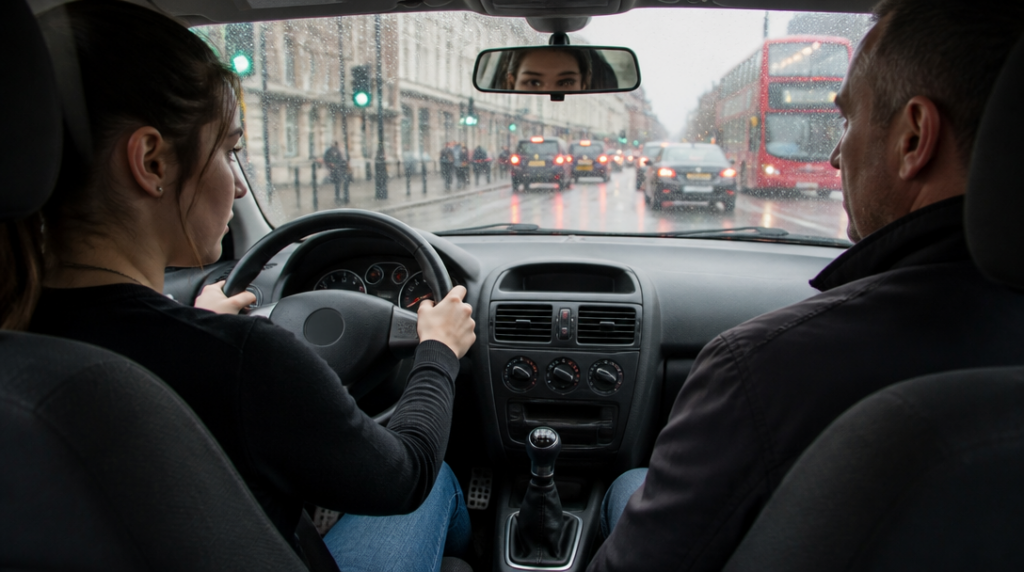
The engine is running, the mirrors have been adjusted three times, and the learner’s hands are fixed at ten and two. Outside the instructor’s car, a bus exhales at the kerb while rain beads across the windscreen. Then comes the question that often arrives before the first junction: how much is this going to cost?
In the UK in 2026, a one-hour driving lesson usually costs between £35 and £45. Some learners will find lessons for around £28, particularly in parts of the North East of England, while prices in central London can reach roughly £45 an hour. Across the country, the wider everyday range is closer to £35–£50.
That hourly figure is only the beginning. The gearbox, the instructor’s location, the number of lessons booked and the amount of practice needed can all move the final bill.
The national price sits near £40 an hour
For a manual lesson, the average price is about £35–£40 per hour. Automatic lessons tend to cost more, averaging approximately £40–£45. The difference is commonly around £2–£5 per hour, although individual instructors may charge more or less than that.
The gap is partly connected to the supply of cars and instructors. Manual vehicles remain widely available, while automatic cars can cost more to purchase, maintain or replace. Demand for automatic tuition has also grown as more learners choose to avoid clutch control and gear changes.
For someone comparing instructors, a £3 difference may look trivial on a single booking. Over several months, it becomes noticeable. Twenty hours at £37 an hour comes to £740. The same number of hours at £44 costs £880, leaving a £140 difference before the practical test, theory test or extra practice is added.
The advertised lesson length needs checking, too. Some instructors offer 60-minute sessions, while others mainly work in 90-minute or two-hour blocks. A two-hour booking priced at £80 may sound expensive beside a £40 hourly rate, but it is simply the same price spread across the longer session. The important comparison is the actual hourly cost, not the largest number shown on the booking page.
London traffic can add pounds before the car moves
Location has a sharp effect on the price. At the lower end, learners in the North East of England may find lessons for around £28 per hour. In central London, approximately £45 an hour is a more realistic figure. Other towns and cities fall between those points, with local demand, instructor availability and operating costs shaping the rate.
A London lesson also has a different physical character from one in a quieter town. The hour may begin in a queue of traffic, with buses edging past and cyclists appearing beside the driver’s door. Progress can be slow, but the lesson still uses fuel, time and the instructor’s full attention. In a busy urban area, an instructor may spend much of the session teaching lane discipline, observation and decision-making at complex junctions rather than covering long stretches of road.
In rural areas, the price may be lower, yet learners can face their own complications. A lesson might include narrow lanes, fast country roads and longer journeys to reach the kind of junction or dual carriageway needed for a particular skill. A lower hourly rate does not automatically mean the learner will need fewer hours.
There is a practical detail that can be easy to miss: the collection point. If an instructor has to drive a substantial distance to pick up a learner, that time may affect availability or be built into the lesson arrangement. Asking where the lesson starts and ends can prevent an apparently cheap booking from becoming awkward or less useful.
Manual or automatic changes the maths
Manual lessons remain cheaper on average, usually costing around £35–£40 per hour. They also teach clutch control, gear selection and hill starts, skills that can make the early lessons feel especially busy. The first attempt at moving away often produces a shudder, a stall and a brief silence from the passenger seat while the learner tries again.
Automatic lessons generally cost about £40–£45 an hour. Without a clutch pedal or manual gear changes, the learner can concentrate sooner on steering, observation, road position and hazards. That can make the first few sessions feel less crowded, particularly in heavy traffic or at complicated junctions.
The licence outcome matters. Passing in an automatic car normally restricts the driver to automatic vehicles. A learner who later wants to drive a manual car would need to take another practical test. Someone choosing between the two should therefore look beyond the price of the next lesson and consider which type of car they expect to use after passing.
The hourly difference is modest, but the total difference depends on the number of lessons. If a learner takes 30 hours, paying an extra £4 per hour for an automatic adds £120. At 45 hours, the same gap adds £180. That may still be worthwhile for a learner who finds an automatic easier to manage, but it is a real cost rather than a minor detail.
Forty-five hours can mean a four-figure bill
The recommended amount of professional instruction often used for planning is 45 hours. At current lesson prices, the lessons alone would cost roughly £1,575–£2,250.
That range comes from multiplying 45 hours by £35 and £50. It covers a broad spread of instructors and regions, and it shows why the hourly price deserves attention. A learner paying £35 an hour for 45 hours spends £1,575. At £45 an hour, the total rises to £2,025. At the upper end of the wider range, £50 an hour produces a £2,250 bill.
Forty-five hours is not a promise that every learner will pass, nor is it a fixed requirement. Some people reach test standard sooner, especially if they have regular private practice with a suitable accompanying driver. Others need more time because they have limited access to a car, feel anxious in traffic or are learning in a demanding urban environment.
The cost can also arrive unevenly. A learner may begin with one lesson a week, then book longer sessions before the test. Two hours in the driver’s seat can provide useful continuity, but it also means a single booking may cost £70–£100 at common rates. That is a sizeable payment for a student or someone managing a tight monthly budget.
Private practice can reduce the number of paid hours, provided the supervising driver meets the legal requirements and the vehicle is properly insured for learner use. It cannot replace the instructor’s role entirely. A family member may be able to offer repetition, but an instructor is better placed to identify habits that feel comfortable yet would cause trouble in a driving test.
Block bookings lower the rate, but read the conditions
Some instructors offer discounts for booking lessons in advance. A block reservation may reduce the hourly price by around 10–15 percent. On a £40 lesson, that would bring the effective rate down to approximately £34–£36, depending on the discount.
Across 10 hours, a 10 percent reduction from £40 an hour saves £40. A 15 percent reduction saves £60. The saving becomes more substantial when a learner is planning dozens of hours, but only if the lessons are actually used.
Block bookings need a closer look than the bold discount figure. Check how long the credit remains valid, whether lessons can be moved, what happens if the instructor is unavailable and whether the booking is refundable. A cheaper rate is less helpful if the learner’s timetable changes and unused hours cannot be recovered.
The instructor’s cancellation policy matters as well. Many learners have paid for a lesson only to discover that cancelling at short notice means losing some or all of the fee. The same rule may apply in reverse if the instructor cancels, so the arrangement should be clear before money changes hands.
A sensible comparison starts with three numbers: the normal hourly rate, the block-booking rate and the likely number of hours needed. Then add the cost of the test car if the instructor charges separately, along with theory and practical test fees and any extra lessons before a retest. The neat £40 figure on the first booking can look very different once the learner has spent an hour circling a busy test centre, waiting for a safe gap in traffic and trying to remember every mirror check at once.