
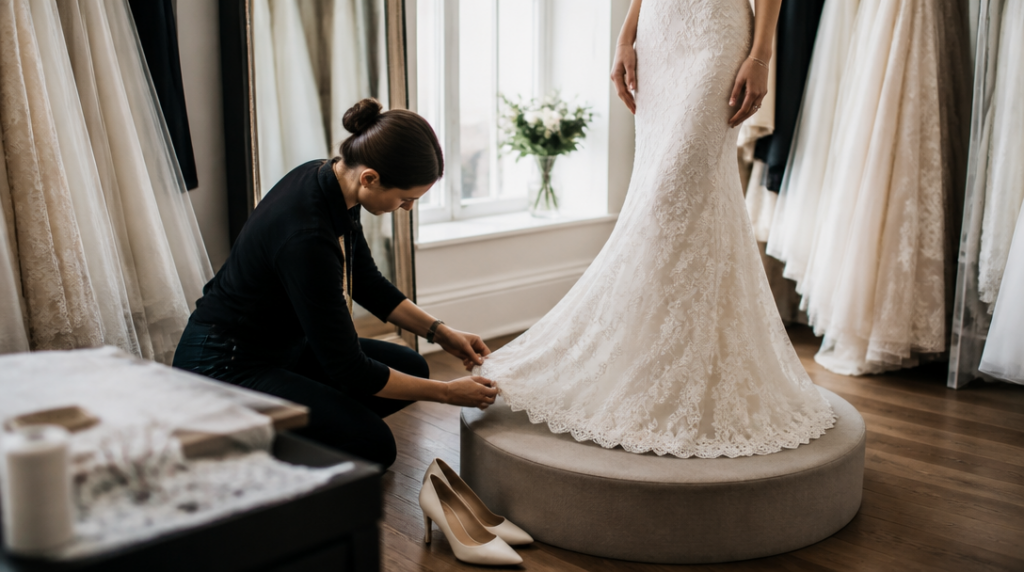
A wedding dress can be perfect in the boutique and still look wrong on the wedding day if the alterations are handled badly. That may sound severe, but the fit is what turns a beautiful gown into your dress. A hem that catches under your shoes, cups that sit too high, or straps that keep slipping can change how you move, stand, and feel in every photograph.
I would choose the alteration specialist almost as carefully as I chose the dress. Not because every gown requires complicated reconstruction, but because bridalwear is rarely forgiving. Satin shows an uneven hem. Beading makes a simple adjustment slow and delicate. Lace often has to be removed and reattached by hand. A dress may look straightforward on the hanger while hiding several layers, built-in structure, boning, cups, bustle points, and a train that needs to fall in exactly the right place.
My first question would not be, “How much do you charge?” It would be, “Do you have room for my dress?” A specialist should ideally have capacity at least 8–12 weeks before the wedding, with roughly three fittings planned along the way. The final fitting commonly takes place one or two weeks before the ceremony, close enough to reflect the finished shoes and undergarments but not so close that a problem becomes a crisis.
That timetable is not generous if the gown has lace, extensive beadwork, sleeves, or a neckline that needs reshaping. For those jobs, I would allow three to five months. A specialist who is booked solid may be excellent, but that does not make the appointment available. In fact, availability can be surprisingly specific: one bridal specialist is currently accepting weddings beginning October 3, 2026. That kind of booking horizon is a useful warning for anyone assuming there will always be a last-minute appointment somewhere nearby.
I would contact alteration specialists before ordering the dress, especially if the wedding date is fixed or the gown needs substantial changes. The boutique may recommend someone, and that recommendation can be useful, but I would still ask the specialist directly about timing. The store’s delivery estimate and the tailor’s working calendar are two separate pieces of the puzzle.
Experience matters most when it is specific. I would look for someone with verifiable bridal experience rather than a general tailor who happens to accept wedding gowns. Altering trousers or everyday dresses is not the same as working with a corseted bodice, a cathedral-length train, or a lace appliqué that must be repositioned so the repair disappears. A bridal alterations team serving more than 1,000 brides a year demonstrates the kind of repeated exposure that builds technical judgment, although volume alone is not a guarantee of personal attention.
I would ask how many wedding dresses the specialist handles, which designers or fabrics they regularly work with, and whether they have altered gowns with features similar to mine. If my dress has sleeves, I would want evidence of sleeve adjustments. If it has heavy beading, I would ask about bead removal and replacement. If I am changing the neckline, I would want to see examples of comparable work rather than a vague promise that it should be fine.
Photographs can help, but I would treat them as one part of the conversation. A polished portfolio may show dramatic transformations while saying little about the specialist’s process. I would pay attention to the details: Does the waist sit smoothly? Does the hem follow the floor without lifting at the sides? Does the bustle preserve the shape of the train? Those small points tell me more than a row of glamorous finished portraits.
The fitting plan should be clear before I leave a deposit. I would expect at least two or three visits, with the exact number depending on the gown and the work involved. Three fittings are often spaced out so the specialist can make an initial adjustment, refine the fit, and complete the final details. One bridal studio requires at least three weeks between fittings and schedules the last one three weeks before the wedding. That is a useful example of how much time a careful process can occupy.
I would also ask what I need to bring to each appointment. The wedding shoes are essential for setting the hem, and the undergarments can affect the entire silhouette. If I plan to wear shapewear, a particular bra, or a petticoat, I would bring those items rather than relying on memory. The dress should be fitted on the body it will actually meet on the wedding day, with the shoes that will determine its length.
A good specialist should explain what can be changed, what may be risky, and what will cost extra. I would be wary of anyone who agrees instantly to every request without examining the gown. Moving a neckline can alter the balance of the bodice. Taking a dress in may be straightforward, while letting it out depends on the seam allowance and construction. Adding or removing sleeves, changing the back, reshaping cups, or reworking lace can become a design project rather than a routine alteration.
Money deserves a written conversation, not a hopeful estimate scribbled in the air. Published figures for common bridal alterations in 2026 often fall around $300–$800, with a broader range of roughly $200–$800 depending on the work and location. Those numbers are only a starting point. A hem, bustle, and minor fitting adjustment will not cost the same as restructuring a bodice and rebuilding a beaded neckline.
I would request a written estimate that separates the work. The quote should make it easier to see whether the price includes the bustle, pressing, final fitting, hand sewing, cups, straps, or any additional appointments. I would ask what happens if the dress arrives later than expected or if a second round of changes becomes necessary. A clear answer is far more reassuring than an artificially low figure that grows with every visit.
The way a specialist communicates tells me plenty. I would rather receive a direct answer about a limitation than cheerful reassurance followed by a surprise. If the specialist is difficult to reach before the appointment, I would question how smoothly the process will run when the dress is in progress. Bridal alterations involve trust: someone is pinning, cutting, and sometimes taking apart a garment that may be difficult or impossible to replace.
I would book a consultation with the dress, not just a description of it, whenever possible. The specialist needs to see the fabric, construction, train, closures, and internal support. I would explain the practical demands of the day too. Will I be walking outdoors? Sitting during a long ceremony? Dancing? Wearing a bustle for several hours? The best fit is not merely one that looks good while I stand motionless on a fitting-room platform.
I also want to know who will perform the work. Some bridal shops send gowns to an outside tailor, while some studios have several specialists with different responsibilities. Neither arrangement is automatically wrong, but I would ask who is making the decisions, who will attend the fittings, and who will handle any corrections. My dress should not become a package passed between people whose names I never learn.
There is a small, practical test I find revealing: I would ask the specialist to describe the most complicated part of my dress. Someone experienced will usually notice construction details quickly and explain the likely sequence of work in plain language. They may point out that the lace needs to be lifted before the hem is shortened, or that the bustle must support the train without pulling the back of the gown upward. That conversation feels more valuable than a generic assurance that bridal alterations are routine.
I would leave the first fitting with the next appointment already scheduled. The closer the wedding gets, the faster bridal calendars fill, and postponing the second fitting can create a problem that no amount of optimism fixes. I would also keep the dress stored exactly as instructed between appointments, avoid trying to make home adjustments, and bring it back for the final check with every accessory that affects the fit.
For me, the best alteration specialist is not simply the person with the shortest waiting list or the lowest quote. It is the person who has handled similar gowns, gives the dress enough time, explains the work without theatre, and leaves room for the final fitting to be calm rather than frantic. A wedding morning already contains enough surprises; the hem should not be one of them.