
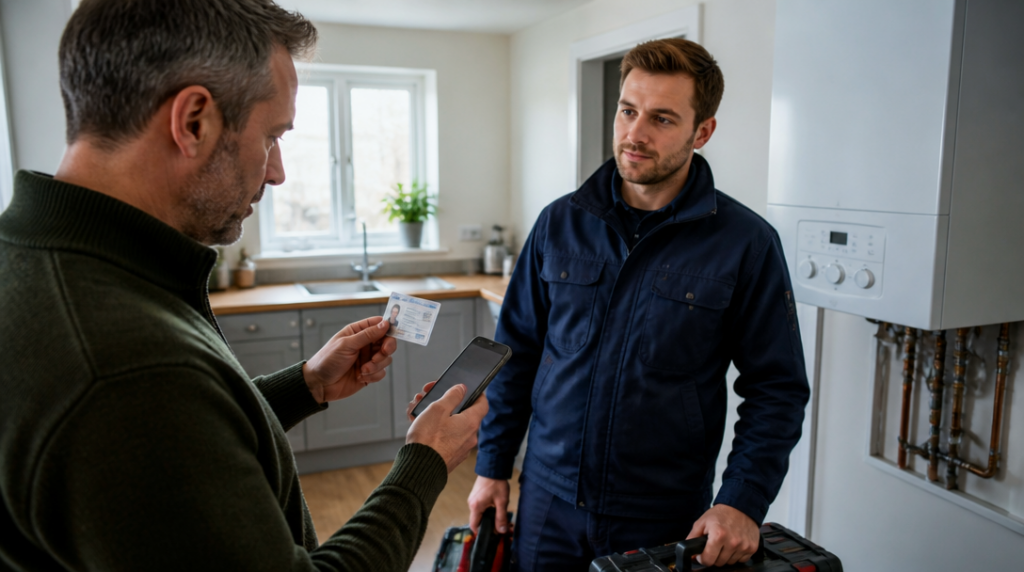
The engineer arrived just after nine, carrying a tool case and wearing a work jacket with a company name stitched across the chest. My boiler had stopped working overnight, so I was tempted to let him get on with it. Then I remembered how little that logo actually proved. Anyone can print a name on a jacket or van.
I asked to see his Gas Safe card before he opened the boiler casing. That small pause changed the whole appointment from a quick repair into a basic safety check. He showed me the card, and I compared his details with the official register before agreeing to the work.
That is the habit I now recommend to anyone hiring a gas engineer in the UK: check the person, check the business and check the exact type of work they are allowed to carry out.
Start with the official register
The first step is to search for the company in the official Gas Safe Register. You can search by the business name or by a British postcode, which is useful if the engineer has given you only a local trading name or if you are checking a firm working in your area.
The search can also be narrowed by the type of service, fuel and appliance. Those filters matter more than many people realise. A company may appear in the register, but that does not automatically mean every engineer working for it is qualified to deal with every gas appliance. Searching for the specific work you need gives you a more useful result than simply finding a familiar-looking business name.
I would do this before the appointment, not while standing in a cold kitchen with a broken boiler. It takes only a few minutes, and it gives you a chance to spot differences in spelling, trading names or contact details before the engineer arrives.
A registered business should be able to match the details you were given. If the engineer turns up under a different name from the one you searched for, ask why. There may be an entirely legitimate explanation, such as a parent company or a trading name, but you should not have to guess.
Ask to see the engineer’s card
A genuine engineer should be able to show a Gas Safe card when you ask. I would ask politely and directly: “Could I see your Gas Safe card before you start?” A professional should understand why you are checking. Evasion, irritation or a vague promise to produce it later would make me stop and reconsider the job.
From February 2026, the card may be physical, digital or both. Whichever format the engineer uses, it should include a photograph, the engineer’s name, a licence serial number and the card’s validity information. The photograph is useful because it lets you compare the card with the person standing at your door, rather than relying on a card that might belong to somebody else.
I would check the name carefully, including the spelling. I would also look at the business information. The card includes the company’s registration number, so it should be possible to compare the engineer’s name and the business trading name with the details shown in the register.
A card is not a substitute for checking the register. It is one part of the process. Cards can be misplaced, outdated or presented by someone who is not authorised for the work being offered, which is why I treat the register and the card as two separate checks.
The card should match the person, the company and the job.
Check the exact work category
This is the part I used to overlook. I assumed that a registered gas engineer could work on any gas appliance. That assumption is unsafe.
Gas work authorisation can be limited to particular categories. An engineer may be authorised to work on boilers but not cookers, or on natural gas appliances but not LPG equipment. The permitted categories may cover boilers, fires, cookers, heaters, pipework or LPG, depending on the individual’s qualifications and current authorisation.
Before the engineer begins, look at the specific work categories on the card and check their expiry dates. The relevant category needs to be valid for the appliance and fuel involved. If you are having a gas hob installed, for example, you need more than proof that the engineer is somewhere in the register. You need confirmation that the engineer is authorised for that type of appliance and work.
This is particularly important when a job involves more than a straightforward repair. Installing an appliance, altering pipework, working on a boiler or dealing with LPG can involve different areas of competence. A person who is qualified for one task may not be qualified for another.
If the wording on the card is unclear, ask the engineer to explain which category covers your job. I would rather have an awkward conversation on the doorstep than discover later that the work was carried out outside the engineer’s authorisation.
Compare the card with the register
Once I have the card in front of me, I compare three things: the engineer’s name, the business name and the registration number. Those details should line up with the official register. I also check that the engineer appears to be connected with the company that sent them.
This matters because a registered firm may use employees, subcontractors or engineers working under another business arrangement. That does not automatically mean anything is wrong, but the person doing the work still needs to be identifiable and appropriately registered. A company name on an invoice is not enough if the person carrying out the gas work cannot be matched to the registration details.
I also check that the registration has not expired and that the particular category required for the job is still valid. A current-looking card can create false confidence if the relevant authorisation has lapsed or does not cover the appliance in front of you.
If the engineer gives me a digital card, I still take the same approach. I look for the photograph, name, licence serial number and validity details, then compare them with the register. The format has changed, but the basic questions have not.
What to do if something does not match
A mismatch does not always prove criminal behaviour. The engineer may have changed employers, the company may trade under more than one name, or the information may not have been updated yet. Still, I would pause the job until the discrepancy is explained clearly.
If I have doubts about the card or the registration details, I would verify them by phone on 0800 408 5500. I would not rely solely on a phone number printed on an unexpected message, invoice or business card. I would use the official contact details for the register and ask for the information to be checked.
There are other warning signs I would take seriously: pressure to start immediately, refusal to show a card, a name that does not appear in the register, or insistence that registration is unnecessary for the work being proposed. A low quote can be tempting, especially when the repair is unexpected, but it is not a reason to ignore basic checks.
I would also be cautious if an engineer says that the company is registered but they personally do not need to show their own card. The business registration and the individual carrying out the work are connected, but they are not interchangeable. I want to know who is actually handling the appliance and whether that person is authorised for the task.
Build the check into the booking process
I now ask for the company’s full trading name and the engineer’s name when I book any gas work. If the appointment is made by a landlord, letting agent or property manager, I ask for those details rather than assuming the contractor has already been checked.
I save the appointment message and take a note of the registration details once I have verified them. That may sound fussy, but it prevents confusion when a different engineer arrives or when several contractors are involved in the same property repair.
For routine work, the check is quick. For installation or work involving pipework, I spend a little longer examining the authorisation categories. I also make sure the engineer knows exactly which appliance is involved and what I expect them to do. Clear information helps avoid a situation in which someone arrives qualified for boilers but is asked to work on an LPG cooker.
The engineer at my house passed the checks, and the boiler repair went ahead. Since then, I have treated the Gas Safe card less like a formality and more like a driving licence: useful only when it belongs to the person holding it and covers the journey they are about to make.