
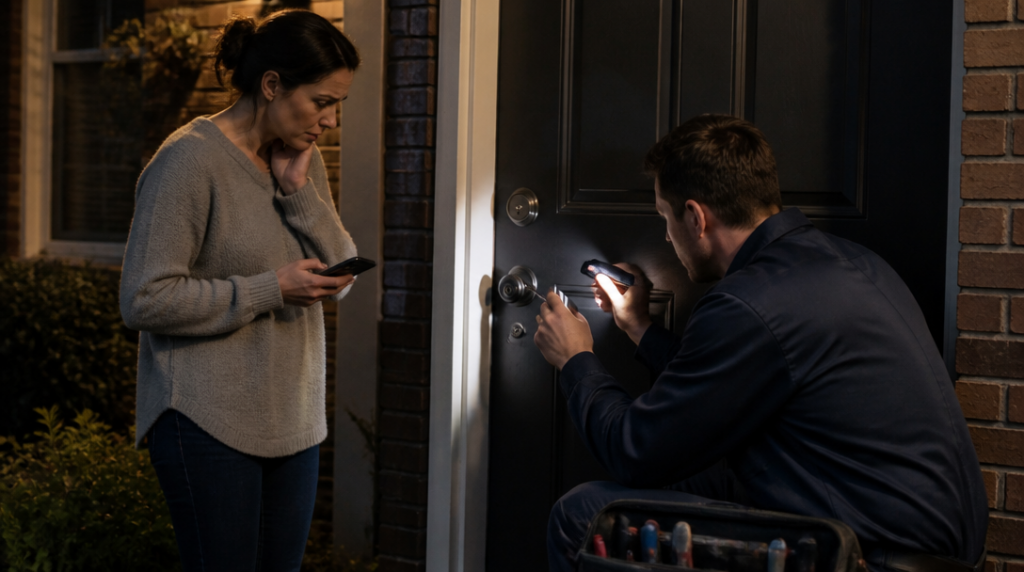
The front door clicks shut. Your keys are still on the kitchen counter, your phone battery is fading, and the first locksmith listing promises help for $29. The offer sounds like a bargain until the technician arrives, studies the lock, and announces that the real price is several hundred dollars.
That pattern is not a minor inconvenience. Emergency locksmith work happens under pressure, often at night, and customers rarely have the time or information needed to compare prices. A service that should be straightforward can turn into a dispute over drilling, replacement hardware, travel fees, programming charges, and payment methods.
So what should a legitimate emergency locksmith cost? And how can a customer tell the difference between a reasonable surcharge and a bait-and-switch?
The price before the technician arrives
In the United States, unlocking a car commonly costs between $50 and $150. Opening a house door usually falls between $75 and $175. Those figures describe the basic service, not every possible complication.
Rekeying, which changes the internal configuration of an existing lock so that an old key no longer works, typically costs $20 to $50 per lock. It can be a sensible option after moving into a new home or losing a set of keys. Replacing the entire lock is more expensive, but not always necessary.
A new deadbolt generally costs $100 to $250, including labor. If an emergency opening requires drilling and destroys the existing lock, the replacement hardware may add another $30 to $150. That is where a low initial quote can begin to unravel: the customer is no longer paying only for access, but also for equipment that may have been damaged during the opening.
Drilling is sometimes unavoidable. It should not be the first explanation offered for every locked door. A customer can ask why non-destructive methods will not work, what part will be damaged, and how much the replacement will cost before authorizing the job.
Car keys are a separate business
Automotive locksmith pricing follows a different curve because modern keys may require electronic programming. A basic duplicate key can cost $10 to $50. A transponder key is more commonly priced between $150 and $400, with the vehicle and key system affecting the final amount.
Programming performed at the location may add another $100 to $350. That extra charge can be legitimate, but it should appear in the estimate before the technician starts. A locksmith who quotes the price of a blank key and only later reveals a large programming fee is not giving the customer a meaningful price.
The distinction between cutting a key and programming one matters. A metal key may open an older vehicle, while a transponder-equipped vehicle can require an electronic match before the engine will start. Customers should describe the vehicle’s make, model, year, and key type as accurately as possible during the first call.
A vague answer such as “we will see when we get there” is not automatically proof of fraud. Some vehicles genuinely have several key configurations. It is, however, a reason to demand a price range and a list of possible additional charges.
The emergency surcharge is where comparisons get messy
Night and weekend work often carries an additional fee. One current pricing schedule lists a surcharge of $25 to $75, while another nationwide estimate reaches $150 to $250. A typical locksmith visit is estimated at roughly $163, although the final amount varies with the service, location, timing, and equipment required.
Those numbers do not form a universal tariff. They show why a customer should ask several specific questions rather than accept a single headline price. Is the quote for the service itself, or does it include dispatch, travel, after-hours labor, replacement parts, and taxes? Does the meter start when the technician leaves the shop or when work begins?
The difference between a $75 night surcharge and a $250 one is large enough to change the decision. A locksmith may charge more for an urgent call outside normal business hours, but the customer should be told the amount plainly before agreeing to the visit.
A particularly suspicious offer is one that advertises an extremely low price without explaining what it covers. The number may be designed to win the phone call, not to describe the eventual bill. By the time the technician arrives, the customer may feel trapped by the lost time and the locked door.
How the bait-and-switch works
Consumer complaints describe a familiar sequence: an unusually cheap estimate, a much higher demand after arrival, and pressure to pay in cash. The technician may claim that the lock is unusually difficult, that drilling is required, or that the original price applied only to a simple service that was never realistic for the situation.
The cash demand is not conclusive by itself. Small businesses may prefer cash or impose different payment terms. Pressure is the more revealing detail. A customer should be wary if the technician refuses to provide a complete written estimate, changes the price without explaining the work, or insists that payment must be made immediately in cash.
Connecticut’s records offer a useful measure of the problem’s scale, though not a complete picture of the industry. As of July 16, 2026, the state had 293 individually registered locksmiths, and officials had recorded 12 complaints against locksmith companies over the previous five years. A complaint count cannot show how many incidents go unreported, but it also does not justify treating every locksmith as dishonest.
State consumer protection officials in Connecticut advise customers to obtain a complete written estimate before work begins. That simple step forces the conversation away from vague promises and toward a price, a service description, and clearly identified extras.
The questions that expose a weak quote
A customer does not need technical knowledge to test an estimate. Ask for the total price to unlock the door, the cost of any replacement lock, the after-hours fee, the travel or dispatch charge, and the payment methods accepted. Ask whether the quoted price changes if drilling becomes necessary.
For a vehicle, ask whether the quote includes cutting, programming, the key itself, and any service call. Give the technician the exact vehicle details and ask what information would cause the price to rise.
Request the estimate in writing, even if it arrives by text message. The document should identify the business, describe the work, and separate labor from parts and fees. If the locksmith will not provide anything in writing, the customer has little protection when the bill changes at the door.
The person who answers the phone may not be the person who performs the work. That is not unusual, particularly with dispatch services. The customer can ask for the technician’s business name, an arrival estimate, and confirmation that the technician will present identification on arrival.
Do not let urgency erase basic safety checks
Before allowing work to begin, confirm that the locksmith is at the correct address and ask for identification. If the job involves a home, vehicle, or rental property, be prepared to show proof that you are authorized to access it. A legitimate professional should understand why that verification matters.
Take a photograph of the lock and the surrounding door before work starts. It creates a simple record of the condition of the property and can help clarify whether damage was present beforehand. This is the sort of small habit that feels excessive in a crisis but takes less than a minute.
If the technician immediately reaches for a drill, ask for the reason. Some locks, damaged mechanisms, and electronic systems cannot be opened cleanly. Others may respond to less destructive methods. The customer does not have to approve drilling merely because the technician has arrived.
Never sign a blank work order. Do not authorize an open-ended instruction such as “repair as needed” without a maximum amount or a clear process for approving additional work.
What a fair bill should reveal
A transparent invoice should make it possible to reconstruct the visit. It should show the basic service, the emergency surcharge if one applies, travel or dispatch charges, labor, replacement parts, and any programming fee. A single unexplained total is difficult to challenge and easy to inflate.
The invoice should also match the work performed. If the locksmith charged for a new deadbolt, the customer should receive the hardware and be able to see what was installed. If a vehicle key was programmed, that service should be listed separately from the cost of the key blank or fob.
Prices can rise for real reasons. A damaged lock, unusual access problem, or electronic key system may require more time and specialized equipment. The question is not whether every emergency job can be predicted perfectly. It is whether the customer received a fair explanation and a chance to approve the new price.
If the amount changes sharply after arrival, pause the job if it is safe to do so. Ask the locksmith to write down the revised price and the reason for the increase. A refusal to explain the charge is a warning sign, not a technical necessity.
The locked door creates urgency, but it does not give a stranger permission to set any price they choose. A few direct questions, a written estimate, and a clear limit on additional work can turn a frantic call into a transaction that is at least visible—and visibility is often the first thing a bait-and-switch depends on removing.