
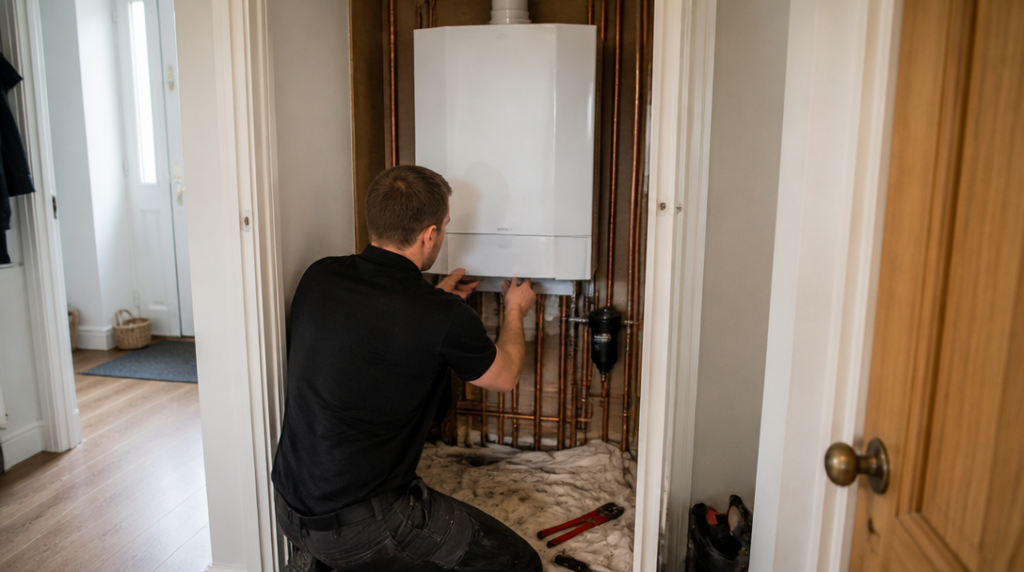
The engineer has lifted the old boiler off the wall, and the quote has suddenly grown by £900. The replacement itself was advertised at a tempting price, but the final figure includes new pipework, a filter, a flue, system cleaning and a few hours of labour that were barely mentioned on the first call.
That is how boiler replacement becomes expensive in the UK: not through one outrageous item, but through a collection of reasonable extras that appear after the headline price has done its job.
In 2026, a standard replacement of a condensing combi boiler, including supply and installation, usually costs around £2,500 to £4,000. The boiler alone commonly accounts for £1,000 to £3,000, while a standard installation adds another £1,000 to £2,000. Those figures describe a fairly ordinary swap, not a major renovation of the heating system.
The awkward question is whether homeowners are choosing the cheapest boiler quote because it is genuinely good value, or because the industry makes comparison almost impossible.
The £2,500 quote that may not stay at £2,500
A like-for-like combi replacement is the simplest case. The new boiler goes in the same place, the existing gas and heating pipes are suitable, the flue can be replaced without structural complications, and the installer does not discover a hidden problem behind the old unit. In that situation, the £2,500 to £4,000 range is a realistic working budget.
The lower end may suit a modest property with straightforward access and limited changes. The upper end becomes easier to understand if the installer is fitting a higher-spec boiler, replacing controls, upgrading pipework or carrying out thorough chemical cleaning and system protection.
A boiler is not just a box that produces heat. The installation must be sized correctly, connected safely and commissioned properly. Poor sizing can leave a home with an inefficient system that cycles too frequently, while inadequate pipework may restrict performance. A bargain installation can therefore become a false economy if it creates noise, uneven heating or recurring faults.
Ask for the quote to separate the boiler, labour, controls, flue, filters, system cleaning, condensate work and any electrical changes. A single figure may look neat, but it tells you very little. The useful question is not “How cheap is this?” but “What exactly has been included, and what could still be added?”
Moving the boiler changes the entire job
Relocating a boiler is where many simple replacements stop being simple. Moving it to a different wall, cupboard or floor often means extending gas and water pipes, altering the condensate drain, installing a new flue route and making sure ventilation and access requirements are still met.
A boiler moved to another position generally pushes the total cost to roughly £3,000 to £5,000. The price can rise further if walls or ceilings need to be opened, the flue must pass through a difficult section of the building, or the new position requires substantial changes to the heating layout.
The location also affects future maintenance. A boiler hidden above a kitchen unit may look tidy, but an engineer still needs safe access to service it. Saving space today can mean paying more every time the unit needs attention. I have always found this one of the stranger features of domestic renovation: homeowners will spend heavily to hide a boiler, then resent the cost of reaching it when something goes wrong.
Relocation can make sense when an existing boiler occupies valuable space or sits in an unsuitable room. It should not be treated as a cosmetic upgrade with a small labour surcharge. It is closer to a compact plumbing project, and the quote should reflect that.
Old back-boilers are a different financial problem
Replacing a back-boiler is rarely a straightforward modern combi swap. Back-boilers were often installed behind fireplaces, with the boiler itself concealed and connected to a separate hot-water cylinder and cold-water storage arrangement. Removing one may involve work around the fireplace, redundant pipework and changes to the way hot water is stored.
Replacing an old back-boiler with a modern system typically costs about £2,200 to £4,500. The final price depends heavily on what replaces it. A combi boiler may free up cupboard and loft space by producing hot water on demand, but it may not be the best fit for a large home with several bathrooms and simultaneous demand.
A system boiler, paired with a hot-water cylinder, can provide stronger hot-water performance for some households while retaining a more familiar layout. It also needs space, controls and a properly configured cylinder. The cheaper-looking option on paper may become awkward if the property’s water pressure, demand or existing pipework does not suit it.
This is a point where homeowners should resist choosing by boiler type alone. The right question is how the household uses hot water. A single occupant with one bathroom has different needs from a family that fills a bath while running two showers and a dishwasher.
Why the average figure can mislead you
Government figures put the average gas-boiler installation at about £3,500 including VAT. That number is useful as a sense check, but it should not be treated as a universal tariff. A small, uncomplicated replacement may sit below it. A larger property with pipework changes, new controls and difficult access can pass it quickly.
Several costs tend to hide outside the boiler’s advertised price. New heating controls may be required or simply recommended. A magnetic filter can protect the system from circulating debris. The installer may advise power flushing, replacing a pump, upgrading the gas supply or fitting a different flue configuration. None of these items is automatically unnecessary, but none should be accepted without a clear explanation either.
The warranty deserves attention too. Some manufacturers offer longer cover only if the boiler is installed and registered under specific conditions, with approved controls or scheduled servicing. A cheaper installer who does not meet those requirements may leave you with a shorter or less useful warranty.
The engineer’s competence matters more than a glossy brochure. Gas work must be carried out by an appropriately qualified professional, and the installation should be properly commissioned with the relevant paperwork supplied. Do not let a sales pitch about a premium brand distract you from the quality of the installation itself. A superb boiler fitted badly is still a bad heating system.
Get several itemised quotes, but do not compare them as though they were identical products. One may include a filter, upgraded controls and disposal of the old boiler; another may charge for each separately. The lowest number wins only when the specifications match.
The heat-pump question changes the calculation
Some households replacing a gas boiler should pause before ordering another gas boiler. That is not a fashionable slogan; it is a question of whether the property can support a different heating system without expensive remedial work.
The Boiler Upgrade Scheme offers a £7,500 grant in England and Wales towards an eligible heat pump. For eligible properties that are not connected to the gas network, support of up to £9,000 is available for installations taking place from 21 July 2026 to 31 March 2027. Eligibility, system design and property requirements still matter, so the grant does not turn every heat-pump installation into a cheap swap.
A heat pump may require larger radiators, better insulation, different controls and suitable outdoor space. Its running costs and performance depend on how the home is insulated and how the system is designed. Installing one in a poorly prepared property can produce frustration rather than comfort.
For a home already connected to gas, the financial case may be less obvious. A new condensing boiler is usually cheaper and quicker to install. Yet replacing a boiler that is already failing can lock the household into another gas-heating cycle for years, while insulation and low-temperature heating improvements might have made a heat pump viable.
That is the uncomfortable part of the decision. The cheapest replacement today may not be the cheapest heating strategy over the life of the equipment. Nor is a heat pump automatically the responsible choice if the building needs major work first. The sensible decision starts with the property, not the advert.
Spend money on the parts you will never show guests
A boiler replacement is an unglamorous purchase. Nobody admires a new unit once it is tucked inside a cupboard, yet the invisible details determine whether the system remains quiet, efficient and reliable.
Prioritise correct sizing, clean pipework, suitable controls, safe access and proper commissioning. Ask whether the quote includes removing the old boiler, disposing of it, adapting the condensate pipe, replacing the flue and balancing the radiators. Find out what happens if the installer discovers damaged valves or unsuitable pipework after work begins.
Do not automatically approve every extra, either. Ask what problem it solves, whether it is required for safety or performance, and whether the price includes VAT. A convincing explanation should be specific. “It is better” is not enough.
The best boiler replacement quote is not necessarily the one with the most expensive equipment. It is the one that makes the hidden work visible before the old boiler comes off the wall, when changing your mind is still cheap.