
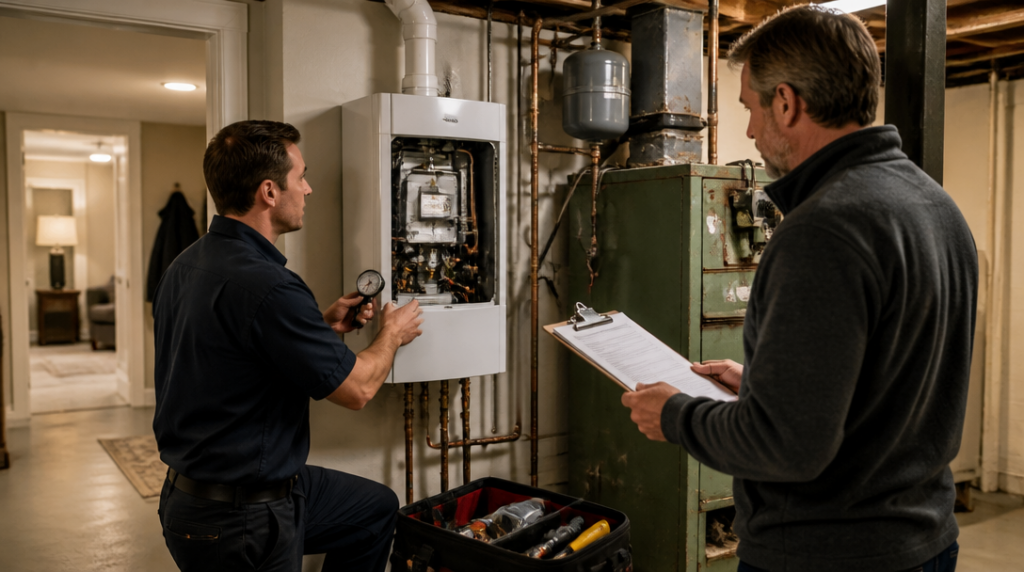
A homeowner in Ohio received a quote to replace a failing gas boiler. The new unit itself seemed reasonably priced, but the final estimate was nearly double the figure mentioned during the initial phone call. The difference came from removing the old boiler, modifying the venting, updating a section of gas pipe, and bringing the condensate drain up to current requirements.
None of those charges were necessarily suspicious. They were simply invisible in the first conversation.
Boiler pricing is full of similarly incomplete numbers. A repair advertised at a few hundred dollars may become more expensive after diagnosis. A replacement price that sounds excessive may include several days of work and substantial changes to the heating system. The useful question is not whether a quote matches an internet average. It is what the quote actually includes.
The broad price range behind a boiler replacement
In the United States, replacing a boiler in 2026 costs an average of about $5,883, with many projects falling between $3,306 and $8,464. Those figures describe a wide market rather than a promise for any particular home. A small, direct replacement in an accessible utility room can land near the lower end. A larger system in a difficult location may move well beyond it.
Installation by itself commonly costs about $3,600 to $8,400, with an average close to $5,900. That may sound strange beside the replacement average, but the numbers are measuring slightly different things and can overlap in real-world estimates. Some contractors separate equipment, labor, permits, disposal, and materials. Others present one bundled replacement price.
The boiler's size and fuel type matter, but they are not the whole story. A quote can rise because the existing flue is unsuitable for the new appliance, the gas supply is undersized, or the boiler has to be moved to meet clearance requirements. High-efficiency models may require new plastic venting and a condensate drain. A system that appears to be a simple swap can therefore become a small construction project.
Removing the old boiler typically adds $150 to $200. That charge covers more than carrying a heavy metal cabinet through the house. Disconnection, draining, disposal, and the time needed to protect floors and walls all take labor. In a cramped basement, access can become one of the least glamorous but most expensive details.
New gas piping is often priced separately at roughly $30 to $75 per linear foot. Even a short run can affect the final bill, particularly if the pipe must pass through finished areas or requires several fittings. Homeowners who compare only the equipment price may conclude that one boiler is dramatically cheaper, when the real difference lies in the work around it.
Why a repair bill can jump after the first visit
The average boiler repair costs about $425, with a typical range of $190 to $660. A broader market range runs from approximately $150 to $750, depending on the fault, the parts involved, and local labor rates. These figures are useful for orientation, not diagnosis.
A service call may begin with a modest charge for inspection and end with a more substantial repair. Ignition problems, faulty thermostats, worn circulator pumps, pressure issues, leaking valves, electrical failures, and blocked flues do not carry the same labor burden. A replacement part may be inexpensive, while reaching it requires draining the system or removing surrounding components.
The first visit may also identify a problem that is not technically inside the boiler. A damaged expansion tank, failing pump, poor water quality, or inadequate piping can create symptoms that look similar to a boiler fault. Replacing one component without addressing the underlying cause can produce a short-lived fix and a second service bill.
That is why a flat repair average should be treated with caution. It tells you what many jobs cost across a large group of homes. It does not tell you whether your boiler is suffering from a cheap sensor failure or a heat exchanger problem that makes continued repairs difficult to justify.
A sensible estimate should distinguish the diagnostic fee from repair labor and parts. It should also say whether emergency, weekend, or after-hours charges apply. Those surcharges can matter more than the part itself. I have seen homeowners spend more time comparing two replacement pumps than checking whether the contractors were quoting the same working hours and warranty terms.
The point where repair stops making financial sense
A boiler does not become uneconomical to repair simply because it is old, and a new boiler is not automatically a bargain because it carries a better efficiency rating. The decision depends on the pattern of failures, the condition of the rest of the heating system, energy use, available parts, and the cost of correcting the installation around the old unit.
A single repair near $400 may be entirely reasonable if the boiler is dependable and the rest of the system is sound. Several repairs in a short period tell a different story, especially if each one leaves another aging component untouched. A major heat exchanger or control-board failure can also shift the calculation, although the right choice still depends on the equipment and the replacement options available in the home.
Complete boiler replacement averages about $6,100 in some market estimates, while many projects fall somewhere between the lower and upper ranges described above. The spread is too large to support a universal rule such as “replace anything over ten years old” or “never spend more than a third of replacement cost on repairs.” Those slogans are convenient, but they ignore the condition of the installation and the homeowner's plans for the property.
A replacement quote deserves closer scrutiny if it contains only a model number and a total price. Ask how the contractor calculated the required capacity. An oversized boiler may cycle inefficiently and create uneven comfort, while an undersized one may struggle during the coldest weather. The existing radiators, pipe layout, controls, and domestic hot-water setup may also affect the correct choice.
Efficiency claims need the same skepticism. A higher rated boiler can reduce fuel use, but the actual benefit depends on operating temperatures, controls, maintenance, insulation, and how the system is installed. A premium appliance connected to a poorly configured system is not a miracle cure.
Four to six hours, or several days of disruption?
A direct gas-boiler replacement can take about four to six hours when the new unit fits the existing arrangement and the work proceeds without surprises. That is the tidy version of the job: same general location, compatible venting, accessible connections, and no major code-related changes.
Changing the boiler type or moving its location can stretch the project to three or four days. New venting, gas piping, electrical work, condensate drainage, water connections, controls, and system flushing may all be involved. The heating system may need to be partially redesigned rather than merely disconnected and reconnected.
The timeline matters because labor is only one part of the disruption. A boiler replacement can affect hot water, access to a basement or utility room, flooring, storage, and the household's ability to heat the building during the work. In cold weather, a delay caused by a missing part is more than an inconvenience.
A contractor who promises a very short installation is not necessarily cutting corners, but the promise deserves context. Ask whether the time estimate assumes a direct replacement and whether the crew has included testing, balancing, cleanup, and removal of the old equipment. The boiler should not be considered finished merely because it starts burning fuel.
How to compare quotes without comparing nonsense
Start by requesting written estimates that describe the same scope. Each should identify the boiler, installation labor, removal and disposal, permits, venting, gas-line work, electrical changes, condensate drainage, controls, startup, testing, and warranty coverage. If an item does not apply, the estimate should say so rather than leave the homeowner guessing.
Check whether the quote covers only the boiler or the full heating system. A low figure may exclude radiators, pumps, tanks, valves, water treatment, chimney work, or repairs to existing piping. It may also assume that the current flue and gas supply are acceptable. Those assumptions can be valid, but they should be visible before work begins.
Ask what happens if the contractor discovers an unexpected problem. A clear change-order process is more reassuring than a vague promise to “deal with it on site.” You should know who approves extra work, how labor is charged, and whether the system can be left safely operational if a separate repair is needed.
The cheapest quote can still be the best one, but only after the scope has been matched line by line. A $4,000 estimate and a $7,000 estimate are not competing prices if one omits venting, disposal, permits, and controls. They are different projects wearing similar labels.
For repairs, request the diagnosis in plain language and ask which part failed, whether the repair addresses the cause or only the symptom, and what warranty applies to the replacement part and labor. If the boiler is repeatedly failing, ask for a repair history and a replacement option rather than accepting another isolated fix by default.
A boiler quote is easiest to misunderstand when it looks precise. The final number may include dozens of decisions that were never visible during the first five-minute conversation, from the length of a gas run to the route taken through a finished basement.