
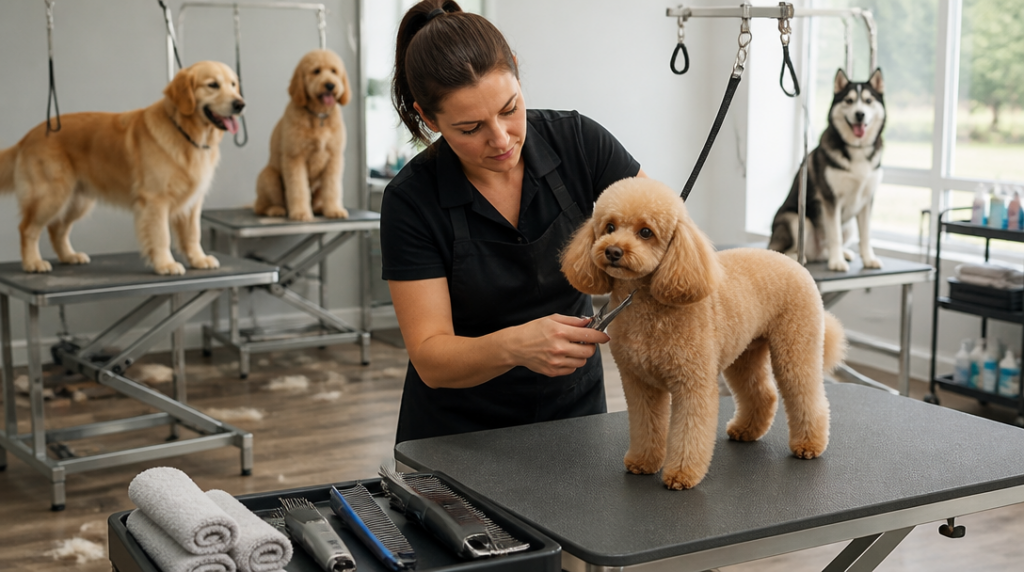
A routine dog grooming visit now averages about $85 at U.S. salons, but that number can conceal a surprisingly wide price gap. A small dog with a manageable coat may cost less than $60, while a large, tangled, or difficult-to-handle dog can push past $120.
That raises a straightforward question: are owners paying for the breed, the size of the dog, or the amount of work required? The answer is usually sitting somewhere between all three.
The basic price ranges by dog size
Small breeds generally fall into the $50–$75 range for a complete grooming appointment. That category might include bathing, drying, brushing, nail trimming, ear cleaning, and a haircut, although the exact package varies from salon to salon.
Medium-sized dogs tend to cost about $65–$95. The jump is not simply about having more dog to wash. Medium breeds may bring denser coats, heavier shedding, or longer drying times, all of which keep a groomer occupied.
Large breeds usually start around $80 and can reach $120 or more. A large dog with a thick double coat may take far longer to dry and brush than its body size alone suggests. In a grooming salon, time is the invisible meter running behind the posted price.
These ranges are useful, but they are not a promise. Two dogs of similar size can receive very different quotes because their coats, behavior, and grooming history are not the same.
What specific breeds usually cost
A miniature poodle typically costs about $60–$80 per visit. Its compact size keeps the basic price below that of many larger dogs, but the breed’s curly coat demands regular brushing and precise clipping. A neglected coat can turn a relatively routine appointment into a much longer job.
Golden retrievers generally fall around $75–$100. They do not usually require the same sculpted haircut as a poodle, but their thick coats create plenty of brushing, bathing, and drying work. The shedding alone can make the appointment feel less like a quick trim and more like a small-scale cleanup operation.
Goldendoodles often land between $80 and $110. Their size varies, but so does their coat. Some have loose waves; others have dense curls that mat easily. Calling every Goldendoodle appointment a standard breed price would be misleading because coat texture can change the workload dramatically.
Huskies and malamutes commonly cost about $85–$110 per visit. Their double coats are the main reason. A groomer may spend substantial time removing loose undercoat and making sure the dog is fully dry, particularly during heavy shedding periods.
The pattern is hard to miss. A breed with a reputation for being “easy” can become expensive when its coat is neglected, while a larger dog with a short, uncomplicated coat may require less labor than expected.
Why the advertised price can change at checkout
A salon’s base price often assumes a dog arrives in reasonably good condition. That assumption matters. Severe matting, excessive shedding, fleas, difficult behavior, or a dog that has not been groomed for a long time can all require extra work.
Matting is especially important because it changes the job itself. Brushing through compacted hair may be painful for the dog and time-consuming for the groomer. In some cases, the safest option is to remove the coat rather than force a brush through it, which can produce a different cut from what the owner had imagined.
The requested style matters too. A simple sanitary trim is not the same service as a full haircut with a carefully shaped face, legs, and tail. Owners who ask for a particular look should ask whether it is included in the quoted package or charged separately.
Nail grinding, teeth cleaning, de-shedding treatments, medicated baths, and specialty shampoos may also appear as add-ons. None of these services is automatically unreasonable, but a vague quote makes it difficult to tell whether a low advertised price is genuinely low or merely the starting point.
A good question before booking is blunt but useful: “What would make the final bill higher than the estimate?” The answer can reveal more than a large price list hanging on the wall.
The mobile grooming premium
Mobile grooming is commonly about 20–30% more expensive than a comparable salon service. On an $85 salon visit, that puts the rough mobile equivalent at about $102–$111.
The premium pays for more than convenience. The groomer brings the equipment to the home, works in a specialized vehicle or setup, and often handles one dog at a time rather than moving through a busy salon. That can be valuable for anxious dogs, older animals, or owners who cannot easily manage transportation.
But the higher price also changes the comparison. A mobile appointment should not be judged against the cheapest salon package if it includes a quieter setting, less waiting, and more individualized attention. At the same time, convenience should not make an unclear quote acceptable. Travel charges, coat-condition fees, and additional services still need to be spelled out.
Why breed charts can be misleading
Breed-based pricing looks tidy on paper. Owners like seeing a number beside a familiar breed because it appears to answer the question immediately. In practice, the label often tells only part of the story.
Consider two miniature poodles. One arrives every few weeks with a brushed-out coat and accepts handling calmly. The other arrives after months without professional grooming, with tight mats and an aversion to clippers. Calling both appointments “miniature poodle grooming” leaves out the part that controls the labor.
The same problem appears with mixed breeds. A Goldendoodle’s grooming cost may depend more on coat density and length than on the word “Goldendoodle” itself. A short-coated mixed breed may be cheaper than a purebred dog of the same weight, while a thick-coated mix may take longer than the owner expects.
This is why many groomers quote from a starting price rather than a fixed price. The system can feel frustrating, especially when a customer wants a clear number before committing. Yet a fixed breed rate would also force salons to treat very different coats as identical jobs.
Location, scheduling, and the real cost of frequency
The national average does not describe every local market. Prices can shift according to regional operating costs, demand, salon overhead, and the availability of experienced groomers. A quote in one city may have little relevance to a quote several states away.
Timing can matter as well. Owners who wait until a dog is badly overgrown may face a more expensive appointment than owners who maintain the coat consistently. That is not because the salon is charging for the calendar; it is because neglected hair takes more time to correct.
For long-coated breeds, grooming is not a single annual expense. It is a repeating household cost. A $75 appointment may sound manageable in isolation, but several visits across the year create a very different budget. The same calculation becomes more serious for large breeds, doodles, and dogs that need extensive brushing or de-shedding.
This is where the national $85 figure can be deceptive. It describes an average visit, not the annual cost of keeping a particular dog comfortable and manageable. A dog that needs frequent professional care may cost far more than the headline number suggests, even if every individual appointment stays close to the average.
How to compare quotes without chasing the cheapest number
Owners should compare what each salon includes, not just the price printed beside the breed. Does the quote cover a full haircut or only a bath and brush? Are nails, ears, and sanitary trimming included? Is de-matting charged by the amount of work, or is there a flat fee?
It also helps to describe the dog honestly before the appointment. Mention the breed or mix, approximate size, coat length, matting, behavior concerns, and the service wanted. A groomer can give a more useful estimate when the description reflects the actual dog rather than an idealized version of it.
The cheapest quote may be perfectly suitable for a short-coated dog needing a basic bath. It may be a poor comparison for a heavily coated dog requiring extensive brushing and styling. Price shopping without comparing the workload is like comparing a haircut with a shave simply because both involve clippers.
For many owners, the most revealing figure is not the starting price but the explanation behind it. If a salon can clearly describe what the appointment includes, what could increase the charge, and how the dog’s coat affects the work, the estimate becomes far more meaningful than a single number on a breed chart.