
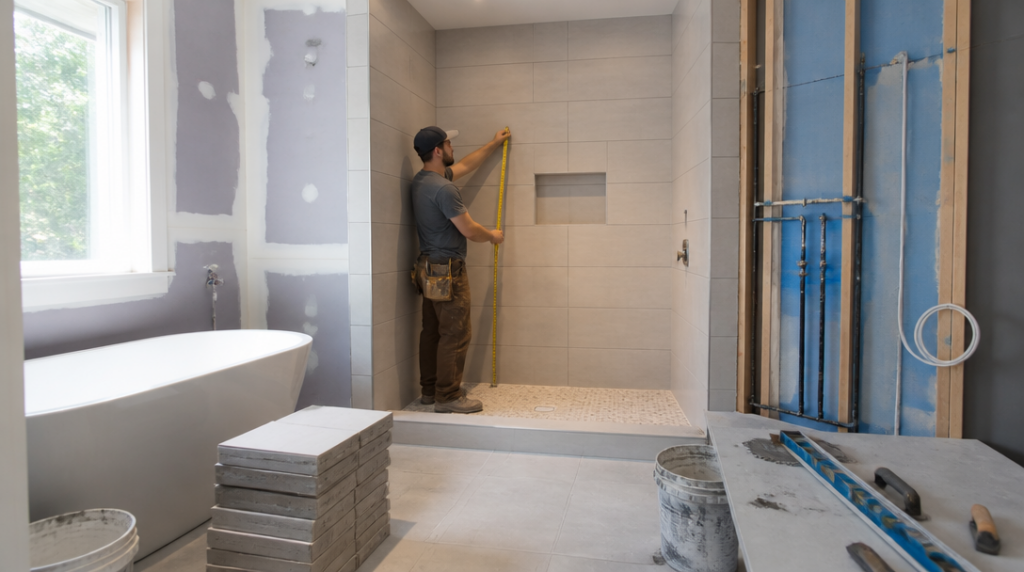
A complete bathroom remodel in the United States can cost about $12,000 on average in 2026, but another national estimate puts the figure closer to $15,586. Both numbers may be accurate. Neither one tells you what your own bathroom will cost.
That is the first problem with bathroom pricing: the word “average” sounds more useful than it is. A bathroom renovation is not a standardized product pulled from a shelf. It is a small construction project involving plumbing, electrical work, waterproofing, ventilation, flooring, fixtures, demolition, and often a surprising amount of repair. Two rooms with the same dimensions can produce radically different invoices.
The more useful question is not, “What does the average bathroom cost?” It is, “How much of my bathroom is being replaced, and what problems will be uncovered once the work begins?”
The national averages tell two different stories
One estimate places a complete bathroom renovation at an average of $12,000, with many projects falling between $6,000 and $18,000. Another national estimate gives an average of $15,586, with a broader range of $6,456 to $24,715.
The gap is large enough to make homeowners suspicious, but it reflects the messy nature of renovation pricing rather than a simple contradiction. A modest refresh with standard fixtures, limited plumbing changes, and inexpensive tile may sit near the lower end. A bathroom with upgraded fittings, more extensive demolition, new wiring, waterproofing repairs, or a rearranged layout can move rapidly toward the upper end.
Even the phrase “complete remodel” leaves room for interpretation. One contractor may use it to describe a new vanity, toilet, floor, and coat of paint. Another may include a fully rebuilt shower, updated plumbing connections, electrical work, new lighting, and repairs to the subfloor. Those are not remotely comparable projects, although both may appear under the same label in a pricing guide.
That is why a low estimate can be dangerous if it is treated as a promise. It may describe a bathroom that looks new from the doorway while leaving the costly infrastructure untouched. Sometimes that is perfectly sensible. Sometimes it is a fresh layer of tile over an old problem.
Tile is visible, but it is rarely the whole bill
Ceramic or porcelain floor tile installation costs an average of about $2,111 per project, with a common range of $949 to $3,425. The tile itself is only one part of that figure. Labor, surface preparation, layout, cutting, grout, adhesive, transitions, and disposal all affect the final price.
A small bathroom does not automatically mean a small tiling bill. Tight rooms can require more cuts around toilets, door frames, vents, cabinets, and pipes. A complicated pattern may use more material and take longer to install. Large-format tile can create a sleek appearance but demands a flatter surface and careful handling. Tiny mosaic sheets may seem easy because they arrive attached to mesh, yet aligning them cleanly around corners and slopes takes patience and skill.
The floor also has to perform. Bathroom surfaces face standing water, humidity, cleaning chemicals, and constant foot traffic. A cheap installation that allows movement beneath the tile can crack grout or loosen tiles long before the rest of the room looks worn. The tiles are the visible skin; the substrate and waterproofing are the bones.
That distinction matters most in a shower. Professional shower tiling commonly costs around $1,800 to $5,000. The range reflects more than square footage. Shower walls require careful waterproofing, accurate slopes, clean penetrations around controls and showerheads, and precise treatment of corners. A decorative niche, bench, border, or unusual tile pattern adds labor even when the room itself is compact.
The most expensive shower is not necessarily the one with the most luxurious tile. It is often the one where the installer discovers that the existing surface is damaged, uneven, or unsuitable for a new waterproofing system.
Demolition can expose the budget you thought you had
Removing old tile adds roughly $1.50 to $4.50 per square foot. That may sound manageable until demolition reveals damaged backer board, deteriorated wood, moisture problems, or an uneven floor. Repairs to the underlying surface can add another $2 to $30 per square foot, depending on what needs to be corrected.
This is where bathroom budgets stop behaving like neat spreadsheets. A homeowner may carefully compare tile prices and fixture discounts, only to find that the real financial risk is hidden behind the wall. The beautiful porcelain selected for the floor is not responsible for the sudden increase. The problem was already there; demolition simply made it impossible to ignore.
That can create an awkward choice. Do you repair everything properly, even if it pushes the project beyond your original budget? Or do you limit the work and accept that some older components remain in place? There is no virtue in replacing sound material purely for the pleasure of calling a project “fully renovated.” There is also little wisdom in covering known water damage because the repair is inconvenient.
A bathroom remodel rewards honesty more than optimism. If the existing plumbing works, the layout is practical, and the surfaces are sound, keeping those elements may protect the budget. If the room has recurring leaks, soft flooring, poor ventilation, or a shower that was never properly waterproofed, cosmetic work can become an expensive delay before the necessary repair.
A new bathroom is a different financial category
Adding a bathroom where none exists is not simply a larger remodel. A new bathroom requires space, drainage, water supply, ventilation, electrical service, walls, finishes, fixtures, and often structural changes. The average cost is about $35,000, with projects ranging from $5,000 to $75,000.
That spread is enormous because “adding a bathroom” can mean very different things. A straightforward installation in an existing, partially finished space is one kind of project. Creating a bathroom on another floor, extending the building, relocating plumbing, or working far from existing drain lines is another. The room’s size matters, but the distance between the proposed bathroom and the home’s systems may matter more.
A powder room without a shower is also fundamentally different from a full bathroom. Fewer fixtures do not eliminate construction costs, but they can reduce the amount of plumbing, waterproofing, and tiling required. Planning the room around its real use is more productive than chasing a generic square-foot price.
The uncomfortable question is whether the extra bathroom is solving a daily problem or merely adding a feature that looks valuable on paper. If the household genuinely needs another full bathroom, the project may be justified. If the goal is resale appeal, the financial return is less predictable than a contractor’s sales pitch may suggest.
What should your estimate include?
A serious estimate should make the scope visible. It should identify demolition, disposal, surface preparation, waterproofing, tile installation, grout, fixtures, cabinetry, plumbing, electrical work, ventilation, painting, and cleanup. If any of those items are excluded, the omission should be clear before work starts.
The estimate should also distinguish between allowances and fixed prices. An allowance for tile or fixtures is not the final cost; it is a placeholder. Choose materials above that allowance and the price rises. Choose items that require additional installation time and labor may rise as well.
Ask how unexpected damage will be handled. No contractor can see through every wall, but the process for approving additional work should not be mysterious. Photographs, a written description, and a clear price before repairs begin are far better than a vague promise to “sort it out later.”
For tiling specifically, ask what surface preparation is included. A quote that covers tile installation but excludes leveling, backer board, waterproofing, or removal may look attractive while leaving the most important work outside the headline number. The cheapest line item is not necessarily the cheapest finished bathroom.
A useful comparison is to request estimates based on the same scope rather than asking several contractors for their idea of a bathroom remodel. One may price a surface refresh, another a partial reconstruction, and a third a full replacement. Their totals will be impossible to compare unless the work is defined in the same language.
Where homeowners tend to spend wisely
Waterproofing is a poor place to economize. So is surface preparation. A slightly less expensive tile can be replaced later if your taste changes; a failed shower assembly can damage parts of the home that were never meant to get wet.
The same principle applies to layout. Moving a toilet, shower, or sink can involve more than disconnecting and reconnecting fixtures. Keeping the existing arrangement may not produce the most dramatic before-and-after photograph, but it can preserve money for better ventilation, stronger lighting, solid cabinetry, or properly installed tile.
Spend on the parts that are difficult to repair once the walls and floors are closed. Be more cautious with fashionable finishes that dominate the showroom but may date the room quickly. I have always found bathroom renovations slightly revealing: people will debate a tile color for an hour, then treat waterproofing as a technical footnote, even though one decision is mostly visual and the other determines whether the room survives.
The final cost should reflect the condition of the room, the complexity of the work, and the standard of installation, not the seductive simplicity of an average. A $12,000 remodel may be entirely realistic for one bathroom and wildly inadequate for another. The difference is usually waiting behind the tile.