
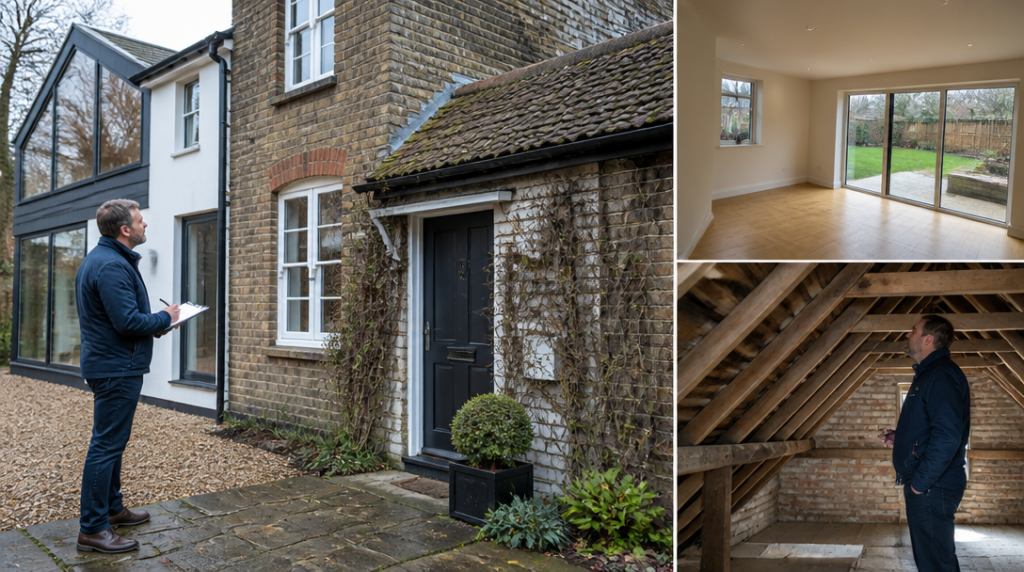
A £300 survey can feel like a sensible economy when you are already paying for solicitors, removals and a mortgage. A £1,000-plus survey can look excessive, especially when the house appears clean, modern and well cared for.
I have always found the real question more useful than the price question: what kind of property am I buying, and how much uncertainty can I comfortably accept? RICS home surveys are built around that decision. The three levels do different jobs, and choosing between them is less about buying the most expensive report than matching the inspection to the building.
The three RICS survey levels
The current RICS Home Survey Standard has applied in Great Britain since 1 March 2021. It sets out three survey levels, each intended for a different depth of inspection.
Level 1 is the Condition Report. Level 2 is the HomeBuyer Report, available either as a survey alone or with additional valuation information. Level 3 is the Building Survey, the most detailed and flexible option.
That sounds straightforward until a buyer starts comparing quotations. Surveyors may describe their services in slightly different ways, and the same property can attract different advice depending on its age, construction and visible condition. I would read the scope of the inspection before looking only at the headline fee.
Level 1: the basic condition report
The Level 1 Condition Report is the simplest option. Its typical cost is about £300–£500.
It provides a basic assessment of the property's condition, drawing attention to significant visible defects. It does not normally offer detailed recommendations for repairs, and it is not designed to investigate a building in the way a more comprehensive survey would.
This level may suit a conventional property that appears to be in reasonable condition and does not present obvious complications. A relatively modern house with familiar construction and no visible signs of neglect may not need the same level of scrutiny as a large Victorian building with altered walls and a tired roof.
The limitation is just as important as the price. A short, high-level report can flag a concern without explaining its full extent or setting out a detailed route to repair. For some buyers that is enough information to proceed or ask further questions. For others, it leaves too much uncertainty.
I think of Level 1 as a first filter rather than a detailed investigation. It can tell you that something deserves attention, but it is not the report I would choose when the building itself is likely to become a major project.
Level 2: the HomeBuyer Report
The Level 2 HomeBuyer Report is the option many buyers associate with a standard pre-purchase survey. In 2026, the typical cost is around £400–£900.
There are two versions to consider. One covers the survey itself. The other combines the survey with a market valuation and an assessment of the amount needed for insurance rebuilding purposes.
That distinction matters. A buyer who wants information about visible condition may not need the additional valuation service. Someone arranging a mortgage, checking whether the agreed price appears reasonable or reviewing buildings insurance requirements may prefer the broader version.
Level 2 is generally intended for conventional houses and flats in reasonably good condition. It is more detailed than Level 1 and should give a clearer picture of defects, maintenance concerns and issues that could affect the property. It is still a visual survey, though, rather than an invitation to open up walls, lift floors or carry out destructive testing.
That boundary is easy to miss when a report runs to many pages. A long document does not mean every hidden problem has been discovered. Damp, roof defects, movement or poor alterations may require specialist investigation if the surveyor sees warning signs. The report can recommend that further work is carried out, but the survey itself may not answer every technical question.
For a typical post-war house in reasonable condition, Level 2 often feels like the practical middle ground. It provides more useful information than the cheapest option without automatically turning a straightforward purchase into a major surveying exercise.
Level 3: the Building Survey
A Level 3 Building Survey usually costs about £700–£1,500 or more. RICS also recognises that bespoke services can exceed £1,000, depending on what the property and the client require.
This is the level I would consider for an older, larger, neglected or unusual property. It is also the stronger choice when a house has been substantially extended, converted or altered. A building with non-standard construction can create questions that a basic report is not meant to explore in depth.
Level 3 provides a more detailed assessment of the building's condition and construction. The surveyor can explain visible defects in greater detail, discuss likely causes and identify areas where repairs or further investigation may be needed. The exact scope still depends on the agreed service, so I would ask what the surveyor will inspect before instructing them.
The extra cost can feel painful when the purchase is already expensive. Yet a detailed report may be particularly valuable when the house has a complex history. An old roof, an extension joined awkwardly to the original building, signs of movement or years of deferred maintenance can turn a seemingly attractive property into a long list of decisions.
This is where I would rather spend money on information than on optimism. One afternoon looking at paintwork and tidy furniture can create a false sense of security; a surveyor's attention is directed toward the parts of the building that buyers often overlook.
Why survey prices vary
The published ranges are useful starting points, not fixed tariffs. Surveyors price work according to the property, the level of inspection, the location and the service included in the quotation.
A small flat and a large detached house do not present the same amount of work. Age, size, construction, accessibility and apparent condition can all affect the time needed. A report that includes a valuation and insurance rebuilding figure may also cost more than a survey-only service.
The cheapest quotation is not automatically poor, just as the highest quotation is not automatically the most suitable. I would compare the surveyor's description of the inspection, the report format, the limits of the service and any exclusions. Two prices mean little if the underlying work is not the same.
It is also worth separating a survey from specialist investigations. If a surveyor identifies possible asbestos, timber decay, drainage trouble, subsidence or another specific concern, a separate specialist assessment may be needed. The RICS survey is not a guarantee that every hidden defect will be found.
Choosing the right level for the property
The property's character should lead the decision. Level 2 is aimed at ordinary homes in reasonable condition. Level 3 is designed for buildings that are older, larger, neglected, unusual or significantly altered.
That does not mean every old house automatically requires Level 3, or that a modern home can never contain serious defects. Construction and visible condition matter more than a simple age threshold. A recently renovated property may deserve careful scrutiny if the work appears unfinished or poorly executed, while a well-maintained older home may be less alarming than its date suggests.
I would pay close attention to clues such as cracks, uneven floors, dated electrics, roof wear, damp smells, poorly joined extensions and evidence of removed walls. Estate-agent photographs are useful for getting an impression, but they are not a substitute for walking around the property or understanding what the surveyor will examine.
If the building feels complicated, the extra cost of Level 3 is easier to justify. If it is a conventional home with no obvious warning signs, Level 2 may provide the proportionate answer. Level 1 is the most limited choice and should be selected with a clear understanding of what it does not cover.
Who orders the survey?
In England, Wales and Northern Ireland, the buyer usually arranges and pays for the survey. That makes the choice part of the buyer's due diligence rather than a standard service included with the sale.
Scotland works differently. The seller normally arranges the Home Report before putting the property on the market. Buyers may still need to consider whether additional advice or investigation is appropriate, particularly if the property has defects or unusual features, but the initial process is not the same as the one used elsewhere in the UK.
That regional difference can catch people out, especially if they are moving between parts of the country. The name of the report may sound familiar while the responsibilities around it are different.
What I would ask before booking
I would start by asking the surveyor which RICS level they recommend and why. A useful answer should refer to the actual property rather than simply pointing to the middle-priced option.
I would then confirm whether the quotation covers a survey only or includes a market valuation and an insurance rebuilding figure. I would ask about the inspection's scope, access limitations, report delivery and any matters that would be excluded because they cannot be assessed visually.
Most importantly, I would describe anything that already concerns me. A roof conversion, extension, crack, damp patch or unusual construction detail may affect the appropriate level of service. The surveyor cannot respond to a concern they have not been told about.
The best report is not necessarily the longest one. It is the one that gives a buyer enough reliable information to decide whether to proceed, renegotiate, commission specialist advice or walk away before the property becomes their problem.