
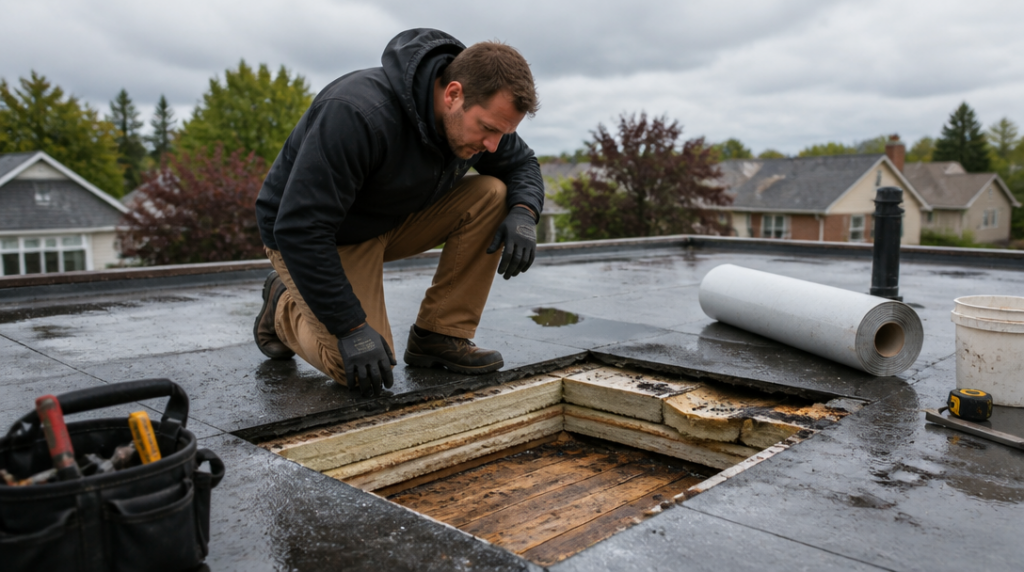
The first sign was a brown ring on the ceiling above the spare bedroom. It had appeared after a night of heavy rain, so the homeowner placed a bucket underneath and called a roofer the next morning. From the driveway, the roof looked fine: flat, clean, and recently painted around the edges. Up close, however, the surface had several soft patches, a tired membrane, and standing water near a clogged drain.
The repair estimate began at a manageable figure. Then the roofer opened one section and found wet insulation beneath it. The job was no longer a patch. It was a roof replacement, complete with tear-off, new materials, disposal, and repairs to part of the deck.
That is why flat-roof pricing can feel unpredictable. The visible surface is only one layer of the project, and problems below it often remain hidden until the old roofing comes off.
The typical price range for a flat roof replacement
In the United States, the average flat roof replacement costs about $7,430 in 2026. A typical range runs from approximately $3,333 to $11,552, although individual projects can fall well outside those figures. A small, accessible roof with little damage may stay near the lower end. A large commercial-style roof over a home, especially one with drainage problems or difficult access, can move quickly toward the upper end.
For a complete replacement, a broader working range is roughly $4,000 to $21,000. Large or unusually complicated roofs may reach $42,000. Those numbers are not contradictory; they describe different types of buildings and levels of complexity. A modest residential roof and a broad, heavily penetrated roof with several drains, skylights, vents, or rooftop equipment are not comparable jobs, even if both are described as “flat roof replacements.”
Roof size gives you a useful starting point. A 1,500-square-foot flat roof commonly costs about $6,000 to $21,000 to replace. For a 2,000-square-foot roof, the rough range rises to $8,000 to $28,000. These figures reflect a complete project rather than the price of a roll of membrane alone.
Most installations, including materials and labor, run from about $4 to $14 per square foot. That rate is helpful for testing an estimate, but it should not be treated as a firm quote. A roof with easy ground-level access may cost less per square foot than a smaller roof squeezed between neighboring buildings, even if the smaller project uses fewer materials.
What the roofing material adds to the bill
The membrane or roofing system often has the strongest effect on the base price. Different materials handle sunlight, foot traffic, ponding water, and installation conditions in different ways, so the cheapest option is not automatically the sensible one for a particular building.
EPDM, a rubber roofing membrane commonly sold in large sheets, generally costs about $5 to $13 per square foot for materials. It is a familiar choice for many low-slope roofs and can work well when properly installed, especially where the design is relatively straightforward.
TPO usually falls between $4 and $14 per square foot for materials. Its bright surface can reflect sunlight, and the seams are heat-welded during installation. The quality of the installation matters greatly: poorly prepared seams or careless detailing around penetrations can undermine an otherwise good system.
Modified bitumen typically costs around $4 to $8 per square foot. It is a layered asphalt-based product that can be installed using different methods, depending on the system and the building. Built-up roofing, sometimes called tar-and-gravel roofing, generally costs about $4 to $10 per square foot for materials.
Material prices are only one piece of the estimate. A membrane that looks inexpensive on paper may require more labor, special adhesives, insulation, edge details, or complicated flashing. The contractor should explain whether the quoted material rate includes insulation, cover boards, fasteners, adhesives, flashing, and warranty-related installation requirements.
Tear-off, disposal, and the layers beneath
Removing the existing roof usually costs about $1 to $5 per square foot. That charge covers more than pulling up old material. Workers may need to cut the roof into manageable sections, carry debris down from the building, load it into a container, and pay for disposal.
A roof that has already been re-covered several times can take longer to strip. Old adhesive may cling to the deck. Saturated insulation can be heavy and unpleasant to handle. If the roof contains multiple layers, the contractor may need to remove them before the condition of the structural surface becomes clear.
This is the part of an estimate that deserves careful attention. Ask whether the price includes a complete tear-off or assumes that the new system will be installed over the existing roof. Overlaying an old roof can sometimes be allowed, but it is not suitable in every situation. Trapped moisture, soft insulation, loose materials, and excessive weight can turn a shortcut into an expensive delay.
Deck repairs are often listed as an allowance rather than a fixed price because the damage cannot be measured until the roof is open. Small repairs may add a modest amount. Widespread rot, structural deterioration, or damaged insulation can change the project substantially. A clear contract should state the labor rate and material pricing for unforeseen repairs instead of leaving the issue entirely open-ended.
A flat roof estimate can change dramatically after the first square is removed.
Drainage is not a minor detail
Flat roofs are not perfectly level. They are designed with a slight slope so rainwater moves toward drains, scuppers, or gutters. If that drainage system is blocked, undersized, damaged, or poorly positioned, water may remain on the roof long after a storm has passed.
Standing water adds weight and can accelerate membrane deterioration. It may also expose weak seams and damage insulation. During replacement, a contractor might recommend tapered insulation, new drain components, additional flashing, or changes to the roof slope. Each solution affects both labor and materials.
A low estimate that ignores drainage is not necessarily a bargain. If the same ponding problem remains after the new membrane is installed, the owner may be paying twice for work that never addressed the cause.
Roof penetrations create another source of cost. Plumbing vents, HVAC equipment, skylights, chimneys, solar attachments, and access hatches all need carefully sealed details. A broad uninterrupted rectangle is relatively efficient to cover. A roof crowded with obstacles takes more measuring, cutting, flashing, and inspection.
Permits and access costs
Building permits for a flat roof replacement commonly cost about $250 to $600, though local requirements and fees vary. The permit may be handled by the contractor or left to the property owner, so the estimate should make that responsibility explicit.
Access can be just as influential as the permit fee. A single-story garage with open space around it is simple to reach. A roof above a narrow passage may require staging, protective coverings, lifts, or extra time moving materials. In urban areas, the project may need special arrangements for debris containers or street access.
The building’s use matters too. Replacing the roof over an occupied home is one thing; working above a business, apartment building, or medical office can involve scheduling restrictions, temporary protection, and phased installation. Those arrangements may not appear in a basic square-foot price, but they still show up in the final invoice.
How to read a replacement estimate
A useful estimate should identify the existing roof condition, the proposed system, the number of layers being removed, and the approximate roof area. It should also describe insulation, cover boards, flashing, edge metal, drains, penetrations, cleanup, disposal, permits, and warranty terms.
Pay attention to vague wording such as “repair as needed” or “standard materials.” Those phrases may be harmless in a small maintenance job, but they leave too much room for disagreement on a full replacement. The estimate should say what brand or type of membrane is proposed, how it will be attached, and whether the price includes removal of all existing roofing.
A low bid can result from a legitimate difference in labor efficiency or overhead. It can also omit items that another contractor included. Compare the scope line by line rather than comparing only the final totals. One bid may include new insulation and drain work while another covers only a new membrane over the existing surface.
The best questions are practical: What happens if wet insulation is found? What is the cost per sheet or square foot for deck replacement? Who pays for additional disposal? How will water be kept out if weather interrupts the work? Which parts of the warranty depend on following a specific installation method?
Ways to control the final cost
The most effective savings usually come from preventing avoidable damage, not from choosing the thinnest material available. Keeping drains clear, fixing small leaks promptly, and arranging inspections after severe weather can extend the life of the existing system and reveal problems before the deck deteriorates.
Timing can matter as well. A contractor may have more scheduling flexibility during slower periods, although weather and local climate still control what can be installed safely. Combining related work, such as replacing damaged edge metal during the roof project, can also prevent a second mobilization later.
Do not cut corners on flashing or drainage to reduce the initial invoice. Those details are easy to overlook once the finished roof is visible, yet they are often where water finds its way inside. A plain roof with sound seams and properly directed water will usually serve the building better than an impressive material installed over a neglected substrate.
For a homeowner planning ahead, the most useful budget is not a single number. It is a realistic range based on roof size, material, tear-off, access, permits, and a reserve for hidden damage. That brown ceiling ring may be small, but the layers above it rarely are.